During World War II, most men joined the service out of a sense of duty and a sense of right and wrong. During the Vietnam war, many men, but not all, were drafted and really didn't want to be there. But they didn't want to go to prison. But men tend to join today's volunteer army so they'll have a job. These are all generalizations of course, but only for the purpose of discussion.
Ethics is a deep and complex subject. Right and wrong may seem easy to determine on most occasions, but what's not easy, at all, is to give reasonable and rational arguments for what's right and wrong on all occasions. That's why ethics is an imprecise branch of philosophy that often asks more questions than it can ever hope to answer. Some moral dilemmas are impossible to resolve.
If a man goes to war and kills out of a sense of duty, then that sense of duty may protect him from some of the psychological consequences of committing violence. He can tell himself that his heart was in the right place and his intentions were good—-and they probably were. But in the heat of battle, things happen.
I write to let you know that I have decided not to attend the 12th World Summit of Nobel Peace Laureates on 23rd-25th April, 2012, in Chicago, USA.
On 10th April, Sec. of State H. Clinton appeared on video in US State Department Web announcing plans for the forthcoming Nobel Peace Laureates Summit and said ‘The US Department of State is proud to be an active partner in this event’.
Sec. Clinton gave details of how the US State Dept. is working with US embassies around the world, to bring twenty students and 4 teachers from 4 countries to Chicago and explained that video conferences and portals for live streaming of events, will be managed by US State department.
I have now decided, with some sadness, not to be associated in this Partnership as I do not agree with many of the Policies of the US State Department. Indeed I have, as a Nobel Peace Laureate, (and in the spirit of Alfred Nobel) often called for disbandment of NATO, end of militarism and war, and for Disarmament and demilitarization. I cannot therefore, in good conscience, be part of a Partnership with the US State Government (NATO). I also believe that my participation in such a partnership would compromise my position and put in jeopardy my work in the Middle East and other countries.
I am very disappointed that what is a great opportunity for young people, the Nobel Laureates and organizations to listen, learn, and exchange friendships and experiences, has been, I believe, seriously compromised in such a Partnership.
However, I hope it will be an enjoyable and educational summit particularly for all the young people, and I am deeply saddened not to be with you all.
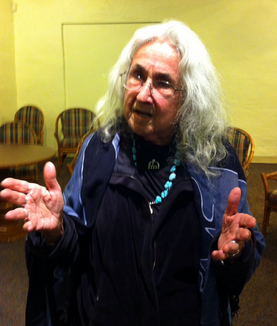
Deena Metzger is a poet, novelist, essayist, storyteller, teacher, healer and medicine woman who has taught and counseled for over forty years, in the process of which she has developed therapies (Healing Stories) which creatively address life threatening diseases, spiritual and emotional crises, as well as community, political and environmental disintegration.
Click on Image to Enlarge
She has spent a lifetime investigating Story as a form of knowing and healing. As a writer, she asks: Who do we have to become to find the forms and sacred language with which to meet these times?
She conducts training groups on the spiritual, creative, political and ethical aspects of healing and peacemaking, individual, community and global, drawing deeply on alliance with spirit, indigenous teachings and the many wisdom traditions. One focus is on uniting Western medical ways with indigenous medicine traditions.
With her husband, writer/healer Michael Ortiz Hill, she has introduced the concept of Daré, meaning Council, to North America. The Topanga Daré relies on Council, alliance with Spirit and the natural world, ancestor work, indigenous and wisdom traditions and teachings, music healing, dream telling, divination, kinship, and story telling to achieve personal transformation, community healing and social change.
She is the author of many books, including most recently, the novels La Negra y Blanca andFeral; Ruin and Beauty: New and Selected Poems; From Grief Into Vision: A Council; Doors: A fiction for Jazz Horn; Entering the Ghost River: Meditations on the Theory and Practice of Healing; The Other Hand; Tree: Essays and Pieces, A Sabbath Among the Ruins, Looking for the Faces of God andWriting For Your Life.
Below are a few of the leading online posts in this area. OSE is a cultural shift, and the primary attribute of Epoch B panarchic self- and hybrid-governance.
Ben Fry, co-founder of Processing and director of Seed Phyllotaxis Lab and�Carlos Ulloa, founder and creator of Papervision3D and HelloEnjoy talk about their software as well as their views on the future of open source and collaboration.
The US State Department has become the world’s leading user of ediplomacy. Ediplomacy now employs over 150 full-time personnel working in 25 different ediplomacy nodes at Headquarters. More than 900 people use it at US missions abroad.
Ediplomacy is now used across eight different program areas at State: Knowledge Management, Public Diplomacy and Internet Freedom dominate in terms of staffing and resources. However, it is also being used for Information Management, Consular, Disaster Response, harnessing External Resources and Policy Planning.
In some areas ediplomacy is changing the way State does business. In Public Diplomacy, State now operates what is effectively a global media empire, reaching a larger direct audience than the paid circulation of the ten largest US dailies and employing an army of diplomat-journalists to feed its 600-plus platforms. In other areas, like Knowledge Management, ediplomacy is finding solutions to problems that have plagued foreign ministries for centuries.
The slow pace of adaptation to ediplomacy by many foreign ministries suggests there is a degree of uncertainty over what ediplomacy is all about, what it can do and how pervasive its influence is going to be. This report – the result of a four-month research project in Washington DC – should help provide those answers.
ROBERT STEELE: Fergus Hanson of Australia has done a truly superb job of describing the considerable efforts within the Department of State to achieve some semblance of electronic coherence and capacity. What he misses–and this does not reduce the value of his effort in the slightest–is the complete absence of strategy or substance within State, or legitimacy in the eyes of those being addressed. If the Department of State were to demand the pre-approved Open Source Agency for the South-Central Campus, and get serious about being the lead agency for public intelligence in the public interest, ediplomacy could become something more than lipstick on the pig. The money is available. What is lacking right now is intelligence with integrity in support of global Whole of Government strategy, operations, tactics, and technical advancement (i.e. Open Source Everything).
That’s become the rallying cry of an army of keyboard warriors known as Anonymous, which in the last 18 months has targeted everyone from the Tunisian government to the Boston police, the Vatican to Sony, Public Safety Minister Vic Toews to PayPal, blocking their websites or retrieving embarrassing files and emails for the world to see.
MONTREAL – The elusive “hacktivist” collective, identified only by its logo of a headless man in a suit or its Guy Fawkes masks, has hacked into the Syrian defence ministry and Bank of America. It has eavesdropped on Scotland Yard and the FBI. And it has outed alleged white supremacists across Canada, including a couple in Quebec City.
With over 15 million page views on its main news website and more than 560,000 Twitter followers, it’s clear the world is paying attention to this nascent form of politics – and for good cause.


 Part 9: Funding