Steven Aftergood: New Policy on Mitigation Risks of Bio Research

02 Infectious Disease, 03 Environmental Degradation, 07 Health, 07 Other Atrocities, Earth Intelligence, Ethics, Government
Steven Aftergood

NEW POLICY ON MITIGATING RISKS OF BIO RESEARCH

Certain types of life science research involving “high consequence pathogens and toxins” would be subject to new review and risk mitigation procedures which might include classification of the research or termination of the funding, according to a U.S. government policy issued yesterday by the National Institutes of Health.

The policy applies to research involving 15 specified biological agents and toxins which “pose the greatest risks of deliberate misuse with most significant potential for mass casualties or devastating effects to the economy, critical infrastructure or public confidence.”

Research that increases the lethality or transmissibility of the agent or toxin, or otherwise enhances its harmful consequences, will be subject to the new review procedures.

Based on the outcome of the review, a risk mitigation plan may be developed.  If less restrictive measures were deemed inadequate, the new policy would allow for national security classification of the research or termination of government funding.

See “United States Government Policy for Oversight of Life Sciences Dual Use Research of Concern,” March 29, 2012.

See also “U.S. Requires New Dual-Use Biological Research Reviews” by David Malakoff, Science Insider, March 29.

Phi Beta Iota:  Nice but inadequate.  The government is paying lip service to this necessary precautionary principle.  If they were really serious, such a policy would encompass all agricultural and industrial processes without exception.

See Also:

Charles Perrow,  The Next Catastrophe: Reducing Our Vulnerabilities to Natural, Industrial, and Terrorist Disasters (Princeton, NJ: Princeton University Press, 2011)

Mini-Me: US Dollar Out, Yuan, System D, and Open Money In + Meta-RECAP

Advanced Cyber/IO, Budgets & Funding, Collaboration Zones, Communities of Practice, Corruption, Ethics, Key Players, Policies, Threats
Who? Mini-Me?

BRICS Move To Replace Dollar With “Super-Sovereign” Global Currency

Alexander Higgins, Contributor

Activist Post, 28 March 2012

As China is expected to rise to the status of a financial superpower within the next 8 years and eclipse the US economy by 2020, Africa becomes center stage in the greatest currency war the world has seen since the 1930s, which is now shifting into overdrive.

Brazil, Russia, India, China and South Africa, collectively known as the BRICS nations, are moving forward with their plan to unseat the US dollar from its throne as the global trade currency and to replace it with a Chinese-denominated “super-sovereign” international currency.

Click on Image to Enlarge

This Geo-political game to establish global monetary dominance is by no means limited to the attack on the US dollar. Instead this is merely the first strike of a concerted campaign of worldwide economic warfare that will soon follow which seeks to bring the United States and its western allies to their knees.

Ultimately the BRICS collective is staging a coup to overthrow the current global financial regime that has been dominated by the World Bank and the International Monetary Fund since the last global currency war was won at the end of World War II.

The attack comes partially in retaliation for the latest round of quantitative easing in which we witnessed the Federal Reserve deliberately printing trillions of dollars in an attempt to jump-start the U.S. economy by forcing investors back into the U.S. stock market by devaluing the US dollar.

Phi Beta Iota:  One third of the global economy is transnational crime, and one third System D or “off the books” entrepreneurial information economics routing around governments.  Now that we know the final third is legalized crime, it becomes much easier to understand why two thirds of the brain power on the planet has opted out of the legalized crime world that favors the 1%.

See Also:

Continue reading “Mini-Me: US Dollar Out, Yuan, System D, and Open Money In + Meta-RECAP”

DefDog: US Ignominous Collapse in Afghanistan I

07 Other Atrocities, 08 Wild Cards, Corruption, Ethics, Government, IO Impotency, Military
DefDog

Responding to Mini-Me: Obama Impeachable Over Afghan Massacre Cover-Up?

Sayed Ishaq Gillami (should be Gillani):  Sayed Ishaq Gailani (born 1954) represents Paktika in the Wolesi Jirga, Afghanistan's lower house of parliament.[1] He is the founder and chairman of the National Solidarity Movement of Afghanistan and currently serves on the Wolesi Jirga's International Relations committee. While still an influential member of the Gailani family, he has claimed leadership of the family and adopted the title Pir. However, most of his family recognizes his uncle, Ahmad Gailani, as the leader of the family and the Qadiriyya Sufi order. (Pir is a title for a Sufi master equally used in the nath tradition. The title is often translated into English as “saint” and could be interpreted as
“Elder”. In Sufism a Pir's role is to guide and instruct his disciples on the Sufi path.)  This means his credentials are impeccable (outside the discord within the family over the title Pir) and nobody in Afghanistan would accuse him of falsehood.

General Sher Mohammed Karimi: (from the article – of the Afghan Army) He is not just from the Afghan Army, he is in fact Chief of Staff.  I know the man personally and he bears no ill-will toward the US.  I would put much stock in what he says.  These two individuals, although not understood by our leadership, represent two of the most unbiased people in Afghanistan.  This alone lends great credence to their stories.  For ISAF/NATO and this Administration to be 180 degrees out will only serve to see a significant increase in attacks on ISAF/NATO personnel, all because of their position and not related to anything the ISAF/NATO personnel did.

Gordon Duff: USG Taking Israeli Espionage & Influence Seriously?

08 Wild Cards, 09 Justice, 10 Security, 11 Society, Civil Society, Corruption, Cultural Intelligence, Ethics, Officers Call
Gordon Duff

Is War on Israel Possible, We Hadn't Thought So But….

To American Jews, the sound of this has to be strange. 78% support Obama but only 5% of Jewish donations go to him and his supporters.

President Orders Israeli Spies Jailed, Israel Watched As Potential Foe

… by  Gordon Duff,  Senior Editor

To American Jews, the sound of this has to be strange.   78% support Obama but only 5% of Jewish donations go to him and his supporters. 

The big money, Koch Brothers, Wall Street and the AIPAC spies and their supporters go to the Republicans, lifelong enemies of the Jewish people, in fact, the source of the huge upsurge of antisemitism in America.

Here is a video funded by the ADL and AIPAC attacking President Obama.  Problem is, in most of the world and much of America, this “attack piece” is seen as a poorly done pro-Obama video.  We aren’t kidding, things have gone that far.

Read rest of article including link to Koch Brothers propaganda video.

Phi Beta Iota:  We have been calling for religious counterintelligence since at least 2003, generally focused on the very negative, unlawful, and often treasonous misbehavior of US citizens with top secret/special compartmented information known to hold dual citizenship with Israel.  Anyone with a security clearances that holds dual citizenship with Israel should be given a choice: lose the Israeli citizenship, or lose the clearances.  They should all be subject to oversight by a highly specialized religious counterintelligence unit with divisions for Opus Dei, the Mormons, the Pentecostals, and others that preach higher loyalties justifying treason to the Republic.  With respect to the current stories, there is no open evidence that the Administration is doing anything serious with respect to containing Israel government covert operations in the USA.  As long as a Goldman Sachs lobbyist is in the position of National Security Advisor (hereafter, Nanny to the President), and Goldman Sachs owns both the Fed and the Secretary of the Treasury positions, Obama would appear to be quite helpless and inconsequential, bracketed as he is by the the huge financial services industry syndicate and the combination of entitlement and national security stakeholders.

Religious Counterintelligence at Phi Beta Iota

Michel Bauwens: Open Sourcing Digital Medical Devices

Advanced Cyber/IO, Collaboration Zones, Communities of Practice, Ethics, Hacking, Mobile, Policies, Real Time, Threats
Michel Bauwens

Essay of the Day: From Open Source to Open Sourcing Digital Medical Devices

Excerpted from Glyn Moody:

“It is not just an issue for life-saving medical devices that can kill as well as save: it is about our increasing reliance on embedded software in everyday life, in developed countries at least.

Clearly, we can’t. If the code is not available, then it necessarily limits the number of people who have looked at it. And as Linus’ Law reminds us, given enough eyeballs, all bugs are shallow. That doesn’t mean opening up the code guarantees that all bugs will be found, but it certainly increases the probability. The corollary is that keeping it closed decreases the chance of someone finding such bugs.

But there’s a problem here. As we move from the realm of “pure” software – that is, programs running on generalised computers producing essentially digital output (even if that is converted into analogue formats like sounds, images or printouts) – to that of “applied” software, there is a new element: the device itself.

For example, in the case of the pacemakers, having the software that drives the computational side of things is only part of the story: just as important is knowing what the software does in the real world, and that depends critically on the design of the hardware. Knowing that a particular sub-routine controls a particular aspect of the pacemaker tells us little unless we also know how the sub-routine’s output is implemented in the device.

What that means is that not only do we need the source code for the programs that run the devices, we also need details about the hardware – its design, its mechanical properties etc. That takes us into the area of open hardware, and here things start to get tricky.

Read rest of article.

Phi Beta Iota:  Governments have all failed to be responsible about understanding complexity and understanding the role of integrity as a foundation for sustainable properity.  Proprietary does not scale.  Closed kills.  It's time now for open everything and no compromises with respect to intelligence and integrity.

See Also:

2012 (Book) THE OPEN SOURCE EVERYTHING MANIFESTO: Transparency, Truth & Trust 

2012 (Slides) THE OPEN SOURCE EVERYTHING MANIFESTO: Transparency, Truth & Trust

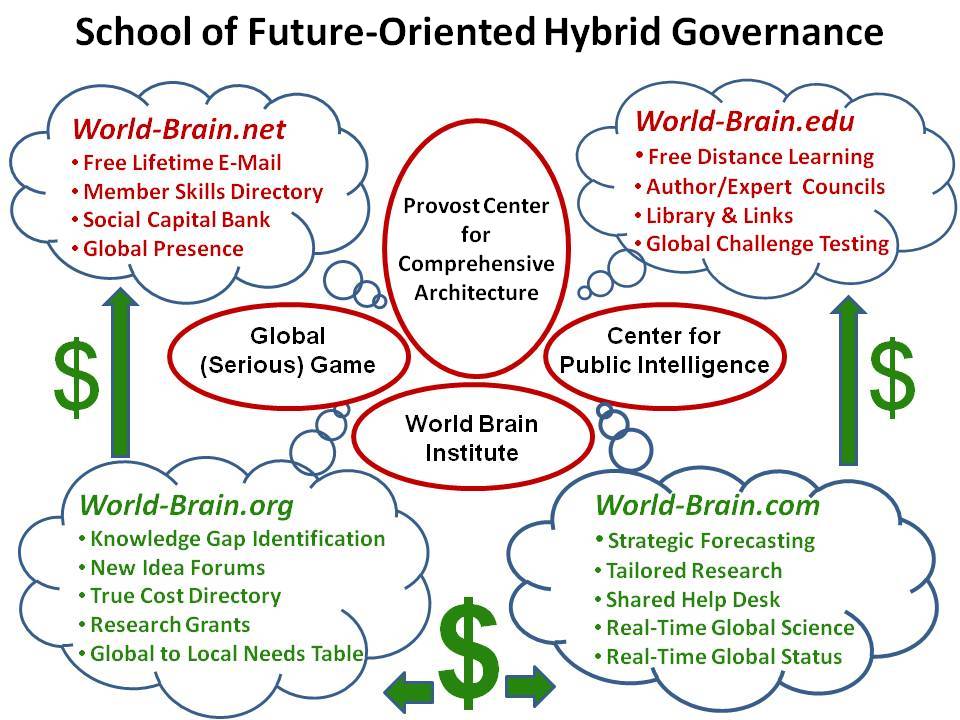
Graphic: School for Future-Oriented Hybrid Governance with World Brain Institute, Global Game, and Prototype Center for Public Intelligence

Advanced Cyber/IO, Collaboration Zones, Ethics, Hacking, Key Players, Mobile, Policies, Real Time, Serious Games, Threats, Topics (All Other), True Cost, Worth A Look
Click on Image to Enlarge

Creative Commons license applies — no financial exploitation without permission.  Robert Steele owns three of the four world-brain urls (net, org, com) and is looking for a university with the gravitas to understand why this concept needs to be implemented in full, soonest.

See Also:

Director of articles & chapters leading to this graphic

Director of briefings & lectures leading to this graphic

Books leading to this graphic

Reviews of books by others leading to this graphic (negative)

Reviews of books by others leading to this graphic (positive)

Personal web page of Robert Steele

Michel Bauwens: The New Rules of Innovation – Bottom-Up Solutions to Top-Down Problems

03 Economy, 11 Society, Advanced Cyber/IO, Civil Society, Cultural Intelligence, Ethics, Methods & Process, microfinancing
Michel Bauwens

The New Rules Of Innovation: Bottom-Up Solutions To Top-Down Problems

In his new book, Vijay Vaitheeswaran argues that we’re thinking about worldchanging innovation all wrong: It’s not going to come from where we expect it.

Arnie Cooper

www.fastcoexist.com, 19 March 2012

The world is currently standing “on the cusp of a post-industrial revolution.” So writes Vijay Vaitheeswaran in his new book, Need, Speed and Greed: How the New Rules of Innovation Can Transform Businesses, Propel Nations to Greatness and Tame the World’s Most Wicked Problems, out March 13. Vaitheeswaran, a 20-year veteran correspondent for The Economist and adviser to the World Economic Forum, wrote the book, he says, as a way to inspire bottom-up solutions to top-down problems like resource depletion, climate change, and growing income inequality. We spoke with Vaitheeswaran about the importance of disruptive technologies, social entrepreneurship, and embracing China’s rise.

Co.Exist: As you point out in your book, modern humanity has arrived at the first phase of an unprecedented “innovation revolution,” yet many are being left behind. Why is that and what are we gonna do about it?

Vijay Vaitheeswaran: First, I think it’s a wonderful time to be alive. Shockingly, this might be the best time to be in the bottom billion because of transformations like mobile telephony and micro-credit. But it’s getting much harder to be in the middle class in places like America. The principal reason for this, I think, is that educational systems are increasingly out of touch with the needs of the ideas economy. The current education system that our and other countries developed was suited to the industrial revolution, a one-size-fits-all model for education that treats people as commodities. But we’re in an innovation age where creativity, individual initiative, willingness to think out of the box and disrupt established business or even lifestyle patterns is much more important than simple manual tasks that produce the next widget. So I think the great challenge for developed economies like the U.S. is to reinvent education. The challenge for each one of us is to keep relearning how to learn.

Continue reading “Michel Bauwens: The New Rules of Innovation – Bottom-Up Solutions to Top-Down Problems”