Journal: Microsoft, Kinect, & Hackers

Collaboration Zones, Communities of Practice, Ethics, IO Technologies, Policies, Real Time, Threats, Topics (All Other)

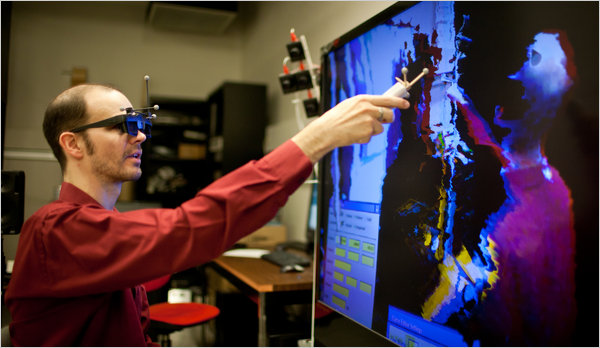
Innovators like Oliver Kreylos were eager for the Xbox Kinect, but not to play games. He uses it to capture live 3-D images.

With Kinect Controller, Hackers Take Liberties

Mr. Kreylos, who specializes in virtual reality and 3-D graphics, had just learned that he could download some software and use the device with his computer instead. He was soon using it to create “holographic” video images that can be rotated on a computer screen. A video he posted on YouTube last week caused jaws to drop and has been watched 1.3 million times.
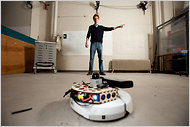
Philipp Robbel combined an iRobot device and the new Microsoft controller that can recognize gestures. He calls it the KinectBot.

Mr. Kreylos is part of a crowd of programmers, roboticists and tinkerers who are getting the Kinect to do things it was not really meant to do. The attraction of the device is that it is outfitted with cameras, sensors and software that let it detect movement, depth, and the shape and position of the human body.

Mehmet S. Akten uses the system to draw in 3-D.

Phi Beta Iota: Microsoft took a few days to “get it” but their “final answer” is exactly right: “Anytime there is engagement and excitement around our technology, we see that as a good thing,” said Craig Davidson, senior director for Xbox Live at Microsoft. “It’s naïve to think that any new technology that comes out won’t have a group that tinkers with it.”  Kudos as well to the New York Times for a lovely piece of useful inspiring reporting.
Reference: Our Choice–Changing the Game

About the Idea, Collaboration Zones, Communities of Practice, Ethics, IO Sense-Making, Officers Call, Policies, Real Time, Threats, Topics (All Other)

Today, with permission, I present Tom Atlee's newest vision, “Are We Ready to Change the Game Yet?,” and at the end, a link to his 2000 audio interview with Jim Rough, pioneer of Citizen Wisdom Councils and author of Society's Breakthrough.

ARE WE READY TO CHANGE THE GAME YET?

by Tom Atlee

2010-11-15-atlee.jpg

Some people say Gandhi was about nonviolence. And he was.

But he is significant for something else that I believe is far more important:

He changed the game.

With no one's permission, he reconfigured the playing field of colonialism to a higher Game in which everything the British did in their smaller, narrower game backfired on them. Prisons, guns, threats and bureaucracies of control not only ceased to work like they used to, but actually generated more power for Gandhi's world-changing Game.

Gandhi's Game involved, in his words, “experiments in Truth” — a search for Truth, a bigger Truth, a common inclusive Truth, a win-win Truth in every situation. The British — and even many of Gandhi's compatriots — were not aligned to that Truth. They wanted victory, control, and righteousness. These things trapped them in their smaller game until, one by one, and sometimes wholesale, Gandhi's commitment to Truth won their hearts and minds — and Shift happened.

Unfortunately he failed to create adequate social institutions that embodied, sustained, and empowered the Search for Truth by the whole of society. He depended on individuals seeing the light and being transformed. The miracle of his work is that so many people did transform — and continue to transform even to this day — inspired by his words, his life, his work. But in the end, what he left was an inspiring possibility, not an India or a world that was united, peaceful, just and sustainable.

Today's world calls us, with increasing intensity, not just to carry on Gandhi's work, but to carry it further. It isn't a matter of doing nonviolence as he and Martin Luther King, Jr., did it. It is a matter of changing the game.

Which brings me to the current state of U.S. politics and governance. These games are desperately in need of changing. Several recent innovations offer us the possibility to actually accomplish that and the timing is ripe.

Continue reading “Reference: Our Choice–Changing the Game”

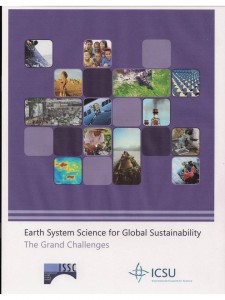
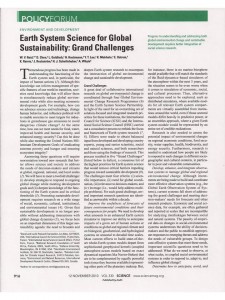
Reference: Earth System Science for Global Sustainability–Grand Challenges

Analysis, Augmented Reality, Budgets & Funding, Communities of Practice, Earth Intelligence, Ethics, Geospatial, History, info-graphics/data-visualization, InfoOps (IO), Intelligence (government), International Aid, IO Sense-Making, Key Players, Maps, Methods & Process, microfinancing, Mobile, Open Government, Policies, Politics of Science & Science of Politics, Power Behind-the-Scenes/Special Interests, Real Time, Secrecy & Politics of Secrecy, Standards, Strategy, Technologies, Threats, Tools, Waste (materials, food, etc)
Main Document (24 Page PDF)

The International Council for Science (ICSU) is spearheading a consultative Visioning Process, in cooperation with the International Social Science Council (ISSC), to explore options and propose implementation steps for a holistic strategy on Earth system research. Five Grand Challenges were identified during step 1 of the process. If addressed in the next decade, these Grand Challenges will deliver knowledge to enable sustainable development, poverty eradication, and environmental protection in the face of global change.

The details of the Grand Challenges are contained in the document ‘Earth System Science for Global Sustainability: The Grand Challenges’, representing input from many individuals and institutions.

Science Article (2 Page PDF)

INTERNATIONAL COUNCIL FOR SCIENCE – PRESS RELEASE

Thursday 11 November 2010

Scientific Grand Challenges identified to address global sustainability

Paris, France—The international scientific community has identified five Grand Challenges that, if addressed in the next decade, will deliver knowledge to enable sustainable development, poverty eradication, and environmental protection in the face of global change. The Grand Challenges for Earth system science, published today, are the result of broad consultation as part of a visioning process spearheaded by the International Council for Science (ICSU) in cooperation with the International Social Science Council (ISSC).

The consultation highlighted the need for research that integrates our understanding of the functioning of the Earth system—and its critical thresholds—with global environmental change and socio-economic development.

The five Grand Challenges are:

  1. Forecasting—Improve the usefulness of forecasts of future environmental conditions and their consequences for people.
  2. Observing—Develop, enhance and integrate the observation systems needed to manage global and regional environmental change.
  3. Confining—Determine how to anticipate, recognize, avoid and manage disruptive global environmental change.
  4. Responding—Determine what institutional, economic and behavioural changes can enable effective steps toward global sustainability.
  5. Innovating—Encourage innovation (coupled with sound mechanisms for evaluation) in developing technological, policy and social responses to achieve global sustainability.

Continue reading “Reference: Earth System Science for Global Sustainability–Grand Challenges”

Journal: Sacred Music from a Time of Peace Among Religions

11 Society, Civil Society, Cultural Intelligence, Ethics, InfoOps (IO), IO Multinational, IO Sense-Making, Methods & Process
Jon Lebkowsky Home

From Jerusalem to Cordoba

Here’s a press release for a performance I’m co-producing with Scoop Sweeney:

AUSTIN – Catherine Braslavsky and Joseph Rowe will bring their musical performance, “From Jerusalem to Cordoba,” from Paris to Austin on December 3, 7pm at St. David’s Episcopal Church, Bethell Hall, 301 E. 8th St., Austin, 78701-3280. The performance is a celebration of the musical and mystical traditions in and around the Mediterranean, from ancient Judaism and Paganism, to medieval Christianity and Islam. It features ancient and original music sung in Hebrew, Aramaic, Latin, Greek, Medieval Spanish, Occitan, and Arabic. Instrumental accompaniment includes Middle Eastern percussion, oud, dulcimer, Tibetan bowls, Indian tampura, and African mbira.

The performance is built on short poetic and narrative texts that include both original material and quotations from Hildegard of Bingen, Meister Eckhart, Ibn ‘Arabi, Yehuda Halevi, etc. The narrative thread woven through the performance evokes a rarely-perceived common ground, and an alternative view of sacred traditions which have so often been in conflict. Braslavsky and Rowe have presented this performance at venues throughout Europe.

The Italian newspaper La Republicca describes the performance as “fascinating… with great spiritual power.” Author Jacques Attali describes it as “A remarkably successful voyage in sound, depicting those rare times when Jews, Christians and Muslims have lived together in peace and dialogue.” Rev. Lauren Artress, Canon at Grace Cathedral in San Francisco, calls it “uplifting and inspiring,” and notes that “Catherine and Joseph are truly gifted musicians. Allow them to enrich your life.” Jon Lebkowsky in Wired Magazine described the music as “…at once new, traditional, and transcendent. … chants and chant-like original compositions powerfully realized as invocations of the human essence — whether it be the soul, spirit, or consciousness — in its ascent.

Taking Place in Austin, more details…..

Phi Beta Iota: This makes the cut for three reasons.  First, Jon is selective about what he sends out.  Second, holistic analysis and understanding must of necessity include music and art–the Western tradition has destroyed the role of the humanities and in so doing, committed sacrilige with science.  Finally, faith is also a part of conscious evolution, and absent its full integration into any intellectual traditional, you end up with fundamentalist idiots doing grave damage within and among communities.  Religion is at its most gifted when it is a vibrant part of the cultural tradition and used to transfer the lessons of civilization from one generation to the next–starting with the Golden Rule.

See Also:

Graphic: Information Operations (IO) Cube

Review: Empire of Illusion: The End of Literacy and the Triumph of Spectacle

Review: Mapping the Moral Domain: A Contribution of Women’s Thinking to Psychological Theory and Education

Review: Consilience–the Unity of Knowledge

Review: Integral Consciousness and the Future of Evolution

Review: Holistic Darwinism: Synergy, Cybernetics, and the Bioeconomics of Evolution

Review: Not by Genes Alone: How Culture Transformed Human Evolution

Review: Philosophy and the Social Problem–The Annotated Edition

Reference: Changing the Game

About the Idea, Analysis, Augmented Reality, Budgets & Funding, Collaboration Zones, Collective Intelligence, Communities of Practice, Counter-Oppression/Counter-Dictatorship Practices, Ethics, Geospatial, info-graphics/data-visualization, InfoOps (IO), Methods & Process, Mobile, Officers Call, Open Government, Policies, Policy, Real Time, Reform, Threats, Tools
Tom Atlee

ARE WE READY TO CHANGE THE GAME YET?

by Tom Atlee

Some people say Gandhi was about nonviolence. And he was.

But he is significant for something else that I believe is far more important:

He changed the game.

With no one's permission, he reconfigured the playing field of colonialism to a higher Game in which everything the British did in their smaller, narrower game backfired on them. Prisons, guns, threats and bureaucracies of control not only ceased to work like they used to, but actually generated more power for Gandhi's world-changing Game.

Gandhi's Game involved, in his words, “experiments in Truth” — a search for Truth, a bigger Truth, a common inclusive Truth, a win-win Truth in every situation. The British — and even many of Gandhi's compatriots — were not aligned to that Truth. They wanted victory, control, and righteousness. These things trapped them in their smaller game until, one by one, and sometimes wholesale, Gandhi's commitment to Truth won their hearts and minds — and Shift happened.

Continue reading “Reference: Changing the Game”

Reference: How Voters Can UNRIG the Two-Party Shell Game

11 Society, Analysis, Augmented Reality, Blog Wisdom, Budgets & Funding, Civil Society, Collective Intelligence, Counter-Oppression/Counter-Dictatorship Practices, Ethics, InfoOps (IO), Mobile, Open Government, Real Time, Reform, Strategy
Nancy Bordier

How Voters Can Unrig the 2012 Elections with Transpartisan Voting Blocs and Electoral Coalitions

Voters did not get what they said they wanted from the 2010 elections. In fact, they got the opposite because the two major parties rigged the elections.

The parties have been rigging elections for decades by gerrymandering election districts and passing campaign financing and election laws that prevent third party candidates from beating major party candidates.

These rigged elections give voters no choice but to vote for one of the two major parties. So voters do the only thing they can do, which is to routinely kick out the major party incumbents in the futile hope that the new major party candidates they elect will not flout their will to the same degree. But regardless of which party candidates they vote for, they get roughly the same policies. These typically sacrifice voters' interests to the special interests that fund lawmakers' electoral campaigns.

Unless voters are empowered to put an end to rigged elections before the 2012 elections, using mechanisms like the one proposed below, the middle class and working Americans will be ruined financially by the lawmakers and special interests that are enabling the business and financial sector to take more than their fair share of national income.

Continue reading “Reference: How Voters Can UNRIG the Two-Party Shell Game”