The US government is preparing to activate an “internet kill switch” according to cyber security experts, and the groundwork has been laid to blame the unprecedented act on Russia.
I read a couple of writes up about “Google May Be Stealing Your Mobile Traffic.” Quite surprisingly there was a response to these “stealing” articles by Google. You can read the explanation in a comment by Malte Ubl in the original article (link here). . . . Today’s Google is now a legacy system. I know this is heretical, but Google is not a search company. The firm is using its legacy platform to deliver revenue and maximize that revenue. Facebook (which has lots of Xooglers running around) is doing essentially the same thing but with plumbing variations. I am probably wildly out of step with youthful Googlers and the zippy mobile AMPers. But from my vantage point, Google has been delivering a closed garden solution for a long time.
Part III in the Reinventing the US Army monograph series.
Robert David Steele
This is the author’s preliminary draft of the third of three monographs focused on the future of the US Army as an expeditionary force in a complex world that is rapidly decentralizing while also facing major development challenges.
Amazon Kindle
We have, with the election of Donald Trump,a once-in-a-century opportunity to rethink, reinvent, and reinvest in our national military concepts, doctrine, human capital, organizations, technologies, and command structures, while eradicating much of the waste that is characteristic of a “government specifications cost plus” approach to contracting. Donald Trump won against all odds, against both parties, without the support of the military-industrial complex. Donald Trump is “unshackled” (his word) – his instincts on costly foreign entanglements and the utility of organizations such as the North Atlantic Treaty Organization (NATO) are on display.
Wars are won or lost in the decade or two before those wars begin. Whether countries have a Grand Strategy or not; evaluate all high-level threats or not; devise a coherent force structure in which all services and civilian agencies are complementary, inter-operable, and sustainable or not; invest in the human factor for leadership and solider agility or not – these will determine the outcome of future wars a decade or two before the first shot is fired.
If the US Army does not re-invent itself, it will absolutely not win the next war.
If the dangers weren’t so great – a possible nuclear war that could exterminate life on the planet – The New York Times over-the-top denunciation of all things Russian would be almost funny, like the recent front-page story finding something uniquely sinister about Russia using inflatable decoys of military weapons to confuse adversaries.
PBI: Above is our editorial title, see our comment below the fold.
Palantir Technologies: An Overview of What Looks Like a Muliti Front War
I read “Conservatives See Political Reprisal As Obama Administration Sues Peter Thiel’s Palantir.” Here in Harrod’s Creek “political reprisal” gets translated as blood feud. The source for the “reprisal” allegation is a real journalistic outfit, The Washington Times. The story appeared on October 16, 2016, when most of the movers and shakers in DC and other US power centers were gearing up to watch NFL football.
He was one of the most respected intelligence officers of his generation. Now he's Donald Trump’s national security alter ego, goading a crowd to lock Hillary Clinton up. What happened?
James Kitfield, Politico,
Inside military and intelligence circles it was understood that McChrystal, along with another ousted former general, David Petraeus, were the preeminent generals and wartime field commanders of their generation of officers, and the manner of their dismissal struck many as insulting. As did the treatment of Lt. Gen. Mike Flynn. . . .
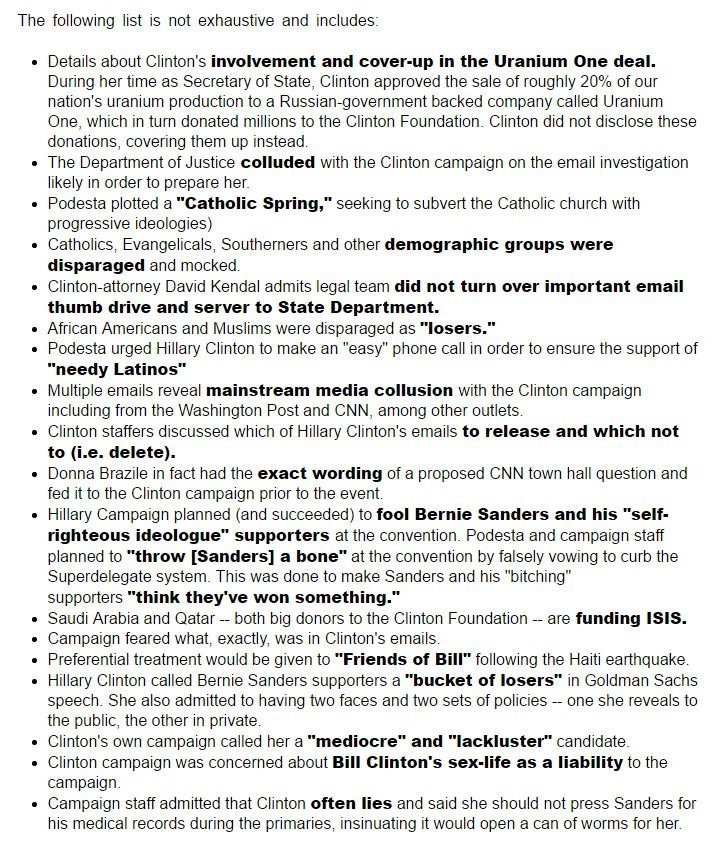
The following JPEG is circulating on the Internet as a summary of some of the disclosures in the newly-released Podesta emails. [PBI Comment and sources below the fold.]