Hillary Clinton: Torn Between Dictators & Rhetoric

02 Diplomacy, 07 Other Atrocities, Advanced Cyber/IO, Autonomous Internet, Corruption, Cultural Intelligence, Government, Mobile
What's Wrong with This Picture?

UPDATED:  Robert Smith comment at Facebook:

“WHAT? Dictators $10 billion, Democracy lovers $25 million, hypocrisy priceless.”

Phi Beta Iota: It is actually much worse than that.  Our estimate of the cost of US being best pals with 42 of 44 dictators is closer to 500 billion, and that is a very conservative estimate.  The cost is roughly divided between US taxpayer money being given away for the wrong reasons, and the “true cost” to the world–and ultimately to the USA–of an unethical, uninformed, unstrategic foreign policy that is in no way, shape, or form focused on creating a prosperous world at peace.  Not to be naive, we realize that we have a government Of, By, and For the Banks and their Corporations.  That is what needs to change, non-violently, on the basis of Internet Freedom and Freedom through the Internet.  In passing, we are not amused when people steal our ideas and offer to help the US Government do for $3 million what we are doing for free.  Three Internet Freedom URLs with links below the line.

Clinton Pledges $25 Million for Net Freedom Fighters

Spencer Ackerman

WIRED February 15, 2011

Secretary of State Hillary Rodham Clinton vowed on Tuesday to invest $25 million for developers to build tools that will let online dissidents get around “thugs, hackers and censors.” It’s her attempt at giving teeth to the so-called “Internet Freedom Agenda” that she unveiled last year.

Read rest of the report….

Continue reading “Hillary Clinton: Torn Between Dictators & Rhetoric”

Internet Freedom–The Public Dialog Continues

Advanced Cyber/IO, Analysis, Augmented Reality, Autonomous Internet, Budgets & Funding, Collective Intelligence, Collective Intelligence, Communities of Practice, Computer/online security, Counter-Oppression/Counter-Dictatorship Practices, Cultural Intelligence, Ethics, Geospatial, info-graphics/data-visualization, InfoOps (IO), International Aid, Journalism/Free-Press/Censorship, Methods & Process, Mobile, Open Government, Peace Intelligence, Policies, Real Time, Reform, Standards, Strategy, Technologies, Threats, Tools
Michel Bauwens

SOURCE: P2P Foundation Category:P2P Infrastructure

This is a specialization of our general Technology section, focusing more explicitely on the ‘true internet' or distributed P2P infrastructures.  It is being updated over the next week or so.

On the overall perspective of the P2P Foundation: What Digital Commoners Need To Do, a meditation on the strategic phases in the construction of a peer to peer world

Help us improve our definition of what a true P2P Infrastructure should be: Defining True P2P Infrastructures

Programmatic Statement for the creation of a world-wide user-controlled network based on a distributed architecture, by Raffael Kéménczy

Projects we find worthty of support:

  1. We Rebuild is a cluster of net activists who have joined forces to collaborate on issues concerning access to a free internet without intrusive surveillance
  2. Open Source Mesh Networking projects monitored by Open Source Mesh
  3. Various strategies to achieve Free Fiber to the home
  4. High Priority Free Software Projects: “The FSF high-priority projects list serves to foster the development of projects that are important for increasing the adoption and use of free software and free software operating systems.”

Projects to decentralize/distribute the internet:

Continue reading “Internet Freedom–The Public Dialog Continues”

Decentralizing the Internet So Big Brother Can’t …

07 Other Atrocities, 11 Society, Advanced Cyber/IO, Autonomous Internet, Civil Society, Counter-Oppression/Counter-Dictatorship Practices, Ethics, InfoOps (IO), Mobile, Real Time, Technologies
Venessa Miemis

Decentralizing the Internet So Big Brother Can’t Find You

Jim Dwyer

The New York Times, February 15, 2011

On Tuesday afternoon, as Secretary of State Hillary Rodham Clinton spoke in Washington about the Internet and human liberty, a Columbia law professor in Manhattan, Eben Moglen, was putting together a shopping list to rebuild the Internet — this time, without governments and big companies able to watch every twitch of our fingers.

Eben Moglen

The list begins with “cheap, small, low-power plug servers,” Mr. Moglen said. “A small device the size of a cellphone charger, running on a low-power chip. You plug it into the wall and forget about it.”

. . . . . . .

Put free software into the little plug server in the wall, and you would have a Freedom Box that would decentralize information and power, Mr. Moglen said. This month, he created the Freedom Box Foundation to organize the software.

. . . . . . .

Social networking has changed the balance of political power, he said, “but everything we know about technology tells us that the current forms of social network communication, despite their enormous current value for politics, are also intensely dangerous to use. They are too centralized; they are too vulnerable to state retaliation and control.”

Read rest of article….

Continue reading “Decentralizing the Internet So Big Brother Can’t …”

An App for Dissidents–And Why It’s Harmful

Autonomous Internet, Counter-Oppression/Counter-Dictatorship Practices, Mobile
Michael Ostrolenk Recommends...

COMMUNICATIONS

An App for Dissidents

A startup is offering free encrypted voice and text communications to protesters in Egypt.

TUESDAY, FEBRUARY 15, 2011  BY ROBERT LEMOS

MIT Technology Review

Two new applications for Android devices, called RedPhone and TextSecure, were released last week by Whisper Systems, a startup created by security researchers Moxie Marlinspike and Stuart Anderson. The apps are offered free of charge to users in Egypt, where protesters opposing ex-president Hosni Mubarak have clashed with police for weeks. The apps use end-to-end encryption and a private proxy server to obfuscate who is communicating with whom, and to secure the contents of messages or phone conversations. “We literally have been working night and day for the last two weeks to get an international server infrastructure set up,” says Anderson.

Anderson and Marlinspike are working with several nongovernmental organizations, such as MobileActive, to create a product that will be of use to other protesters. Of course, the software would not have helped when the Egyptian government took the unprecedented step of effectively shutting down both Internet and cellular communications across the entire country at the end of January.

Read rest of article….

Continue reading “An App for Dissidents–And Why It's Harmful”

CONNECT First, the Collective Intelligence Will Happen Naturally

Advanced Cyber/IO, Augmented Reality, Autonomous Internet, Blog Wisdom, Civil Society, Collective Intelligence, Collective Intelligence, Counter-Oppression/Counter-Dictatorship Practices, Earth Intelligence, Ethics, Historic Contributions, InfoOps (IO), Methods & Process, Mobile, Open Government, Policies, Real Time, Reform, Strategy, Tools
Venessa Miemis

An Idea Worth Spreading: The Future is Networks

Venessa Miemis. March 16 2010

Emergent by Design

This weekend I experienced a snowcrash; a moment where the seemingly disparate pieces of information floating in my head came together. A synapse fired, a new connection was made, and I was brought to a new level of consciousness, a new way of seeing the world. In reading this over, it almost sounds obvious, but it took me a while to get here. I hope that by sharing with you, it’ll help you “get it” too. So let me take you on my thinking trail.

Read every single word….

See Also:

How to Communicate if the US Government Shuts down the Internet

16+ Projects & Initiatives Building Ad-Hoc Wireless Mesh Networks

A Metathinking Manifesto [Who's the Architect?]

Continue reading “CONNECT First, the Collective Intelligence Will Happen Naturally”

Who’s Who in Collective Intelligence: Michel Bauwens

Advanced Cyber/IO, Alpha A-D, Articles & Chapters, Civil Society, Collective Intelligence, Collective Intelligence, Counter-Oppression/Counter-Dictatorship Practices, Cultural Intelligence, Gift Intelligence, Gift Intelligence, Mobile, Open Government, Standards, Tools
Michel Bauwens

Michel Bauwens (born 21 March 1958) is a Belgian Peer-to-Peer theorist and an active writer, researcher and conference speaker on the subject of technology, culture and business innovation.

Bauwens is founder of the Foundation for Peer-to-Peer Alternatives and works in collaboration with a global group of researchers in the exploration of peer production, governance, and property.

With Frank Theys, Bauwens is the co-creator of a 3 hour documentary TechnoCalyps, an examination of the ‘metaphysics of technology'. He taught and, with Salvino Salvaggio, co-edited a two-volume French language anthologies on the Anthropology of Digital Society.

Bauwens is the author of a number of on-line essays, including the seminal thesis Peer to Peer and Human Evolution, and The Political Economy of Peer Production. He was also editor of the email Pluralities-Integration newsletter (until 2007, when it ceased production).

http://duckduckgo.com/?q=Douglas+Johnson+faith+religion
Structured Web Hits

Personal Biography at P2P Foundation

P2P in a Nutshell [See especially The State of It All]

P2P Theory Core Works

Peer Governance as a third mode of governance

Cognitive Capitalism

Reference: How We Use Social Media in Emergencies

Advanced Cyber/IO, Cultural Intelligence, InfoOps (IO), Methods & Process, Mobile, Real Time

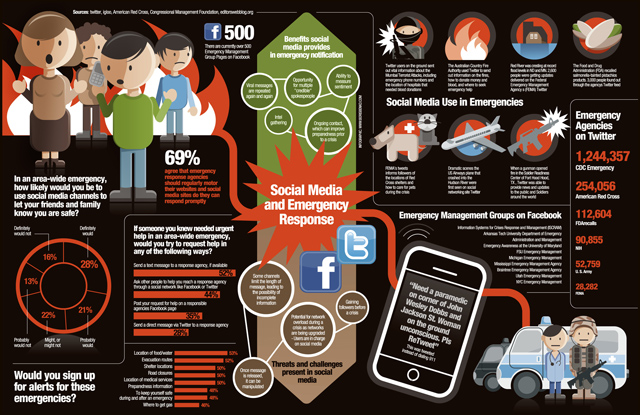
How We Use Social Media During Emergencies [INFOGRAPHIC]

Mashable

Click on Image to Enlarge

The use of social media during national and international crises, both natural and political, is something that Mashable has followed with great interest over the past few years.

As a culture, we started becoming more aware of the power of social media during times of crisis, like when the Iran election in 2009 caused a furor, both on the ground and on Twitter. More recently, the Internet and social media played an important role in spreading news about the earthquake in Haiti and political revolution in Egypt.

But what about other kinds of natural disasters or crime? Can social media be used to good effect then?

Read full story….

noble gold