Telegeography Global Traffic Map 2010 + Cell Phones & Cancer: New Report Sends Mixed Messages

07 Health, Geospatial, Mobile, Technologies
see the larger version

Global Traffic Map 2010
The Global Traffic Map depicts voice traffic flows on the world’s largest international calling routes. Accompanying figures and tables provide valuable insight into regional traffic flows, price and revenue trends, top calling destinations, the impact of mobiles on the international voice market, and the scale of Skype.

Cell Phones & Cancer: New Report Sends Mixed Messages

A new study from Interphone, a study group within the , a segment of the World Health Organization, says there is no increased risk of brain cancer from cell phone use … but then seems to waiver a bit in its position. When it comes to adults, an increased risk of brain cancer is not established…

Related:
+ Review: SMS Uprising: Mobile Activism in Africa

Mobile + Micro-Volunteering

11 Society, Civil Society, Gift Intelligence, microfinancing, Mobile, Non-Governmental

It seems as though we've also entered a phase of “micro”. From micro-phones and micro-processors to micro-loans, micro-giving, micro-blogging, and  micro-volunteering. (How will “nano” fit into this?)

Problem:
73% of Americans do not volunteer (2007 US Dept Labor).
Root Cause:
Most volunteer opportunities require vetting, many hours, and a long-term commitment. It’s akin to a second job. For most people, the process is inconvenient, takes too much time, and doesn’t easily fit into hectic lives.Our Theory of Change: Americans have spare time – billions of hours – but in small windows of idle moments: sitting in an airport, waiting in a doctor’s office, riding the bus to work, and more. If we can reach people during these spare moments we harness a huge pool of untapped human energy.To harness micro spare time we must reach people via mobile, but until recently, mobile phones were limited.

The arrival of smartphones like iPhone (with Internet, graphics, camera, GPS, video, audio, and more) created enormous possibilities. 115 million smartphones were sold in 2007 with projections of 700 million by 2012 (WashPost, Aug 2008).The Extraordinaries is smartphone software that allows millions of volunteers to perform tasks on their smartphones in just a few minutes. We make volunteering feel like a video game to encourage repetition and competition. People login to our system from any place on Earth within cell reception, and constructively use small windows of spare time for science, medicine, nonprofits, government, and more. Nearly anything you do on a regular computer you can do on a smartphone.

You can help:
-Translate micro-finance loan applications (Kiva).
-Transcribe subtitles for human rights videos (Witness).
-Immigrants improve their English (Phone ESL).

(I'm sure you can think of many more possibilities)

Also see this list from Time Magazine

North Koreans + Cellphones = Subverting Oppression, Citizen Intelligence, Baring Secrets

Counter-Oppression/Counter-Dictatorship Practices, Government, Mobile

(So cool, so ill) Read the rest of the story fr NY Times

SEOUL, South Korea — North Korea, one of the world’s most impenetrable nations, is facing a new threat: networks of its own citizens feeding information about life there to South Korea and its Western allies.

The networks are the creation of a handful of North Korean defectors and South Korean human rights activists using cellphones to pierce North Korea’s near-total news blackout. To build the networks, recruiters slip into China to woo the few North Koreans allowed to travel there, provide cellphones to smuggle across the border, then post informers’ phoned and texted reports on Web sites.

The work is risky. Recruiters spend months identifying and coaxing potential informants, all the while evading agents from the North and the Chinese police bent on stopping their work. The North Koreans face even greater danger; exposure could lead to imprisonment — or death.

Related:
Mobile_Citizen_Intelligence_Link_Table (examples of on-the-ground to on-the-web)

EVENT REPORT: State of the Planet 2010, Columbia Univ, New York City

01 Poverty, 03 Environmental Degradation, 03 India, microfinancing, Mobile, Threats, United Nations-affiliated


Panels and keynotes program schedule
I was told via email from someone involved in the event that a video will be posted online.I will be posting this over a the Earth Institute blog (especially since it has zero comments for the March 25 event) as a challenge to improve the overall framework of the “State of the Planet 2012”.

State of the Planet 2010 Event Report:
Intro
I attended this bi-annual event in 2008. At that time there was not a global webcast that included panelists located in other countries. At the 2010 event, there was a V.I.P. section closer to the ‘stage' that I was not notified about. The V.I.P. section had about 3 times more people than the non V.I.P. section which was odd. Despite it being a V.I.P. section, there was never enough time given to them to ask all the questions via microphone. This is a Jeffrey Sachs event, it's his show. He's the main advisor to Ban Ki-Moon, and friends with the president of Mexico (who keynoted this event), so it seems to be more from his perspective and his friends. Therefore, it was a very narrow-visioned event that should not be entitled “State of the Planet”. People involved with the publication “State of the Future” for over a decade (
www.stateofthefuture.org) were never mentioned, invited, or asked to contribute. Yet, these people have worked with the United Nations for over a decade. Collective intelligence has been written and software is being developed by those involved in the “State of the Future” (Millennium Project), yet Jeffrey Sachs was attributed to the idea of “worldwide brainstorming” for “collective invention”. And unfortunately, there was an obsession at this event on ‘climate change' and carbon. “Industrialization footprint” involves a broader range of hazards and toxins that needs more air time. More ‘fluid' thinking was lacking while an excess of a kind of cloned groupthink was prevalent (or ‘carbon copying' if you will, pun intended). The forum has great potential but as of 2008 & 2010, is too insulated and will not be respected as highly intelligent and strategically effective by a broad range of people (outside of Ivy League Columbia) concerned about serious global issues. On an interesting note, Zbigniew Brzezinski was once a Columbia professor (see Obama video on his Brezinski recognition).
Continue reading “EVENT REPORT: State of the Planet 2010, Columbia Univ, New York City”

Journal: Individual Dignity & Collective Defense

07 Other Atrocities, 08 Wild Cards, 09 Justice, Civil Society, Law Enforcement, Mobile, Tools

Full Story Online

Google execs convicted in Italy for Down syndrome video

MILAN (Reuters) – A Milan court convicted three Google Inc executives on Wednesday for violating the privacy of an Italian boy with Down's syndrome by letting a video of him being bullied be posted on the site in 2006.

Phi Beta Iota: The Italians made a mistake.  Instead of using the video to aggressively convict the bullies of the Down's syndrome boy, they are shooting the messenger.  This is just as ignorant and ill-advised as the police trying to criminalize Twitter  texts and cell phone video of police brutality.  The right of the people to bear witness cannot be undermined by the courts, IOHO.

Journal: Free Twitter Rocks, People Rule in Haiti

Collaboration Zones, Collective Intelligence, Communities of Practice, Ethics, Geospatial, InfoOps (IO), Key Players, Methods & Process, Mobile, Policies, Real Time, Reform, Strategy, Technologies, Threats, Tools
Full Story Online

Twitter Teams with Haiti Telco To Provide Free Text Tweets

WIRED 22 February 2010

Text messages have already raised $32 million for Haiti relief. Now Twitter is partnering with the devastated nation’s dominant telco to provide free text Tweets to Haitians so they can better keep in touch with each other and the outside world.

“Kevin Thau and our mobile team have recently arranged free SMS tweets for Digicel Haiti customers,” Twitter co-founder Biz Stone writes on the company’s blog. “To activate the service, mobile phone users in Haiti can text follow @oxfam to 40404. Accounts are created on the fly and any account can be followed this way.”

The move is much more than a gesture, as it might seem in place where limitless text plans abound and the standard of living is much higher. Under Digicel’s pre-paid plan Haitians pay $0.08 to text locally, $0.15 to text internationally and $0.23 to send an MMS. But considering that the country’s per capita income is about $1,300, that would be the equivalent of $2.46, $4.62 and a whopping $7.07 in the U.S. (which had a 2008 per capita income of about $40,000).

As has become almost routine now, the initial flood of information and pictures to emerge from the disaster zone reached the world via Twitter, and the use of texting is an especially crucial lifeline in the underdeveloped world.

Phi Beta Iota: BRAVO TWITTER!  Who would have thought Haiti would be the silver lining for the poor.  At one stroke Twitter hass connected scharitable giving from the 80% that do not normally give, with the bottom-up needs of the poor articulated via Twitter for free.  Now if Twitter can team with others such as Nokia, Microsoft, and IMB to offer free cell phones to the five billion poor, with back office harvesting of the data and a global grid of volunteer translator educators in 183 languages, we save the world quick time.

Journal: The End of Old Money

03 Economy, Civil Society, Collective Intelligence, Commerce, Commercial Intelligence, Cultural Intelligence, Ethics, Mobile
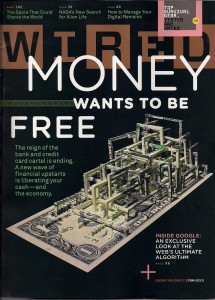
WIRED Home Page

We stopped subscribing to WIRED when advertising crossed the 60% mark, but this issue came to us and has a useful article on the end of old money, which is to say, the end of money where banks and credit cards take an undeserved cut from every transaction while taking huge risks with your money as collateral.

The Open Money movement is proceeding apace, with community-oriented credit cards like Interra, new forms of home rule stripping corporations of their illegitimate “personality” status, and moving money from Wall Street to the local bank.

Meanwhile, Twitter is changing the world again by becoming a trusted point to point money transfer agent.  here are five new ways to pay that cut out the banks and credit card organized legalized crime lords:

Twitpay. Type a friend's Twitter handle, a dollar amount, and twitpay to transfer funds to their PayPal account.

Zong. Instead of entering credit card information anew for every online purchase, users fill in their phone number and the charge shows up on their monthly bill.

Square. The latest from Twitter cofounder Jack Dorsey, this 3/4 inch cube turns any iPhone into a credit card reader.

GetGiving. This mobile app uses PayPal to enable charities to accept small donations without the usual exorbitant credit card transactions fees.

Hub Culture. Travelers can avoid the hassle and fees of swapping dollars for euros by transacting in vritual currency in this international network of workstations.

To our surprise, PayPal itself, central to most alternative schemes, was not highlighted other than being mentioned above.

noble gold