Worth a Look: A Plan to Dump Congress in 2012

Worth A Look


————————– Re-Inventing Democracy ————————–

Take a stand.  Find allies.  Build winning voting blocs.  Get Control of Government.

2012: How U.S. Voters Can Wrest Control of Congress from Special Interests
(Revised 09.29.10)
The electorate's dissatisfaction with the nation's lawmakers has reached a critical stage. A majority of U.S. voters want to see most elected representatives in Congress defeated because they favor special interests over voters' interests. Unfortunately, legal obstacles erected by the two major parties prevent voters from replacing most of these representatives unless they use the large scale collective action power of the Internet to work around them.

These obstacles range from federal and state election laws to campaign finance laws and Supreme Court decisions that favor private over public funding of elections. Voters can't change these laws within the foreseeable future. But they can circumvent them at the Congressional election district level. The web savvy 125 million voters who used the Internet to influence the outcome of the 2008 elections can use breakthrough web technologies to elect a majority of Congressional representatives untainted by special interests in 2012.

These technological advances, particularly the web application discussed in this series, enable voters to build winning transpartisan voting blocs in their…

Read the rest….

Home Page with PROTOTYPE Policy Options and Voter Empowerment

Phi Beta Iota: Similar to what we conceptualized with Joe Trippi and others in 2008, but with its own unique and patentable approach, this PROTOTYPE could be the “killer app” for democracy.  We will know more in early 2011.

See Also:

Graphic: 24/7 Participatory Budget-Policy

Election 2008 Chapter: Call to Arms, Fund We Not Them

2008 ELECTION 2008: Lipstick on the Pig

2007 The Big Picture: Restoring the Constitution and the Republic through Deliberative Democracy

Journal: Outside the Beltway ….

08 Immigration, 09 Justice, 10 Security, Civil Society, Cultural Intelligence, Government, Law Enforcement
Cheery Waves Recommends....

Pelosi, Boxer star in TV ad telling Latino voters “don't vote”

Unflattering photos of House Speaker Nancy Pelosi, California Sen. Barbara Boxer and California Rep. Maxine Waters play a central role in a new TV commercial created by a Republican front group, telling Latino voters to stay home on Election Day.

The Spanish-language ads, entitled “No Votes” (“Don't Vote”), are sponsored by a Virginia-based group that calls itself “Latinos for Reform.”

Published reports indicate that the ads are the work of Robert Desposada, a Republican political consultant, former Republican National Committee director of Hispanic affairs and pundit on the Spanish language TV network Univision.

Imagine for a moment that the New York State Police are warning American boaters to steer clear of the Canadian side of Lake Ontario because they might fall victim to pirates.

Imagine that violent gangs armed with military weaponry created a no man's land along a portion of the border shared by the United States and Canada that challenged the sovereignty of both nations.

Would this for a moment be tolerable? Would the president of the United States or the leaders of Congress simply treat it as a regrettable yet acceptable border problem? Of course not. Yet residents of South Texas are expected to endure precisely this situation on the U.S.-Mexican border.

Read Rest of Article….

Reference: How to Think Like Steve Jobs…Explore!

Articles & Chapters, Cultural Intelligence, info-graphics/data-visualization, Methods & Process
DefDog Recommends...

Very interesting……Jobs sees the same things as other leaders, but he perceives them differently.

The key to thinking differently is perceiving things differently. To perceive things differently, you must be exposed to divergent ideas, places and people. This forces your brain to make connections it otherwise might miss. Steve Jobs has done this his entire life. He dropped out of college so he could “drop in” to classes that really interested him, such as calligraphy, whose lessons would come back to him years later when he designed the Mac, the first personal computer with beautiful fonts. Jobs wanted the Apple II to be the first personal computer people used in their homes, so he sought inspiration for it in the kitchen appliance aisle at Macy's. And when he hired musicians, artists, poets and historians on the original Macintosh team, he was again exposing himself to new experiences and novel ways of looking at problems.

Leadership

How To Think Like Steve Jobs

Carmine Gallo, 10.19.10, 04:30 PM EDT

You have to bombard your brain with new and novel experiences.

imageThomas Friedman, the New York Times columnist, recently wrote that America's core competency is its ability to attract, develop and unleash creative talent. He suggested that what America needs if it is to emerge from the Great Recession even stronger than before is more Jobs–Steve Jobs. That sounds good on paper, but how does Steve Jobs do it? How did Apple‘s chief executive pioneer the personal computer, revive the Apple brand in 1997 when it was close to bankruptcy and grow Apple into the most valuable tech company in the world? That's the question I took on in writing my new book, The Innovation Secrets of Steve Jobs.

Read Rest of Story Online….

Reference: Reader-to-Leader Framework–Motivating Technology-Mediated Social Participation

Collective Intelligence, Collective Intelligence, Communities of Practice, Cultural Intelligence, info-graphics/data-visualization, InfoOps (IO), IO Mapping, IO Multinational, Methods & Process, Mobile, Open Government, Standards, Strategy, Tools

The Reader-to-Leader Framework: Motivating Technology-Mediated Social Participation

Jennifer Preece, University of Maryland1
Ben Shneiderman, University of Maryland2

Abstract

Billions of people participate in online social activities. Most users participate as readers of discussion boards, searchers of blog posts, or viewers of photos. A fraction of users become contributors of user-generated content by writing consumer product reviews, uploading travel photos, or expressing political opinions. Some users move beyond such individual efforts to become collaborators, forming tightly connected groups with lively discussions whose outcome might be a Wikipedia article or a carefully edited YouTube video. A small fraction of users becomes leaders, who participate in governance by setting and upholding policies, repairing vandalized materials, or mentoring novices. We analyze these activities and offer the Reader-to-Leader Framework with the goal of helping researchers, designers, and managers understand what motivates technology-mediated social participation. This will enable them to improve interface design and social support for their companies, government agencies, and non-governmental organizations. These improvements could reduce the number of failed projects, while accelerating the application of social media for national priorities such as healthcare, energy sustainability, emergency response, economic development, education, and more.

Recommended Citation

Preece, Jennifer and Shneiderman, Ben (2009) “The Reader-to-Leader Framework: Motivating Technology-Mediated Social Participation,” AIS Transactions on Human-Computer Interaction (1) 1, pp. 13-32
Available at: http://aisel.aisnet.org/thci/vol1/iss1/5

Visit Home to Download Free

Reference: Science 2.0 by Ben Shneiderman

Articles & Chapters, Collective Intelligence, Communities of Practice, Cultural Intelligence, info-graphics/data-visualization, IO Mapping, IO Multinational, Mobile, Open Government, Strategy, Tools

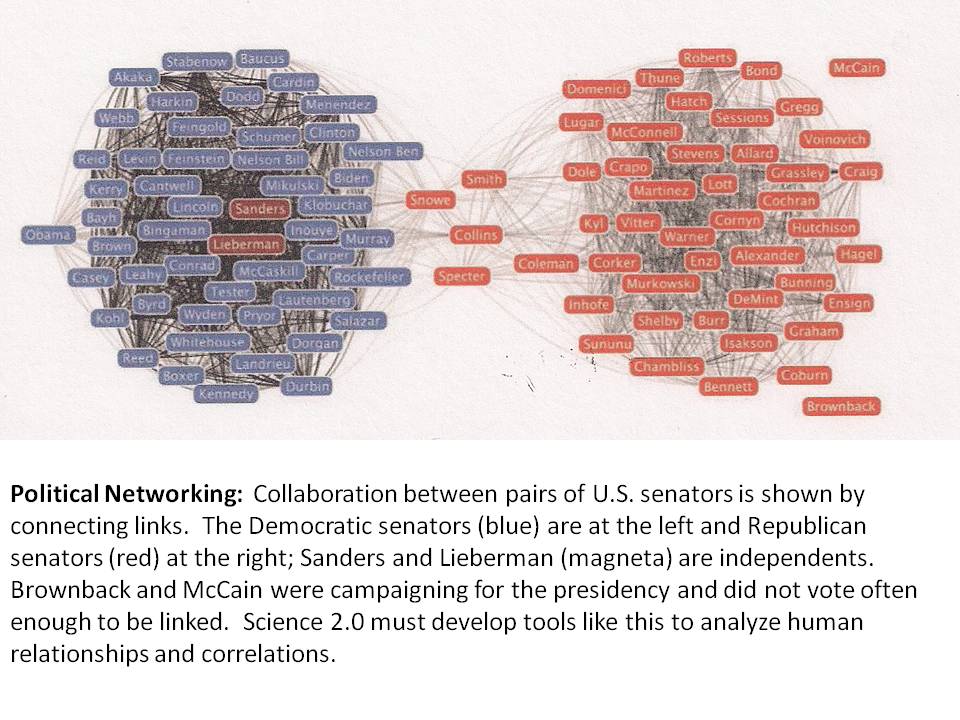
Click on Image to Enlarge

Read Source Article, Science 2.0 (2008-07-03)

Phi Beta Iota: Eugene Garfield gave us citation analysis via the Institute for Scientific Information, and Dick Klavans and company have given us the (fragmented) web of knowledge.  Top commercial intelligence practitioners have long known that published experts can lead to unpublished experts without which ground truth cannot be determined.  If citations are the “things” that can be measured, “relationships” or “transactions” are the intangibles between the spaces, the Ying of the Yang.  This article is important in part because it coincides with MajGen Robert Scales, USA (Ret) view that WWI was about chemistry, WWII was about physics, WWIII was about information, and WWIV is about human factors.

See Also:

Reference: 27 Sep MajGen Robert Scales, USA (Ret), PhD

Search: The Future of OSINT [is M4IS2-Multinational]

2010: Human Intelligence (HUMINT) Trilogy Updated

2010 INTELLIGENCE FOR EARTH: Clarity, Diversity, Integrity, & Sustainability

Graphic (12): Gun Control Perspectives

10 Security, 11 Society, Civil Society, Collective Intelligence, Cultural Intelligence, History, Mobile, Open Government, Peace Intelligence, Standards, Strategy, Tools
Marcus Aurelius Recommends

Following is self explanatory. About all I can add is:

– “The West wasn't won with a registered gun.”
– As Charlton Heston said, “… from my cold, dead hand …”
– “Better to be judged by twelve than carried by six.”
– “Don't dry fire in a gunfight.”
– “I am the NRA — and I vote!”

Click on Image to Upload

Eleven Other Images Below the Line

Continue reading “Graphic (12): Gun Control Perspectives”

noble gold