This study and a wide variety of email and wiki posts may be a tipping point that puts the full weight of the International Consortium of Investigative Journalists into the battle against corrupt judges in the pockets of the banks — specifically, judges that have been ruling against individual home owners being illegally foreclosed, refusing to grant their motions for presentation of the actual mortgage document. Despite laws being passed that demand exactly that, the judges are being paid to ignore those laws.
Here is the 357 page PDF, one of the most viewed documents (top 5%) on LinkedIn.
The story has passed from the media's attention. If you listen to the mainstream media, and look at all those cozy, “come on down y'all” ads BP has put up on television, things have returned as if the oil spill never happened. As this story makes clear, it is all an Orwellian propaganda lie. I ran this story because a reader on the Gulf Coast wrote to tell me t! hat whatever I thought was going on, human lives, the coast, and the ecosystem were still devastated. This carbon energy crisis may not really be over for years; indeed, things may never be as they once were.
Most people I know who have been directly affected by the spill have lost faith in the recovery process. They tried to give BP the benefit of the doubt and work with [claims czar Kenneth] Feinberg, who was tasked by BP to handle the claims after the initial claims process failed. People were asked to fill out paperwork over and over again and their claims were still rejected for reasons not made clear to them. No one seems satisfied that their elected officials fought the fight for them. Most of them don't believe any money will trickle down to them at all.
One clearly sees the character of these corporations in times of disaster. They have obviously spent billions developing extraction technologies, and virtually nothing on how to cope with what happens if it all goes wrong. Here is as clear an example as anyone could provide.
Hundreds of beached dolphin carcasses, shrimp with no eyes, contaminated fish, ancient corals caked in oil and some seriously unwell people are among the legacies that scientists are still uncovering in the wake of BP's Deepwater Horizon spill.
This week it will be three years since the first of 4.9 billion barrels of crude oil gushed into the Gulf of Mexico, in what is now considered the largest marine oil spill in the history of the petroleum industry. As the scale of the ecological disaster unfolds, BP is appearing daily in a New Orleans federal court to battle over the extent of compensation it owes to the region.
Collaborative consumption: Technology makes it easier for people to rent items to each other. But as it grows, the “sharing economy” is hitting roadblocks
WHY pay through the nose for something when you can rent it more cheaply from a stranger online? That is the principle behind a range of online services that enable people to share cars, accommodation, bicycles, household appliances and other items, connecting owners of underused assets with others willing to pay to use them. Dozens of firms such as Airbnb, which lets people rent out their spare rooms, or RelayRides, which allows other people to rent your car, act as matchmakers, allocating resources where they are needed and taking a small cut in return.
Phi Beta Iota:The Economist is the first mainstream media source to open up to the emergent possibilities. There are three major changes being facilitated by the Internet and the related applications, generally those that are NOT proprietary, NOT owned by a major corporation, and NOT predatory:
01 Collaborative Sharing of products, services, and places
02 True history of products, services, and places (e.g. “my fish today”)
03 True cost of products, services, and behaviros.
It is the last one that is awaiting a major breakthrough that combines the open source crisis making and global diaspora translation and posting, with the still missing heavy lifting of research such as was done for a single cotton T-shirt.
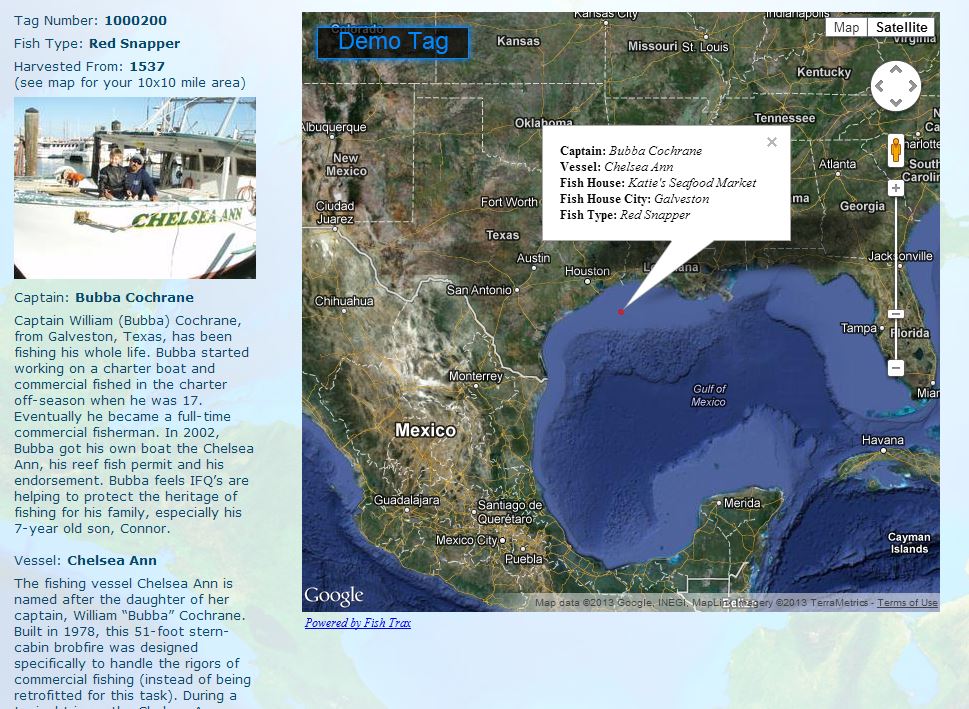
This is the page from Gulf Wild program. When you buy a fish that has a Gulf Wild ID number on it, you can find out everything about it.
Simply enter this ID number on their website or (cell phone) and it will provide you with:
Click on Image to Enlarge
The bio and history of the fisherman who caught the fish.
What the fish is, where the fish was caught (with a map) down to 10 miles, and when it was caught.
Info on fishing practices (e.g. was it caught as part of a sustainable fisheries program?).
NOTE: Canada has a similar program called “This Fish”
I believe we're going to see programs like this for all of the food (and an increasing number of products) we buy, from meats to vegetables.
Why? Info like this is addicting. Once you get it, you want it on everything.
Fortunately, it's also really easy to put a service like this together for local producers, and that's a good thing.
Here's why: This type of insight would positively differentiate fresh, high quality local produce from the generic products of indefinite age, quality, and origin we get from the global industrial system.
That would be a good thing, since it would help make local food more plentiful and that makes us ALL more resilient.
I have reached a point where I have been forced to conclude that Monsanto is an evil corporation, as I understand that word. I know, from what you have written me that many of you, as have I and Ronlyn, have signed petitions against Monsanto. Now take the next step. Stop buying their products. Here is a URL where you will find the list of the companies Monsanto owns.
WARNING NOTICE: The list is not accurate and has been removed from Phi Beta Iota. The concept remains valid, but the public must first properly identify all Monsanto companies. We continue to wonder why farmers are not suing Monsanto for willful trespass, unlawful deprivation of property use, and health violations related to the toxicity and third generation infertility that are associated with Monsanto's GMO offerings.
This is the first of two stories. I am running them both today, because I want to make the point that in nuclear accidents there is a question as to whether they are ever really “over;” this is the thing that is different about nuclear power. Tar sands oil leaks, such as the one in Arkansas, eventually get cleaned up. Nuclear waste is forever.
US residents near the Hanford Nuclear Reservation may be in grave danger: a nuclear safety board found that the underground tanks holding toxic, radioactive waste could explode at any minute, due to a dangerous buildup of hydrogen gas.
In addition to everything else Fukushima has shown us the unintended consequence of radioactive tuna. This technology is fine, until it's not fine. Then it's a problem for we know not how many years, and creates horrible social problems.
Phi Beta Iota: The irresponsibility — partly in ignorance but mostly in corruption — of most governments — cannot be understated. The “inudstrialization” of the knowledge industry led to fragementation, a disconnect from ethics, and ultimately to a perversion of how knowledge is used, to internalize profits and externalize hazards, risks, and lasting costs. Very uncivilized.