The ultimate goal of the US is to take the resources of Africa and Middle East under military control to block economic growth in China and Russia, thus taking the whole of Eurasia under control, author and historian William F. Engdahl reveals.
The crisis with the US economy and the dollar system, the conduct of the US foreign policy is all a part of breakdown of the entire superpower structure that was built up after the end of WWII, claims Engdahl.
“Nobody in Washington wants to admit, just as nobody in Britain a hundred years ago wanted to admit that the British Empire was in terminal decline,” claims the author, noting that “All of this is related to the attempt to keep this sole superpower not only intact, but to spread its influence over the rest of the planet.”
William F. Engdahl believes the uprisings in the Middle East and North Africa is a plan first announced by George W. Bush at a G8 meeting in 2003 and it was called “The Greater Middle East Project”.
The 2012 election is now in play, and the Republican wing of the war party is gearing up to blame President Obama for America’s failed wars (who, while not entirely blameless, is hardly the architect of defeat) and the accompanying national humiliation. This email is about an opening shot that just appeared in the Weekly Standard.
One of my closest friends, retired Marine Colonel XXX, forwarded the attached analysis of the US defeat in Iraq. (I use the word ‘analysis’ charitably) It was written by Fred Kagan, his wife, and another person, neocons all. The Kagans are among one of America’s most vocal advocates preventative war, especially the invasion of Iraq, and were “architects” of the so-called “surge” (which is Versailles-speak for a relatively modest, time-consuming escalation, whereas in traditional military parlance, the word ‘surge’ implies a massive increase, like a doubling or tripling, of effort over a very short period of time).
Below is an excellent interview with Anthony DiMaggio in Counterpunch. DiMaggio author ofThe Rise of the Tea Party, due out in November 2011. He uses the “propaganda model” developed by Noam Chomsky and Edward Herman in their bookManufacturing Consent to document and explain the Tea Party’s organizational dynamics for manufacturing dissent, and he compares these dynamics to those of the Occupy Wall Street movement.
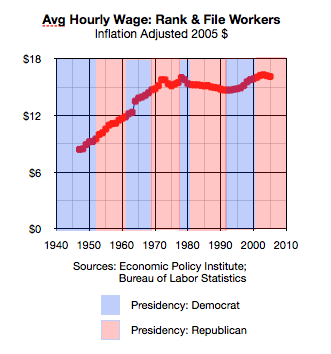
Before reading the interview, consider please the following: The forces powering the rage of the Tea Party — the stagnation of incomes and the increasingly unequal distribution of income — were around long before the Tea Party erupted on the national scene.
Click on Image to Enlarge
That the distribution of income had shifted in a very fundamental way toward the wealthy and especially the super-wealthy at the expense of the bottom 80% of the working population was clearly demonstrated in a classic study by Emanuel Saez and Thomas Piketty (Quarterly Journal of Economics, February 2003, updated in 2009), and subsequently confirmed by many other others, including just last week, on 25 October 2011, by the Congressional Budget Office.
It has also clear for years that inflation-adjusted wage growth that underpinned the improved living standards of great American dream machine sputtered out during the 1970s (see chart below).
So, it is simply beyond dispute that a fundamental change in the income distribution has taken place since the late late 1970s. That change is also correlated with the wave of deregulation, tax cutting, defense spending increases (with a slight interregnum following the Soviet Union’s collapse), and deindustrialization/globalization that took off after 1980 during the Reagan Administration and accelerated during the Clinton and Bush II Administrations.
Phi Beta Iota: Keep an open mind. This is deeply serious and directly relevant to understanding the convergence of the honest right, the honest left, and OccupyWallStreet.
What Lenin meant to convey was that the Soviets were not the ordinary class organisation, whose purpose, according to the Mensheviks and Social-Revolutionists, was to fight only for the economic demands of the working class within the framework of bourgeois society. In his opinion such Soviets would be doomed in advance. In fact, no Soviets were needed for such a purpose. In his view, the Soviets were organisations for the seizure of state power, and for transforming the workers into the ruling class. That is why he again and again told the Petrograd workers in the course of 1916: ‘Ask yourselves a thousand times whether you are prepared, whether you are strong enough; measure your cloth nine times before you cut. To organise Soviets means to declare a war to a finish, to declare civil war upon the bourgeoisie, to begin the proletarian revolution.’
The OWS formations carry such potential, albeit (likewise) in an embryonic state. Their internal democratic structures are the key to this, and that is the part that should be replicated. As assemblies of people are constituted among more and more communities (and the accomplishment of this is extremely important to insuring that the internal democracy of each group is replicated in the aggregation of all such groups, in whatever form that ultimately takes, should it develop that far), both the possibility of coordinate mass action and the potentiality of an alternative political structure that represents all segments of the population emerges. The lesson from Lenin as applied to OWS is to recognize both the positive and negative potential that it represents and to both engage it and shape it to fit the needs of all communities. In the United States in particular, given the historically dominant role of racism in the social order, that means ensuring that the construct that is springing into existence before our eyes is made to become responsive to the direction of the traditionally oppressed communities, particularly communities of color.
Assuming that the most important task is to address the racist nature of this society and to prevent this from being replicated in whatever emerges from the present activities, it would seem that, as the best defense is a good offense, the oppressed communities here (and elsewhere, as this is becoming a global phenomenon) must organize as never before, and in a way that is compatible – in form and substance – with the present model, and which will thus insure that the voices and self-determined interests of these communities will find full expression.
More from Dan DeBar: My thinking on this is not fully developed, but, if you can spare 58 minutes and suffer some of the fits-and-starts of my thought process in the process, I did go into some depth in this video – – which starts off a bit slow, but eventually gets across a good picture of my thinking on the matter. As I felt I got deflected somewhat by the host from my main point – that of the centrality of the issue of racism to any solution of the problems being articulated by, or serving as the catalyst for, the OWS “movement” – I fleshed that out a bit more in this video.
Below is the proposal passed by the Occupy Oakland General Assembly on Wednesday October 26, 2011 in reclaimed Oscar Grant Plaza. 1607 people voted. 1484 voted in favor of the resolution, 77 abstained and 46 voted against it, passing the proposal at 96.9%. The General Assembly operates on a modified consensus process that passes proposals with 90% in favor and with abstaining votes removed from the final count.
Phi Beta Iota: The Oakland Occupy General Assembly is certainly within its rights to declare a General Strike, but there is a very clear line between a non-violent voluntary General Strike and a punitive attack on main street business. The entire matter of how best to conduct a General Strike that immobilizes politicians and banks while bringing business to small and main street businesses is one meriting deliberation.
The Harvard professor has spooked the right. As she begins her high-profile Senate campaign against GOP star Scott Brown in Massachusetts, the consumer advocate tells Samuel P. Jacobs how she created ‘much of the intellectual foundation' for the Occupy Wall Street movement. She also talks about her past life as a Republican and the challenges of being a woman on the campaign trail—and says she's no ‘guileless Marxist.'
Phi Beta Iota: The implied claim is a real stretch. Ethics has been around for a very long time, as has populism. The Internet is new. An awakening engaged and modestly enraged public is new. At best Warren is – like most of us – a modest catalyst for convergence.