Journal: The Rise and Sell-Out of the Enviro Establishment

01 Agriculture, 03 Economy, 03 Environmental Degradation, 05 Energy, 07 Health, 09 Justice, 11 Society, 12 Water, Advanced Cyber/IO, Civil Society, Commerce, Commercial Intelligence, Cultural Intelligence, Earth Intelligence, Government
Chuck Spinney Recommends...
Herewith are the first two parts of Jeff St Claire's important multipart series on the systemic corruption and corporatization of the environmental movement.

A Concise History of the Rise and Fall of the Enviro Establishment

How Green Became the Color of Money

By JEFFREY ST. CLAIR, Counterpunch

Part I

New Year's Edition
December 31, 2010 – January 2, 2011

EXTRACT:  Watt, Gorsuch, Levelle and Crowell were magnificent villains for fundraising: direct mail revenues of the top environmental groups exploded tenfold from 1979 to 1981. Green became the color of money, and the rag-tag band of hardcore activists who populated the Hill in the 1970s gave way to a cadre of Ivy League-educated lobbyists, lawyers, policy wonks, research scientists and telemarketers. Executives enjoyed perks and salaries that rivaled those of corporate CEOs.

A Concise History of the Rise and Fall of the Enviro Establishment

How Green Became the Color of Money

By JEFFREY ST. CLAIR, Counterpunch

Part II

Weekend Edition
January 7 – 9, 2011

EXTRACT:

By the end of Reagan’s second term, the big environmental organizations were well-pickled in the political brine of Washington, with freshness and passion drained out.

. . . . . .

EXTRACT:  Under instructions from Bush, Lujan ordered the Bureau of Land Management to fast track the purchase of the Goldstrike Mine by Barrick Resources, a Toronto-based company controlled by financier Peter Munk. The way thus lubricated, Barrick acquired the 1,800 acre gold mine near Elko, Nevada, for the princely sum of $9,500. By the time the mine is shuttered, the Goldstrike will yield an estimated $10 billion in gold. In 1995, in consideration for his favors, George Bush was invited to join Barrick’s board of advisers.

Phi Beta Iota: The work of Jeffrey St. Claire and CounterPunch are representative of public intelligence in the public interest–the work suffers from being isolated and lacking holistic integrity–there is no means for the public to “connect the dots” or evaluate each predatory move in situ and in context.  That is the emergent challenge and opportunity of the 21st Century.

Reference: Genocide of Bees From Failure of Government

01 Agriculture, 03 Economy, 03 Environmental Degradation, 06 Family, 07 Health, 10 Security, 11 Society, Articles & Chapters, InfoOps (IO), Intelligence (government)

Leaked Memo Sheds Light on Mysterious Bee Die-Offs and Who's to Blame

The culprit may be a pesticide that the EPA has allowed on the market despite the fact that the company which makes the pesticide has failed to prove it is safe.

AlterNet / By Jill Richardson

December 10, 2010

Read long detailed and compelling story….

Phi Beta Iota: This is the part that the President, the Director of the Office of Management, and the Director of National Intelligence simply do not compute.  As presented in the M4IS2 briefing in Chile, in today's complex era security is everything about everything always.  Intelligence must mature.  We have wasted 19 years going on 25.  Creating a Smart Nation and a Smart Government starts with evidence-based policy-making–intelligence is where that comes from, and public intelligence is how we nurture integrity within the government.

See Also:

Sense-Making Summit: Public Health (October 2011)

2010 INTELLIGENCE FOR EARTH: Clarity, Diversity, Integrity, & Sustainability

Graphic: Intelligence Maturity Scale

Journal: Army Shines with Bee Deaths But Case Still Open

Journal: Bees’ tiny brains beat computers

Journal: Electromagnetics, Bees, & Agriculture

Worth a Look: Book Reviews on Intelligence (Lack Of)

Pesticides: Germany bans chemicals linked to honeybee devastation (2008)

Journal: Bees’ tiny brains beat computers

Indications & Warning: Army Spirit and Public Fat

04 Education, 07 Health, 10 Security, 11 Society, Cultural Intelligence, Military, Officers Call, Strategy
Who, Me?

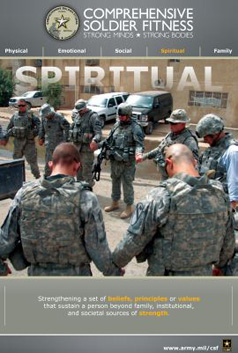
Army's “Spiritual Fitness” Test Comes Under Fire

Jason Leopold

TruthOut Wednesday 05 January 2011

Test Was Designed by Psychologist Who Inspired CIA's Torture Program

An experimental, Army mental-health, fitness initiative designed by the same psychologist whose work heavily influenced the psychological aspects of the Bush administration's torture program is under fire by civil rights groups and hundreds of active-duty soldiers. They say it unconstitutionally requires enlistees to believe in God or a “higher power” in order to be deemed “spiritually fit” to serve in the Army.

Comprehensive Soldier Fitness (CSF) is a $125 million “holistic fitness program” unveiled in late 2009 and aimed at reducing the number of suicides and post-traumatic stress disorder (PTSD) cases, which have reached epidemic proportions over the past year due to multiple deployments to the wars in Iraq and Afghanistan and the substandard care soldiers have received when they return from combat.

Read rest of article….

Tomgram: William Astore, We're Number One (in Self-Promotion)
Posted by William Astore at 9:40am, January 6, 201
EXTRACT:  In April 2010, for instance, a group of retired top brass and others released a report claiming that 27% of Americans between 17 and 24 are “too fat to fight.”  “Within just 10 years, the number of states reporting that 40 percent of their 18- to 24-year-olds are obese or overweight went from one [Kentucky] to 39.”  No reason to focus on that, though.  After all, it was so last year.

Just as the year ended, however, the Education Trust issued a report indicating that nearly a quarter of all applicants to the Armed Forces, despite having a high-school diploma, can’t pass the necessary military entrance exam.  This isn’t Rhodes Scholarships we’re talking about, but not having “the reading, mathematics, science, and problem-solving abilities” to become a bona fide private in the U.S. Army.  We’re talking the sort of basic that, according to an Education Trust spokesperson, makes it “equally likely that the men and women who don't pass the test are [also] unprepared for the civilian workforce.”

includes

Freedom Fighters for a Fading Empire
What It Means When We Say We Have the World’s Finest Fighting Force
By William J. Astore

EXTRACT:  As for our armed forces, though most Americans don’t know it, within U.S. military circles much criticism exists of an officer corps of “tarnished brass”that is deficient in professionalism; of generals who are more concerned withcovering their butts than leading from the front; of instruction at military academies that is divorced from war’s realities; of an aversion “to innovation or creativity… [leading to] an atmosphere of anti-intellectualism” that undermines strategy and makes a hash of counterinsurgency efforts.  Indeed, our military’s biting criticism of itself is one of the few positive signs in a fighting force that is otherwise overstretched, deeply frustrated, and ridiculously overpraised by genuflecting politicians.

Read entire article (second half of same link)…

William J. Astore, a retired lieutenant colonel (USAF) and professor of history, is a TomDispatch regular.  He welcomes reader comments atwjastore@gmail.com. To listen to Timothy MacBain's latest TomCast audio interview in which Astore discusses the military nightmares of a fading empire, click here or, to download it to your iPod, here.

Reference: Bioterrorism Threat and US Preparedness

07 Health, White Papers
Berto Jongman Recommends...

Ready or Not? Protecting the Public from Diseases, Disasters, and Bioterrorism

In the eighth annual Ready or Not? Protecting the Public from Diseases, Disasters, and Bioterrorism report, 14 states scored nine or higher on 10 key indicators of public health preparedness. Three states (Arkansas, North Dakota, and Washington State) scored 10 out of 10. Another 25 states and Washington, D.C. scored in the 7 to 8 range. No state scored lower than a five.   . . .    Thirty-three states and Washington, D.C. cut public health funding from fiscal years (FY) 2008-09 to 2009-10, with 18 of these states cutting funding for the second year in a row.

See Also:

Journal: US Public Health InfoTech NOT….

Journal: US Public Health InfoTech NOT….

02 Infectious Disease, 07 Health, Communities of Practice, IO Multinational, IO Sense-Making
Berto Jongman Recommends...

Public Health Information Technology: Additional Strategic Planning Needed to Guide HHS's Efforts to Establish Electronic Situational Awareness Capabilities

GAO-11-99 December 17, 2010
A catastrophic public health event could threaten our national security and cause hundreds of thousands of casualties. Recognizing the need for efficient sharing of real-time information to help prevent devastating consequences of public health emergencies, Congress included in the Pandemic and All-Hazards Preparedness Act in December 2006 a mandate for the Secretary of the Department of Health and Human Services (HHS), in collaboration with state, local, and tribal public health officials, to develop and deliver to Congress a strategic plan for the establishment and evaluation of an electronic nationwide public health situational awareness capability. Pursuant to requirements of the act, GAO reviewed HHS's plans for and status of efforts to implement these capabilities, described collaborative efforts to establish a network, and determined grants authorized by the act and awarded to public health entities. GAO assessed relevant strategic planning documents and interviewed HHS officials and public health stakeholders.

HHS did not develop and deliver to congressional committees a strategic plan that demonstrated the steps to be taken toward the establishment and evaluation of an electronic public health situational awareness network, as required by PAHPA. While multiple offices within HHS have developed related strategies that could contribute to a comprehensive strategic plan for an electronic public health information network to enhance situational awareness, these strategies were not developed for this purpose. Instead, the offices developed the strategies to address their specific goals, objectives, and priorities and to meet requirements of executive and statutory authorities that mandated the development of strategies for nationwide health information exchange, coordinated biosurveillance, and health security. However, HHS has not defined a comprehensive strategic plan that identifies goals, objectives, activities, and priorities and that integrates related strategies to achieve the unified electronic nationwide situational awareness capability required by PAHPA. The department has developed and implemented information technology systems intended to enable electronic information sharing to support early detection of and response to public health emergencies; however, these systems were not developed as part of a comprehensive, coordinated strategic plan as required by PAHPA. Instead, they were developed to support ongoing public health activities over the past decade, such as disease and syndromic surveillance. Without the guidance and direction that would be provided by an overall strategic plan that defines requirements for establishing and evaluating the capabilities of existing and planned information systems, HHS cannot be assured that its resources are being effectively used to develop and implement systems that are able to collect, analyze, and share the information needed to fulfill requirements for an electronic nationwide public health situational awareness capability.

Read recommendations, access full report…

Long comment and recommended historical warnings and prescriptions below the line.

Continue reading “Journal: US Public Health InfoTech NOT….”

New ABC News Weekly Show Related to the Design Revolution & Global Health

01 Poverty, 02 Infectious Disease, 03 Economy, 04 Education, 07 Health, International Aid, Technologies, Videos/Movies/Documentaries

Be the Change: Save a Life
ABC News kicks off year-long global health care series Friday, Dec. 17 at 10pm eastern/9pm central.

“20/20 ABC starts a weekly show about the Design Revolution.”
Tonight: Stanford's Extreme Affordability Program showcased: http://abcn.ws/f16Dq9

Thanks to those posting to the Out of Poverty Twitter feed

Also see:

+ How the “Entrepreneurial Design for Extreme Affordability” class launched several internationally known start-ups

+ Design for the Other 90% Exhibit + “Micro-Giving” Global Needs Index to Connect Rich to Poor/Fullfill Global-to-Local Requests

Be the Change: Save a Life

ABC News kicks off year-long global health care series Friday, Dec. 17 at 10/9c.