The Public Health Emergency Exposes an Economic and Existential Crisis
Margaret Morganroth Gullette
Tikkun, Spring 2014
ver the past decade of devastating recession and feeble recovery, there has been a sharp rise in suicides of men aged fifty and over — almost 50 percent, according to the Centers for Disease Control and Prevention. From 1999 to 2010, rates of suicide overall have gone up, but the steepest rise was for midlife men: those who used to be thought of as prime-age workers at the peak of their experience and ability. In that decade, the suicide rates for men aged fifty to fifty-four rose from 20.6 per 100,000 to 30.7 per 100,000.
Much is made of the implications of the arms trade and the spread of weapons, notably manufactured by the permanent members of the United Nations Security Council. This has become a fact of life and is accepted as such.
Curiously it is less evident whose weapons are used in the final killing of individuals in combat — especially the weapons used “illegally” by insurgents. The following is a brief exploration of the possibility of identifying who supplied the bullet which finally entered the body of the person maimed or killed.
Does the person so wounded — or the relatives of those killed — have the right to know who produced the bullet? Is this a fundamental human right or a matter of human responsibility?
Whereas not many years ago it would have been considered ridiculous to sell fruit individually identified by marks enabling their precise origin to be determined — even to the person who packed them — such labelling is now commonplace. The argument is that in the event of a threat to health associated with the product, whether fruit or other consumer products, responsibility can be precisely established. Such labelling may be a requirement governing import of foreign products.
If precise labelling can be justified for sources of life-giving human nourishment, because of their potential threat to health, is there not a case for denitrifying those products intended as a means of incapacitating individuals, possibly terminally? Do relatives have a right to the bullet by which a loved one was killed?
More generally is it appropriate to be able to indicate, with as much details as possible, who was responsible for the manufacture of the bullet? Should the bullets used in insurgency operations be a matter of public knowledge?
Hampton Creek Foods and other startups have big dreams of restructuring the food supply so that it uses less land, water, energy, and other resources. In doing so, they are taking on corporate giants such as ConAgra, General Mills, and Kraft that spend billions on research and technology development.
Such ambitions have run up against considerable challenges in industries such as clean tech. But those involved in the new food binge might prefer a different example. Hampton Creek’s CEO, Josh Tetrick, wants to do to the $60 billion egg industry what Apple did to the CD business. “If we were starting from scratch, would we get eggs from birds crammed into cages so small they can’t flap their wings, shitting all over each other, eating antibiotic-laden soy and corn to get them to lay 283 eggs per year?” asks the strapping former West Virginia University linebacker. While an egg farm uses large amounts of water and burns 39 calories of energy for every calorie of food produced, Tetrick says he can make plant-based versions on a fraction of the water and only two calories of energy per calorie of food — free of cholesterol, saturated fat, allergens, avian flu, and cruelty to animals. For half the price of an egg.
In an FCC ruling last week, they completely decimated the idea of internet freedom or net neutrality. They basically said that the corporations that can pay more can get faster internet service – this opens the floodgates for corporate rule online.
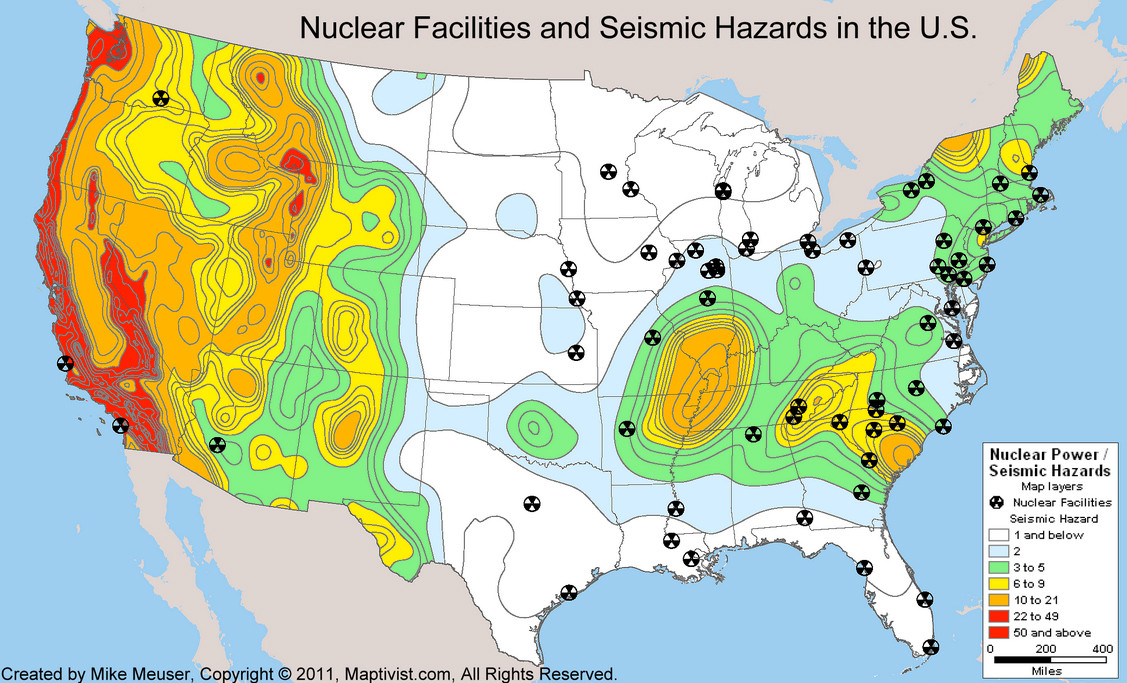
Here we have a pretty realistic take on the state of the U.S. nuclear industry. We have been so lucky not to have had a crisis like Chernobyl. Click through to see the supporting graphics.
The Nuclear Regulatory Commission has had a busy few weeks. Last month, thanks to Freedom of Information Act queries filed by numerous organizations, the Commission was forced to disclose a dossier of emails showing the lengths it had gone to in the immediate aftermath of the Fukushima disaster to downplay the risk of a similar catastrophe happening in the US. The correspondence showed a startling lack of preparedness.
Click on Image to Enlarge
In one example, NRC public affairs officer David McIntyre offered his opinion on what Energy Secretary Steven Chu should have done when asked by CNN whether American nuclear plants could withstand a force 9.0 earthquake: ‘He should just say, ‘Yes, it can.’ Worry about being wrong when it doesn't. Sorry if I sound cynical.”
The documents also show a background briefing for then NRC chairman Gregory Jaczko and other commissioners that split intelligence into ‘public answer” and “additional technical, non-public information.” In some cases the NRC withheld crucial details and misdirected the media.
Street protests continue to rock Brazil and, frustrated by mainstream media coverage, a new group of citizen journalists is using digital tools to tell a different side of the story
EXTRACT
But the battles are not just being waged on the street. Angered by what they see as a misrepresentation of the issues by traditional media, new independent media collectives and networks have emerged over the past year. Armed with smartphones, digital cameras, and apps such as Twitcasting and Twitcam that allow them to broadcast live online, they are presenting their own version of events. Some of them are reaching a huge audience across the country and are now looking to expand their reach internationally.
PM moves to close loophole that allows sexual predators to produce and possess ‘manuals' to help them commit crimes
Paedophiles will be handed the same treatment as terrorists under a crackdown on child abuse to be included in the Queen's speech.
David Cameron said he wanted to close a loophole that allows sexual predators to produce and possess “manuals” giving tips on how to identify victims, groom them, and evade capture.
In future, they will face the same kind of sanctions as extremists who download guides to bomb-making.
The issue came to light after GCHQ and the National Crime Agency found online examples of the guides in the chaotic part of cyberspace known as the “dark web”.