Jason Silva: Creativity, Marijuana, & Butterfly Effect

09 Justice, 11 Society, Advanced Cyber/IO, Blog Wisdom, Civil Society, Collective Intelligence, Cultural Intelligence
Click on Image to Enlarge

On Creativity, Marijuana and “a Butterfly Effect in Thought”

Jason Silva

Reality Sandwich

“The truly creative mind in any field is no more than this: A human creature born abnormally, inhumanly sensitive.” […] “…by some strange, unknown, inward urgency they are not really alive unless they are creating.” — Pearl Buck, Winner of a Nobel Prize in Literature in 1938.

In a blog post last year entitled “Marijuana and Divergent Thinking”, Jonah Lehrer explains that many creative
tasks require the cultivation of an “expansive associative net, or what psychologists refer to as a “flat associative hierarchy.” What this essentially suggests is that creative people should be able to make far-reaching connections among all sorts of seemingly unrelated ideas, and to not dismiss one possible connection just because it seems far-fetched.

Creativity and insight almost always involve an experience of acute pattern recognition: the eureka moment in whicwe perceive the interconnection between disparate concepts or ideas to reveal something new.

The Imaginary Foundation says that “to understand is to perceive patterns” and this is exactly what all great thinkers have done throughout the ages: they have provided a larger, dot-connecting, aerial view of things that subsumes the previous paradigm. As Richard Metzger has written:

What great minds have done throughout history is provide an aerial view of things. A larger more encompassing view that often subsumes the previous paradigm and then surpasses it in completeness with the vividness of its metaphors. Consider now how the evolving notions of a flat earth, Copernican astronomy and Einsteinian physics have subsequently changed how mankind sees its place in the cosmos, continuously updating the past explanations with something superior.


Read more….

Pierre Sprey Skewers Chuck Spinny & Stephen Walt — Big Oil, Wall Street, and Military-Industrial Complex Destroying USA

03 Economy, 10 Security, 11 Society, Blog Wisdom, Civil Society, Commerce, Commercial Intelligence, Corruption, Cultural Intelligence, IO Deeds of War, Military, Power Behind-the-Scenes/Special Interests, Strategy
Pierre Sprey

My good friend Pierre Sprey took issue with my characterization of Steven Walt's critique of US grand strategy as being excellent subject to two omissions.  Attached herewith are Pierre's comments — they are spot on, and I stand corrected on my characterization of “excellent” … or perhaps more accurately … I stand clearly and fairly skewered.  😉

Chuck Spinney
Cap Ferrat, France

Comments by Pierre Sprey:

Chuck,

Although I appreciate that Mr. Walt's heart is in the right place–particularly regarding his admirably staunch opposition to the malign influence of the Israelis, the neocons and “W”–his essay's concept of US grand strategy for the last two decades is just as shallow as the crap from the NYT, the WSJ, the Post and the Council on Foreign Relations. He commits the two fundamental errors common to nearly all foreign policy pundits, errors that inevitably reduce their beard-stroking discussions of “grand strategy” to silliness:

1. He assumes that the US has a foreign policy or a grand strategy when in fact it has none. The US government's actions, like every other country's, are dominated by its domestic politics. And those politics dominate every move made with regard to other countries.

2. He ignores the three most powerful–and most permanent–domestic influences on America's actions abroad: Big Oil, Wall Street and the MICC. Anybody who ignores these three in recounting U.S. actions abroad is either a) hopelessly out of touch, or b) is serving the interests of the defense, financial or oil establishments, or all three.

Aside from these two crippling errors in his reasoning, Mr. Walt's fulsome praise for the success of the USG's “offshore balancing”–that is, the Big Oil (and MICC) inspired policy of setting Iran and Iraq at each other's throats since the 1940s–shows either profound ignorance or profound Kissingerian cynicism.

One last piece of silliness in the Walt essay, quite common to journalists and historians seeking a “hook” for their American Empire story, is the idea of the August 2, 1990 “turning point”, a date that marks the beginning of the decline in our allegedly successful empire. Such hooks only mask the inescapable spread of rot within empires, usually starting at birth.

With Mr. Walt's help, I am coming to believe all public discussions of grand strategy should be greeted with howls of derisive laughter.

Pierre

Post Under Discussion:

Chuck Spinney: Madness in White House, K Street Thrives

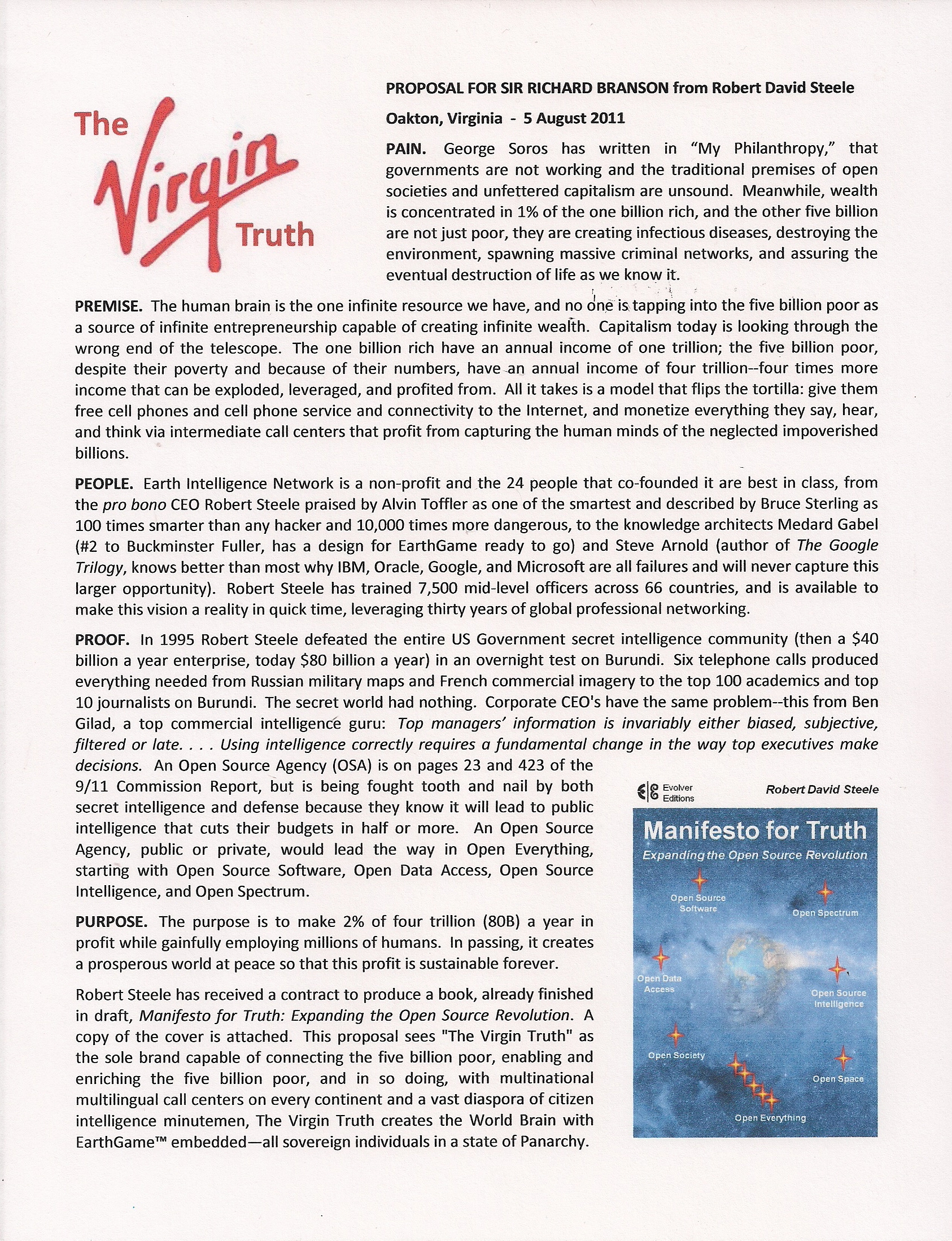
Robert Steele: The Virgin Truth (Old)

Advanced Cyber/IO, Commerce, Earth Intelligence, Ethics, Fact Sheets, Hacking, InfoOps (IO), Key Players, Methods & Process, Mobile, Policies, Real Time, Reform, Strategy, Threats

OBE See Instead: 2012 Robert Steele for Richard Branson: The Virgin Truth 2.6

Robert David STEELE Vivas

There is a very talented author, journalist, and speaker, Mike Southon, who publishes in the Financial Times.  One of his articles, “Perfect Pitch,” 7 March 2009 was instrumental in crafting the below one-page “pitch.”  Mike's four web sites:

www.ft.com/mikesouthon
www.yoodoo.biz
www.mikesouthon.com
www.beermat.biz

Short Persistent URL for this post (The Virgin Truth):

http://tinyurl.com/Steele4Branson


Click on Image to Enlarge

One-Pager Online Updated

Patrick Meier: Building Resilient Societies

11 Society, Blog Wisdom
Patrick Meier

On Building Resilient Societies to Mitigate the Impact of Disasters

I recently caught up with a colleague at the World Bank and learned that “resilience” is set to be the new “buzz word” in the international development community. I think this is very good news. Yes, discourse does matter. A single word can alter the way we frame problems. They can lead to new conceptual frameworks that inform the design and implementation of development projects and disaster risk reduction strategies.

The term resilience is important because it focuses not on us, the development and disaster community, but rather on local at-risk communities. The terms “vulnerability” and “fragility” were used in past discourse but they focus on the negative and seem to invoke the need for external protection, overlooking the possibility that local coping mechanisms do exist. From the perspective of this top-down approach, international organizations are the rescuers and aid does not arrive until they arrive.

Resilience, in contrast, implies radical self-sufficiency, and self-sufficien-cy suggests a degree of autonomy; self-dependence rather than dependence on an external entity that may or may not arrive, that may or may not be effective, and that may or may not stay the course. In the field of ecology, the term resilience is defined as “the capacity of an ecosystem to respond to a perturbation or disturbance by resisting damage and recovering quickly.” There are thus at least two ways for “social ecosystems” to be resilient:

  1. Resist damage by absorbing and dampening the perturbation.
  2. Recover quickly by bouncing back.

So how does a society resist damage from a disaster? As noted in an earlier blog post, “Disaster Theory for Techies“, there is no such thing as a “natural disaster”. There are natural hazards and there are social systems. If social systems are sufficiently resilient to absorb the impact of a natural hazard such as an earthquake, then disaster unfolds. In other words, hazards are exogenous while disasters are the result of endogenous political, economic, social and cultural processes. Indeed, “it is generally accepted among environmental geographers that there is no such thing as a natural disaster. In every phase and aspect of a disaster—causes, vulnerability, preparedness, results and response, and reconstruction—the contours of disaster and the difference between who lives and dies is to a greater or lesser extent a social calculus.”

Read more….

John Robb: Second Global Depression (D2) 2008-2018+

03 Economy, 11 Society, Blog Wisdom
John Robb

Friday, 05 August 2011

JOURNAL: D2, The Second Global Economic Depression

D2 is shorthand for the second global economic depression.  It started formally in 2008, and despite a short respite over the last two years, it never left.  It was only delayed by massive amounts of government intervention.  It is now back in force.

D2, given the forces driving it, is going to last a decade or more.  Simple prepping might help a little but it's far from what is going to be required given its duration.

This depression will fundamentally reorder the economic, political and social landscape.  When it ends, most of the global institutions and markets we see today will mere husks of what they are today.

What will replace them?  That's up to you.

Koko: Bloomberg & Soros Do Wrong Thing Righter

01 Poverty, 03 Economy, 06 Family, 11 Society, Budgets & Funding, Civil Society, Commercial Intelligence, Cultural Intelligence, Gift Intelligence, Government, IO Deeds of Peace, Methods & Process, Reform
Koko

Can George Soros, Michael Bloomberg save New York's troubled young men?

CSM, 4 August 2011

New York Mayor Michael Bloomberg announced a $127.5 million plan Thursday to help young black and Hispanic men. The effort includes money from financier George Soros and his philanthropy.

Education

Socioeconomic and Health issues

Employment

Incarceration

Read more….

Koko signs:  Smart men both, but neither of them has a holistic understanding of system design.  In the jungle, connectivity matters.  King of the Reflexive Practice Jungle, Dr. Russell Ackoff, would say this is a magnificent example of doing the wrong thing righter.  Paying to connect these young men to a broken system makes no sense–funding them to build a new system to displace the broken one–now that is reflexivity.  Good intentions, bad design.  We have just two questions.

1.  Has anyone asked the young men what they want?

2.  In the context of a city failing the resilience test and likely to experience near-catastrophic unemployment in the middle class over the next ten years, is there a strategy for resilience?

See Also:

Continue reading “Koko: Bloomberg & Soros Do Wrong Thing Righter”

Serious Games for Serious Civic Engagement

Advanced Cyber/IO, Civil Society, Collective Intelligence, Government, Policies, Serious Games, Threats

   Serious Games for Serious Civic Engagement

Use The Power of Collaborative, Serious Games to Engage Citizens and  

  Resolve Our Budget Crises


It’s no secret. We’re broke. Local governments, state governments, the U.S. Federal Government and many international governments are all facing budget shortfalls, spending cuts and reduced services. All of us — ordinary citizens, elected officials, civic and community leaders — know that we must make dramatic changes and tough choices to solve this crisis. But how do we engage our communities in identifying and prioritizing the best possible solutions? How do we create more engaged and informed citizens?

Our Answer?  Fix Broke(n) Governments through Serious Games

On January 29, 2011, The Innovation Games® Company designed and produced an in-person serious game to help more than 100 citizens, community leaders and city officials in San Jose, CA collaboratively prioritize possible cuts to the city budget.

Instead of polling residents individually, our specially designed Innovation Game®, the San Jose Budget Games, created an opportunity for ordinary citizens to negotiate with one another, listen to their neighbors and create budgets that reflected not only their own but others viewpoints. Civic leaders left the San Jose Budget Games with both a clear and actionable list of the proposals citizens could compromise on and also a record of why they had found common ground—and the game results have impacted the actual city budget.

Our experience with the city of San Jose has convinced us that games are a powerful tool for civic engagement: Thus we’re seeking funds to extend our existing in-person version of Budget Games into an online version.  Instead of engaging hundreds of citizens, we want to powerfully connect tens of thousands or even millions of motivated citizens with their elected officials—and we need your help to get this done.

Read more….

noble gold