Journal: Obama Misses the Afghan Exit Ramp

08 Wild Cards, 09 Justice, 10 Security, 11 Society, Corruption, Government, Military

Obama Misses the Afghan Exit Ramp

by Ray McGovern, Consortium News, June 25, 2010
Raymond McGovern (born 1939) is a retired CIA officer turned political activist (see biography).

Is President Barack Obama so dense that he could not see why Gen. Stanley McChrystal might actually have wanted to be fired — and rescued from the current March of Folly in Afghanistan, a mess much of his own making?

McChrystal leaves behind a long trail of broken promises and unfulfilled expectations. For example, there is no real security, at least during the night, in Marja, which McChrystal devoted enormous resources to conquer this spring.

Remember his boast that he would then bring to Marja a “government-in-box” and offer an object lesson regarding what was in store for those pesky Taliban in Kandahar, Afghanistan’s second largest city?

But it’s now clear that there will be no offensive against Kandahar anytime soon. On its merits, that is surely a good thing, but it is a huge embarrassment for McChrystal and his former boss, the never nonplussed Gen. David Petraeus.

When McChrystal and his undisciplined senior aides let a Rolling Stone reporter know what they really thought of the “intimidated” Obama and most of his national security team, Obama and his advisers rose to the bait.

FULL STORY ONLINE

Phi Beta Iota:  Ray McGovern is a man of intelligence and integrity.  He gives General McChrystal too much credit here for a contrived exit, while at the same time touching on the pathethic lack of integrity in the White House, happy to sacrifice lives of “the little people” if it can embroil General Patraeus, who never had a shot at the Presidency, in a one-man quagmire.  What Obama has just done is treason in the purest sense of the word: there has been no strategic analysis, no Whole of Government conceptualization of what we need to do to rescue America while disengaging from a lecacy of 50 years of colonialism, militarism, and predatory immoral capitalism.  Obama is treating the US military–and especially General Patraeus who should have known better than to accept– as a pawn on the political chess-board–at the same time that he is, with malice aforethought, doing nothing at all in the public interest, just counting the days to his Goldman Sachs retirement package.   Shame.  Shame.  Shame.

Article recommended by Chuck Spinney.

Event: 28 Jun-2 July 2010, Singapore International Water Week

12 Water
Event page

The Singapore International Water Week is the global platform that brings policymakers, industry leaders, experts and practitioners together to address challenges, showcase technologies, discover opportunities and celebrate achievements in the water world.

Themed Sustainable Cities: Clean and Affordable Water, the Singapore International Water Week 2010 will focus on the need for efficiency and cost effective solutions to address water problems amidst a constantly changing environment. More than half of the earth’s population already live in cities, and the trend towards urbanisation is accelerating. As urbanisation continues to gain momentum, there is an urgency to address the water shortage issues before the situation deteriorates further and hampers economic growth.

The event’s flagship programmes comprise:
• Lee Kuan Yew Water Prize
• Water Leaders Summit
• Water Convention
• Water Expo
• Business Forums

Related:
+ First dedicated live blog from a major water/wastewater conference
+ 40 page resource of water-related links with descriptions

New Card Ready to Print of 10 Global Threats, 12 Policies, 8 Major Players, 8 Humanities

Communities of Practice, Key Players, Policies, Threats

Freely print and use:

384 KB at 300 DPI (CMYK color) at 2 inch X 3.5 inch business card size. After clicking on the image below, the image will display, then right click the image and choose “save as.” From a Linux based laptop using an old Firefox browser, an error occurred. If you need another way to download, it is posted at this Flickr URL.

Click here to download the 384 KB .JPG file

Journal: IG Audit–El Paso Intelligence Center a bust

09 Justice, Law Enforcement
Marcus Aurelius Recommends

Washington Post, Jeff Stein

The El Paso Intelligence Center, launched in 1974 to identify drug traffickers south of the border, is all but a complete bust, the Justice Department’s Inspector General reported Tuesday.

The 86-page report was a virtual laundry list of seemingly intractable problems at the border intelligence post, opened by the Drug Enforcement Administration with great fanfare 36 years ago.

“EPIC could not produce a complete record of drug seizures nationwide because of incomplete reporting into the National Seizure System, which is managed by EPIC,” Glenn A. Fine, chief of the Office of the Inspector General, reported.

“EPIC had not sustained the staffing for some key interdiction programs, such as its Fraudulent Document unit, its Air Watch unit, or its Maritime Intelligence unit….” Fine added.

“As a result, EPIC’s service to users in these program areas had been disrupted or diminished for periods of time.”

READ FULL STORY ONLINE

Journal: State Department Wants Its Own Military

02 Diplomacy, Government
Marcus Aurelius Recommends

So, let me see — State wants, say, a billion dollars worth of DoD hardware gratis…what does the Marine Corps Security Guard Battalion say about all that?  I guess that means jobs for former aviation warrant officers and maybe retired SF NCOs….but who pays for the contractors?
 
Boston Globe     June 15, 2010      Associated Press

Diplomats Seek War Gear As Troops Exit Iraq

WASHINGTON — The State Department says its diplomatic staff won’t be safe after the American military leaves Iraq unless it has its own combat-ready protection force, a warning that underscores concerns about the Iraq army and police the US has spent billions of dollars training and equipping.

Vehicles and aircraft used by the department’s Bureau of Diplomatic Security to protect personnel in other parts of the world are “inadequate to the extreme security challenges in Iraq,’’ according to documents the State Department sent to the Pentagon in April.
The bureau will need to “duplicate the capabilities of the US military’’ by December 2011, the documents say, when all American forces are scheduled to leave Iraq.

The State Department wants 24 of the Army’s Black Hawk helicopters, which cost between $12 million and $18 million each; 50 bomb-resistant vehicles; heavy cargo trucks; fuel trailers; and high-tech surveillance systems, according to the documents.

Patrick Kennedy, the State Department’s undersecretary for management, wants the equipment transferred at “no cost’’ from military stocks.

Full Story Online

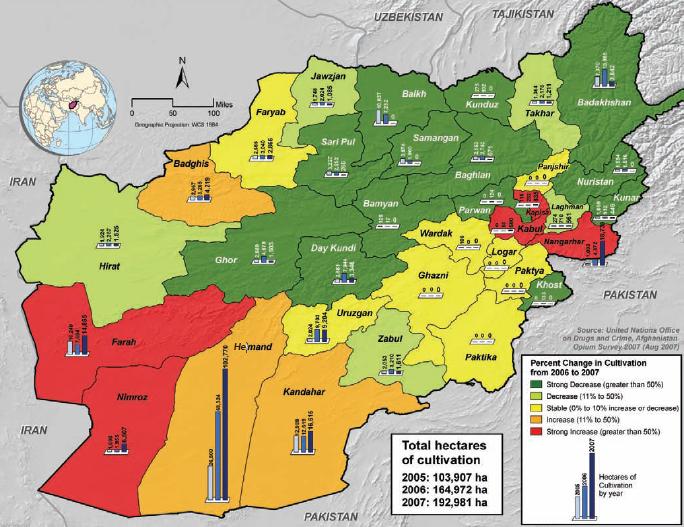
Afghanistan War Wealth + Corruption Cycle (Opium, Hashish, Minerals, Past Pipeline Attempts)

01 Agriculture, 01 Poverty, 03 Economy, 05 Energy, 07 Other Atrocities, 08 Wild Cards, 10 Security, Afghanistan, Corruption, Geospatial, Government, Military

Talk of wealth from minerals by US geologists and Pentagon personnel add to the darkening view that those involved in war, corruption and disregard for the people of Afghanistan (and sacrificed soldiers + more to be sacrificed) will prosper…

+ Opium = supplies 90% of crop source for heroin (president Karzai's brother links to heroin trade)

2005-2007 production (source: U.N.) Click to Enlarge

+ Hashish = April 2010 report: Afghanistan Hashish, (not only opium) Declared World’s Largest Producer

Income from cannabis per ha (gross/net) US$ 3,900 / US$ 3,341 | Income from opium per ha (gross/net) US$ 3,600 / US$ 2,005 | Income from wheat per ha (gross/net) US$ 1,200 / US$ 960

+ Minerals = US geologists, Pentagon, Indian firms claim 1-3 trillion dollar value of mineral wealth in Afghanistan
and “Afghanistan's resources could make it the richest mining region on earth” and more importantly, this being ‘known' in 2007. (direct: USGS link) and that the Soviets were aware of mineral wealth during their Afghanistan occupation.

+ Gas Pipeline attempts = 1998 Congressional record related to Unocal/U.S. interests in Central Asia & November 2001 Asia Times article about the book “Bin Laden, la verite interdite (Bin Laden, the forbidden truth)” mentioning the US government's main objective in Afghanistan was to consolidate the position of the Taliban regime to obtain access to the oil and gas reserves in Central Asia.

past pipeline planned

BBC in 2002 mentions Unocal (Unocal.com is now Chevron.com) and others abandoning pipeline plans due to U.S. missile attacks in 1999. Reports on Enron attempts to make a deal with the Taliban (this 2002 CounterPunch article too). Encyclopedia of Earth also has a short mention of this topic

+ HistoryCommons.org Unocal profile timeline on their Central Asia activities
+ HistoryCommons.org timeline of president Karzai (election organized by the United Nations).

+ Corruption in Afghanistan = Transparency International ranks Afghanistan 179th of 180 countries.  And Afghan corruption has doubled since 2007 (IntegrityWatch survey).
Pre-existing plan to attack Taliban before 9/11 was even posted in the BBC and a variation of this was posted at MSNBC in 2002.

“To be truthful about it, there was no way we could have got the public consent to have suddenly launched a campaign on Afghanistan but for what happened on September 11”
-Tony Blair (London Times, 7/17/02)
originally at http://www.timesonline.co.uk/article/0,,2-358038,00.html but no longer at that URL

Related:
+ Karzai Aide in Corruption Inquiry Is Tied to C.I.A. (Aug 26, 2010)
+ Corruption Suspected in Airlift of Billions in Cash From Kabul (WSJ: June 25, 2010)
+ Event Report: 20 Nov 09 NYC, Counterinsurgency–America’s Strategic Burden
+ (Book) Taliban: Militant Islam, Oil and Fundamentalism in Central Asia by Ahmed RashidMar. 1, 2001
+ Afghan War Diaries Explorer
+ UN/World Bank Afghanistan Drug Industry Report (2006)
+ SourceWatch: Opium economy in Afghanistan
+ GlobalSecurity.org: Afghanistan Opium cultivation
+ Wkipedia: Trans-Afghanistan Pipeline
+ Free Book: “The Politics of Heroin in Southeast Asia by Alfred W. McCoy

The Mexico + American Narcosphere (Calling Carlos “Slim” Helu)

01 Poverty, 02 Diplomacy, 03 Economy, 04 Education, 06 Family, 07 Health, 07 Other Atrocities, 08 Immigration, 09 Justice, 09 Terrorism, 10 Security, 10 Transnational Crime, 11 Society, Audio, Civil Society, Commerce, Corruption, Government, Law Enforcement, Media, Military, Mobile, Research resources, Videos/Movies/Documentaries

Excellent May 31, 2010 New Yorker article by William Finnegan called Letter from Mexico, Silver or Lead which is unfortunately only available by subscription only (click here for link to abstract also pasted below) The most telling two words of the article = “state capture.”

ABSTRACT: LETTER FROM MEXICO about La Familia Michoacana and the pervasive power of drug traffickers in the country. Writer visits the hill town of Zitácuaro in the Mexican state of Michoacán. On the morning before his arrival, the dismembered body of a young man was left in the middle of the main intersection. It was an instance of what people call corpse messaging. Usually it involves a mutilated body and a handwritten sign. “Talked too much.” “You get what you deserve.” The corpse’s message—terror—was clear enough and everybody knew who left it: La Familia Michoacana, a crime syndicate whose depredations pervade the life of the region.

Mexico’s president, Felipe Calerón declared war—his metaphor—on the country’s drug traffickers when he took office, in December, 2006. It was a popular move. Although large-scale trafficking had been around for decades, the violence associated with the drug trade had begun to spiral out of control. More than twenty-three thousand people have died since Calderón’s declaration. La Inseguridad, as Mexicans call it, has become engulfing, with drugs sliding far down the list of public concerns, below kidnapping, extortion, torture, unemployment, and simple fear of leaving the house. The big crime syndicates still earn billions from drugs, but they have also diversified profitably. In Michoacán a recent estimate found eight-five per cent of legitimate businesses involved in some way with La Familia. Among Mexico’s drug trafficking organizations, La Familia is the big new kid on the block. It first gained national attention in September, 2006, when five severed heads rolled onto the dance floor at a night club in Uruapan, Michoacán. A senior American official in Mexico City told the writer, “La Familia is looking more and more like an insurgency and less like a cartel.” Mentions one of La Familia’s leaders, Nazario Moreno González, who is also known as El Chayo, or El Más Loco (the Craziest). Writer discusses La Familia’s activities with a local politician and relates how the cartel has, in some places, filled the vacuum created by public distrust of the police and the courts.

The overwhelming growth of organized crime in Mexico in the past decade is often blamed on multiparty democracy. Until 2000, the country was basically a one-party state for seventy-one years under the Institutional Revolutionary Party (PRI). Drug trafficking flourished, but its practitioners enjoyed stable relations with officialdom. Describes how the election of Vicente Fox in 2000 changed the status quo between drug traffickers and government. Writer gives a survey of other significant Mexican drug cartels, including the Sinaloa cartel, and the Zetas, who had previously occupied Michoacán. Tells about the rise of La Familia in 2006 and its expansion into nearby states. Discusses U.S.-Mexico relations and the drug trade. Writer visits a drug-rehabilitation center in Zamora. Describes acts of kidnapping and extortion perpetrated by La Familia.

Links Connecting Police Corruption + Narcosphere + U.S. + North Mexico/Chihuahua/Juarez & Beyond: Continue reading “The Mexico + American Narcosphere (Calling Carlos “Slim” Helu)”

noble gold