Why Criminal Hackers Must Not Be Rewarded Part 1: The Fruit of the Poisoned Tree
By M. E. Kabay, 11/30/2009
In 1995, I participated in a debate with distinguished security expert Robert D. Steele, a vigorous proponent of open-source intelligence. We discussed the advisability of hiring criminal hackers. Perhaps readers will find the polemic I published back then of interest today. I’m sure it will provoke vitriolic comments from the criminal hacker community.
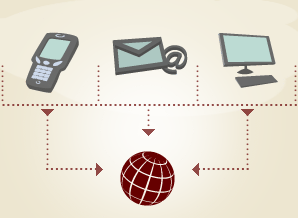
The Ushahidi Engine is a platform that allows anyone to gather distributed data via SMS, email or web and visualize it on a map or timeline. Our goal is to create the simplest way of aggregating information from the public for use in crisis response.
Usahndi Visual Concept
This is a huge development, one that could lead to a more rapid creation of the World Brain with embedded EarthGame as a means of connecting all human minds with all information in all languages all the time.
See our briefing given in Denmark to think about how this might apply to the global harmonization of gifts from the one billion rich to needs of the five billion poor at the household and item level.
NIGHTWATCH Special Report: October in Afghanistan 27 November 2009
Taliban and other anti-government fighters have begun to go to winter quarters, in Pakistan or in Afghanistan. The fighting will drop somewhat during the winter, but in the core provinces of the Pashtun south, weather is not a factor.
Based on Taliban public statements, their attacks will remain focused on disruption of the overland truck lifeline for Afghan and NATO forces, mainly by using improvised bombs. In the face of renewed NATO resolve, the Taliban also will wait for the next opportunity to attempt to take power.
Taliban cannot defeat NATO forces, but NATO forces cannot defeat Taliban, especially without combat air support. The government in Kabul cannot survive without NATO forces, but by this time next year the Afghan forces will need more logistics and air support rather than combat soldiers, if the US and European NATO trainers are competent.
The future of Open Source Intelligence (OSINT) is Multinational, Multifunctional, Multidisciplinary, Multidomain Information-Sharing & Sense-Making (M4IS2).
The following, subject to the approval of Executive and Congressional leadership, are suggested hueristics (rules of thumb):
Rule 1: All Open Source Information (OSIF) goes directly to the high side (multinational top secret) the instant it is received at any level by any civilian or military element responsive to global OSINT grid. This includes all of the contextual agency and mission specific information from the civilian elements previously stove-piped or disgarded, not only within the US, but ultimately within all 90+ participating nations.
Rule 2: In return for Rule 1, the US IC agrees that the Department of State (and within DoD, Civil Affairs) is the proponent outside the wire, and the sharing of all OSIF originating outside the US IC is at the discretion of State/Civil Affairs without secret world caveat or constraint. OSIF collected by US IC elements is NOT included in this warrant.
Dr.Dave Warner, a medical neuroscientist, has an MD/PhD from Loma Linda University, is the director of the Institute for Interventional Informatics and has gained international recognition for pioneering new methods of physiologically based human-computer interaction. The rest of us know him as one of the leaders of STRONG ANGEL, as the pioneer of the one-ounce laptop TOOZL, and more recently, as the lead definer of of Whole of Government and Multinational Multifunctional Information Sharing & Synergy Capabilites.
TG Daily Andrew Thomas Wednesday, 25 November 2009
The US Congress could start an investigation into leaked emails which suggest climate change statistics have been consistently manipulated to make the case for anthropogenic global warming more credible.
The emails leaked from the Climatic Research Unit at the University of East Anglia in the UK – which claims to be the repository for the most comprehensive set of climate data on the planet – contain what many observers see as clear evidence that scientists have been altering that data to fit in with their man-made global warming beliefs.
Nov 13th 2009
From The World in 2010 print edition
By John Parker
Conflicts over natural resources will grow
In the world’s earliest written legal code, dating from 1790BC, Hammurabi, the king of Babylon, laid down rules governing the maintenance of irrigation systems and the amount of water people could take from them. Two generations later, his grandson abandoned this rules-based approach and used the river Tigris as a weapon against rebels in Babylon.
The world is charting a similar course, away from rules governing scarce resources towards conflict over them.