Patrick Meier: Crisis Mapping Climate Change, Conflict, Aid in Africa

Advanced Cyber/IO, Blog Wisdom, Civil Society, Earth Intelligence, Geospatial, Peace Intelligence
Patrick Meier

Crisis Mapping Climate Change, Conflict and Aid in Africa

I recently gave a guest lecture at the University of Texas, Austin, and finally had the opportunity to catch up with my colleague Josh Busby who has been working on a promising crisis mapping project as part of the university’s Climate Change and African Political Stability Program (CCAPS).

Josh and team just released the pilot version of its dynamic mapping tool, which aims to provide the most comprehensive view yet of climate change and security in Africa. The platform, developed in partnership with AidData, enables users to “visualize data on climate change vulnerability, conflict, and aid, and to analyze how these issues intersect in Africa.” The tool is powered by ESRI technology and allows researchers as well as policymakers to “select and layer any combination of CCAPS data onto one map to assess how myriad climate change impacts and responses intersect. For example, mapping conflict data over climate vulnera-bility data can assess how local conflict patterns could exacerbate climate-induced insecurity in a region. It also shows how conflict dynamics are changing over time and space.”

The platform provides hyper-local data on climate change and aid-funded interventions, which can provide important insights on how development assistance might (or might not) be reducing vulnerability. For example, aid projects funded by 27 donors in Malawi (i.e., aid flows) can be layered on top of the climate change vulnerability data to “discern whether adaptation aid is effectively targeting the regions where climate change poses the most significant risk to the sustainable development and political stability of a country.”

If this weren’t impressive enough, I was positively amazed when I learned from Josh and team that the conflict data they’re using, the Armed Conflict Location Event Data (ACLED), will be updated on a weekly basis as part of this project, which is absolutely stunning. Back in the day, ACLED was specifically coding historical data. A few years ago they closed the gap by updating some conflict data on a yearly basis. Now the temporal lag will just be one week. Note that the mapping tool already draws on the Social Conflict in Africa Database (SCAD).

This project is an important contribution to the field of crisis mapping and I look forward to following CCAPS’s progress closely over the next few months. I’m hoping that Josh will present this project at the 2012 International Crisis Mappers Conference (ICCM 2012) later this year.

Phi Beta Iota:  Now imagine a global database on corruption that is updated daily and then hourly, anonymously sourced as needed, calling out corrupt officials by name, date, time, and place.


Mini-Me: Bin Laden Road Show Begins Part I – David Ignatius on the CIA’s “Captured” Abbottabad Files

07 Other Atrocities, Corruption, Director of National Intelligence et al (IC), Government, IO Deeds of War, Media
Who? Mini-Me?

Huh?  We do not make this stuff up.  CIA's Covert Action Staff is evidently having a ball, and David Ignatius has no problem playing the bimbo.  Note the built-in pre-excuse on poor syntax.  Note the pretense that incoherence was connected to long periods of time between sending, receiving, and responding.  The hit on Fox is some kid [or geriatric annuitant]'s idiot idea of being clever — when Bin Laden was alive, he knew full well there is no substantive difference between CNN, NBC, ABC, CBS, and Fox [or the two political parties in the US that exclude everyone else from access to the public treasure].

All of this is beyond belief for anyone with BOTH intelligence and integrity.  When all of the documents are released (after the November elections, of course), they will be torn apart.

The bin Laden plot to kill President Obama

David Ignatius

The Washington Post, 16 March 2012

Before his death, Osama bin Ladenboldly commanded his network to organize special cells in Afghanistan and Pakistan to attack the aircraft of President Obama and Gen. David H. Petraeus.

“The reason for concentrating on them,” the al-Qaeda leader explained to his top lieutenant, “is that Obama is the head of infidelity and killing him automatically will make [Vice President] Biden take over the presidency. . . . Biden is totally unprepared for that post, which will lead the U.S. into a crisis. As for Petraeus, he is the man of the hour . . . and killing him would alter the war’s path” in Afghanistan.

Continue reading “Mini-Me: Bin Laden Road Show Begins Part I – David Ignatius on the CIA's “Captured” Abbottabad Files”

Chuck Spinney: Investigating NATO’s War Crimes Against Libya

02 China, 04 Inter-State Conflict, 05 Civil War, 06 Russia, 07 Other Atrocities, 08 Wild Cards, 09 Justice, 10 Security, 11 Society, DoD, Government, Law Enforcement, Military, Non-Governmental, Officers Call, Peace Intelligence
Chuck Spinney

Investigations Around Libya

NATO’S Craven Coverup of Its Libyan Bombing

by VIJAY PRASHAD, Counterpunch, March 15, 2012

Ten days into the uprising in Benghazi, Libya, the United Nations’ Human Rights Council established the International Commission of Inquiry on Libya. The purpose of the Commission was to “investigate all alleged violations of international human rights law in Libya.” The broad agenda was to establish the facts of the violations and crimes and to take such actions as to hold the identified perpetrators accountable. On June 15, the Commission presented its first report to the Council. This report was provisional, since the conflict was still ongoing and access to the country was minimal. The June report was no more conclusive than the work of the human rights non-governmental organizations (such as Amnesty International and Human Rights Watch). In some instances, the work of investigators for these NGOs (such as Donatella Rovera of Amnesty) was of higher quality than that of the Commission.

Due to the uncompleted war and then the unsettled security state in the country in its aftermath, the Commission did not return to the field till October 2011, and did not begin any real investigation before December 2011. On March 2, 2012, the Commission finally produced a two hundred-page document that was presented to the Human Rights Council in Geneva. Little fanfare greeted this report’s publication, and the HRC’s deliberation on it was equally restrained.

Nonetheless, the report is fairly revelatory, making two important points:

Continue reading “Chuck Spinney: Investigating NATO's War Crimes Against Libya”

NATO CIMIC: The Roles of India & Pakistan in Afghanistan’s Development & Natural Resources

NATO Civ-Mil Ctr
Click on Image to Enlarge

PDF (7 Pages):  20120316 NATO CIMIC Role_of_India_Pakistan_in_Afghanistan_Development

March 2012

This report addresses the roles of India and Pakistan on the economic development of Afghanistan based on the material provided in open sources.

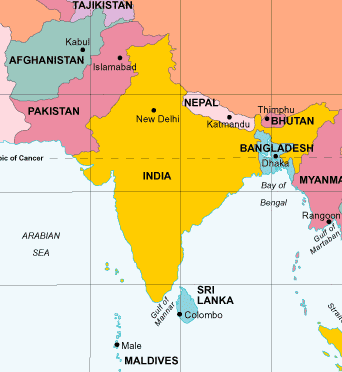
The involvements of Pakistan and India in Afghanistan are often related to each other. Given that the research and materials concerning these two countries’ involvement in Afghanistan heavily overlapped, the Civil-Military Fusion Centre (CFC) determined to address these two topics in one consolidated report.  It may be useful to preface the specific discussion of Indian and Pakistani contributions with a discussion of these countries broader strategies towards Afghanistan. For instance, an article noted by South Asia scholar Christine Fair in Foreign Policy indicates India hopes to contribute to peace and stability in Afghanistan and the emergence of an Afghan government which is on friendly terms with India. Similarly, a report from the Jinnah Institute and the United States Institute of Peace (USIP) indicates that Pakistan wishes to have friendly relations with Afghanistan and to ensure that events in Afghanistan do not contribute to instability in Pakistan. Such factors and many others, as demonstrated in the following sections, have led these two countries to make significant contributions to reconstruction, development and natural resource exploitation in Afghanistan.

NATO CIMIC: The Role of China in Afghanistan’s Economic Development & Reconstruction

NATO Civ-Mil Ctr
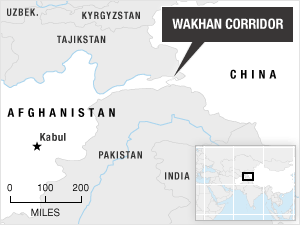
Wakhan Corridor (AF) Touches China

PDF (8 Pages):  20120316 NATO CIMIC Role_of_China_in_Afghanistan_Economy_Development

March 2012

This report examines the contribution of the People’s Republic of China to reconstruction and development in Afghanistan, with a particular emphasis on mining and natural resource exploitation.

On 05 December 2011, at the Second International Bonn Conference on Afghanistan, China’s Minister of Foreign Affairs declared the following: “The Chinese people cherish friendly sentiments toward the Afghan people and sincerely hope that peace, stability, independence and development will come to Afghanistan at an early date. We will work with the international community and make our due contribution to the achievement of this goal.” Such comments reflect China’s engagement with Afghanistan’s development, which has, since March 2010, taken place in the scope of the China-Afghanistan comprehensive cooperative partnership agreement, according to Eurasia Review. The topic of Chinese involvement in Afghanistan is taken up in this report, which primarily focuses upon China’s contribution to development and natural resource exploitation in Afghanistan. This review of Chinese engagement is divided into the following sections: (i) aid and development financing, (ii) bilateral trade and (ii) investment in natural resources. It builds upon previous CFC work concerning this issue, including a May 2010 report on “Chinese Involvement in Afghan Development”.

Michel Bauwens: Occupy as a Business Model

03 Economy, Blog Wisdom
Michel Bauwens
Aljazeera – Fri, 09 Mar 2012 21:24 GST
Chiang Mai, Thailand – Last week I discussed the value crisis of contemporary capitalism: the broken feedback loop between the productive publics who create exponentially increasing use value, and those who capture this value through social media – but do not return these income streams to the value “produsers”..
In other words, the current so-called “knowledge economy” is a sham and a pipe dream – because abundant goods do not fare well in a market economy. For the sake of the world's workers, who live in an increasingly precariousness situation, is there a way out of this conundrum? Can we restore the broken feedback loop?.Strangely enough, the answer may be found in the recent political movement that is Occupy, because along with ” peer producing their political commons “, they also exemplified new business and value practices. These practices were, in fact, remarkably similar to the institutional ecology that is already practiced in producing free software and open hardware communities. This is not a coincidence..

NIGHTWATCH: SWIFT Banking Attack on Iran

05 Iran, Blog Wisdom

Iran – European Union – Society for Worldwide Interbank Financial Telecommunication (Swift): Swift, the communications provider for secure financial transactions for more than 10,000 financial institutions and corporations around the world announced it will disconnect Iran's banks from the system.

On its home page, SWIFT published the following news item:

Continue reading “NIGHTWATCH: SWIFT Banking Attack on Iran”

noble gold