Almost 30 years ago, a British diplomat asked me to lunch in Beirut.
Despite rumours to the contrary, she told me on the phone, she was not a spy but a mere attaché, wanting only to chat about the future of Lebanon. These were kidnapping days in the Lebanese capital, when to be seen with the wrong luncheon companion could finish in a basement in south Beirut. I trusted this woman. I was wrong. She arrived with two armed British bodyguards who sat at the next table. Within minutes of sitting down at a fish restaurant in the cliff-top Raouche district, she started plying me with questions about Hezbollah's armaments in southern Lebanon. I stood up and walked out. Hezbollah had two men at another neighbouring table. They called on me next morning. No problem, they said, they saw me walk out. But watch out.
. . . . . .ABSOLUTELY WORTH A FULL READ. . . . . .
More and more, WikiLeaks is exposing the hopeless nature of US foreign policy and that of its supposed “allies”. Attack on the international community indeed!
Phi Beta Iota: The US Government continues to be chaotic in part because its civilian leaders simply do not know what they do not know. They have the best of intentions, but have been promoted into a new world far removed from the world imprinted on them in their formative years. There are four ways to address global engagement needs:
1. With government employees performing inherently governmental functions. PROBLEM: The US Government has become hollow, with most of the experienced personnel scheduled for retirement in 2012 (if they don’t retire we lose what is left of the middle), and the bulk of the population, e.g. at CIA, having less than six years experience and being phenomenally ignorant of the real world. An inter-agency cadre for D&D does not exist.
2. With contractors hired to government specifications on a cost plus basis. This is what killed the Pentagon–decades of engineering responsive to military specifications on a cost plus basis, with no accountability anywhere. As we have seen in Iraq and elsewhere, individual instances aside, contractors are generally too expensive, very under-qualified, and often a major political risk hazard. They also loot our qualified manpower–in both intelligence and special forces, we have lost too many good people to bad jobs with too much money.
3. Multinational government task forces in which we plan, program, and budget for using the US military as a “core force” to provide intelligence, operations (mobility, logistics), and communications, and we default to unclassified information-sharing and sense-making. This allows culturally and linguistically qualified individuals to work at the highest levels of performance for the lowest per capita cost.
4. Multinational hybrid task forces in which we plan, program, and budget for using the US military as the “core force” to provide intelligence, operations (mobility, logistics), and communications, and we default to unclassified information-sharing and sense-making. This increases by a factor of SEVEN the number of culturally and linguistically qualified individuals to work at the highest performance levels for the lowest per capita cost with the greatest possible flexibility in covering all needs–the “eight tribes” (academia, civil society, commercial, government–all levels, law enforcement, media, military, non-governmental) become a “whole” force, using shared information and shared mostly unclassified decision support (intelligence) to achieve both a common view of the battlefield, and to most efficiently connect micro-needs in the AOR with micro-gifts from an infinite range of givers.
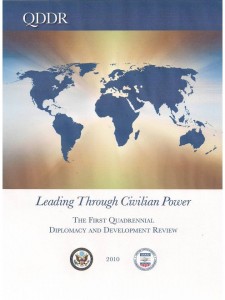
The Quadrennial Diplomacy and Development Review is at least 20 years too late. It means well. It is both delusional and incomplete. Delusional because no one part of government can become effective until the Office of Management and Budget (OmB) learns to manage again, and incomplete because State simple does not “get” bona fide multinational operations or recognize the “eight tribes.” There is a small seed crystal here, one that could flourish if the Department of Defense (DoD)–or any significant element of DoD such as the US Army–were to “flip the tortilla” and recognize that the greatest contribution DoD can make in the next 20 years is to get a grip on reality, get a grip on open spectrum, open source intelligence, and open source software, and serve as the “center” for Whole of Government planning, programming, and budgeting, toward the end of creating a prosperous world at peace via low-cost low-risk multinational hybrid task forces that use information and intelligence as a substitute for wealth, violence, time, and space.
NOTE: On some systems links above appear to be underlining, they are actually links.
One hears again and again Afghans say that the Taliban may not be liked but that the US is distrusted, even hated
Patrick Cockburn – The Independent 18/12/10
During the mid-1960s, America's goal during a crucial stage in the Vietnam war was to defeat the enemy militarily. But it had no realistic political strategy to underpin the goal, and it was this which ultimately led to failure.
America's strategy in Afghanistan is now suffering from a similar weakness. Barack Obama made the edgy claim this week that the US army is stabilising the military situation, but neither he nor his national security advisers show any signs of understanding the speed at which, politically, the US is losing ground.
Again and again in Kabul one hears Afghans say that the Taliban may not be liked, but that the Afghan government and its US allies are increasingly distrusted, even hated, by the mass of the population.
Mexico said Thursday that more than 30,000 people have been killed in drug violence since President Felipe Calderon launched a crackdown against cartels in late 2006.
The government said the violent La Familia cartel in western Mexico has been “systematically weakened” by recent arrests and deaths of leading members of the gang.
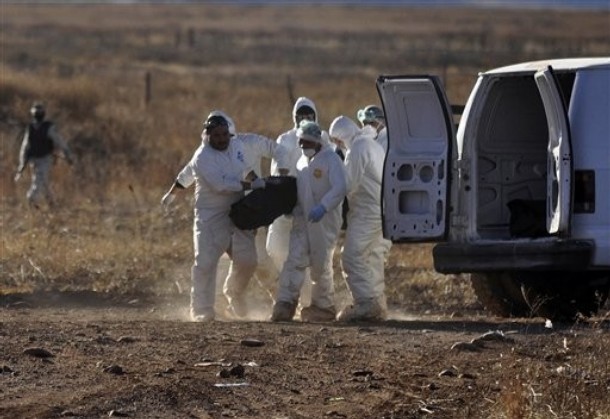
Forensic workers carry a body inside a body bag that was found at a clandestine grave in the town of Asencion, near the northern border city of Ciudad Juarez, Mexico, Saturday Dec. 11, 2010. At least 5 bodies have been found in three separate clandestine graves found in the site. (AP Photo/Raymundo Ruiz)
Phi Beta Iota: Both Mexico and the USA are “unintelligent” countries lacking in strategic analytics able to clearly demonstrate “cause and effect.” If they were “smart nations” as we have been advocating since 1995, marijuana would have been legalized long ago, corruption among local officials squelched, pay and training for the police substantially increased….and so on. Everything is connected. For example, the weapons do not really come from US handgun stores–they come from the Guatemalan military that sells entire shipments of “old” weapons provided to the US, and then tells the US the weapons were destroyed. The serial numbers on the captured weapons tell the truth. Until nations learn to think honestly and holistically, any single flaw can be fatal, and multiple flaws will interact in unanticipated and increasingly costly ways. In the USA, crime runs from the border to Wall Street, where drug money laundering has long been known to be a major source of liquidity. Politicians in both countries are paid to be anemic in their thinking and ineffective in their duty to the public. Under these circumstances, neither law enforcement nor the military can be effective. Integrity is the missing factor.
In a recent opinion piece, “Kosovo and the Myth of Liberal Intervention,” Neil Clark in the Guardian on 15 December gave the reader a good summary of the some of the myths surrounding the Kosovo war, although he helped to perpetuate one myth, namely that the so-called genocide of Kosovar Albanians by the Serbs could be as high as 10,000. While Clark fudged the issue by using a range of 2,000-10,000, the fact remains that examination of mass burial sites by the International Criminal Tribunal for the Former Yugoslavia (ICTY) exhumed 2,788 bodies in Kosovo, some of whom were undoubtably Serbs; nor could the ICTY distinguish how many of these bodies were victims of war crimes or were the unintended detritus of NATO's “precision” bombing. The number of 10,000 was a face-saving, last-ditch, “statistical” estimate produced by the US State Department (its earlier estimates were far higher), which had a vested interest in proving the genocide it claimed Serbia had committed as a justification for NATO's “humanitarian” bombing campaign. The estimate of 10,000 was based on dubious (to put it charitably) statistical methods for estimating the number of bodies the State Department said existed but could not find — once illustrating government's propensity to confuse the a priori with the a posteriori
The word ‘slavery' often conjures brutal images of a long since vanquished historic project, but its practice, more commonly and legally referred to as human trafficking, continues to thrive in every corner of the globe – making it the world's second largest criminal industry.
By Cassandra Clifford for ISN Insights
People are comparatively cheaper than they were in the 1600-1800s, when slaves were purchased for life. Now ownership tends to last only a few months to a few years, making slaves cheaper to purchase and more easily disposable. In 1850 the purchase price of a slave in the southern US averaged the equivalent of $40,000 today. According to Free the Slaves, a slave today costs an average of $90. People have become a disposable commodity, cheap and easy labor one can just toss out when no longer needed. Globalization and the post-World War II population boom have increased access to, and lowered the cost of, transportation, which has in turn contributed to the increased levels of global slavery. Victims are often driven into slavery by severe poverty or acute need for economic gain. Additionally, the ethnicity of today's slave is rarely important.