Event/Trip Report/Reference: 1200-1330 8 Apr Woodrow Wilson Center DC In Search of a National Security Narrative for the 21st Century

Advanced Cyber/IO, Analysis, Augmented Reality, Budgets & Funding, Collective Intelligence, Communities of Practice, Cultural Intelligence, Ethics, History, InfoOps (IO), Intelligence (government), International Aid, Key Players, Methods & Process, Officers Call, Open Government, Policies, Policy, Reform, Serious Games, Strategy, Threats
Click on Image to Enlarge

“The National Conversation” Debuts

The Woodrow Wilson International Center for Scholars has announced a new initiative launching April 8, 2011: The National Conversation at the Woodrow Wilson Center. The National Conversation will examine overarching themes of U.S. international and domestic policy, drawing on high-profile guests and experts from all sides of the political sphere to provide thoughtful, intelligent explorations of challenging issues with the goal of informing the national public policy debate.

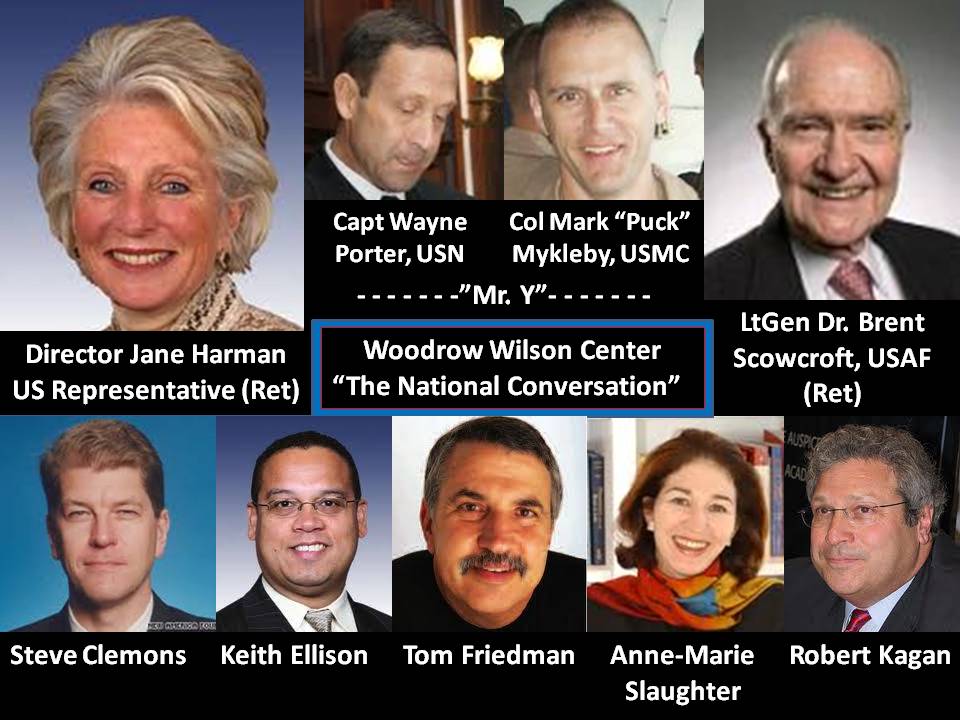
From uprisings in the Arab world to troubled economies around the globe, challenges to America’s role in the global community have seldom been greater or more complex. And with economic woes at home and our military capacity stretched thin through involvement in Afghanistan, Iraq, and Libya, many are left wondering about our ability to respond and adapt to a rapidly changing world. At a time when national unity around a shared vision is lacking, there is a growing belief that a new national security narrative must emerge that defines the role of the U.S. in global affairs for a new century. But can we achieve such a national consensus in this era of hyper-partisanship? A possible answer comes in the form of an anonymous “white paper.” Two US military officers have written an essay describing a vision for the missing narrative under the authorship of “Mr. Y.” Join our panel as it discusses the ideas contained in this provocative paper from an unexpected source. Is this the blueprint for the narrative we seek?

The inaugural National Conversation kicks off April 8 from 12:00 to 1:30 p.m., with a discussion on the search for a new national security narrative to guide U.S. policy in the 21st Century. Five panelists will participate in a discussion moderated by award-winning New York Times columnist and author Thomas Friedman. The panel will feature: Steve Clemons, founder of the American Strategy Program at the New America Foundation; Representative Keith Ellison (D-MN), the first Muslim American to be elected into the U.S. Congress; Robert Kagan, senior fellow for foreign policy at the Brookings Institution; Brent Scowcroft, U.S. national security adviser to President Ford and President H.W. Bush; and Professor Anne Marie Slaughter, former director for policy planning for the U.S. Department of State and current Bert G. Kerstetter '66 University Professor of Politics and International Affairs at Princeton University.

Event Home Page

Watch Video of the Event (Permanent URL)

Note:  Robert Steele invited comment starts at 01:15:12

Download “A National Strategic Narrative,” By Mr. Y (15 Page PDF)

Strategic Analytic Model from Earth Intelligence Network

Trip Report & Selected Links with Graphics Below the Line

Continue reading “Event/Trip Report/Reference: 1200-1330 8 Apr Woodrow Wilson Center DC In Search of a National Security Narrative for the 21st Century”

Reference: A National Strategic Narrative

Advanced Cyber/IO, Analysis, Augmented Reality, Collective Intelligence, Communities of Practice, Cultural Intelligence, Earth Intelligence, InfoOps (IO), Intelligence (government), Key Players, Methods & Process, Officers Call, Policies, Policy, Reform, Serious Games, Strategy, Threats, True Cost, White Papers
Click on Image to Enlarge

PDF (15 Pages)

See Also:

Integrity Emergent: Chairman of the Joint Chiefs

2011 Cyber-Command or IO 21 + IO Roots

Search: violent comprehensive revolutions are of

07 Other Atrocities, 08 Wild Cards, 11 Society, Advanced Cyber/IO, Civil Society, Counter-Oppression/Counter-Dictatorship Practices, Cultural Intelligence, Ethics

Here are the concise references focused on revolution.  For corruption, collective intelligence, open space and other methods of non-violent consensus building and emergence, see the lists at the end of this post.

Preconditions of Revolution in the USA Today

Search: four preconditions for revolution

Search: revolution theory preconditions

Here is the bottom line:

Continue reading “Search: violent comprehensive revolutions are of”

The Emergent Open Source Revolution

Advanced Cyber/IO, Analysis, Augmented Reality, Autonomous Internet, Collaboration Zones, Collective Intelligence, Communities of Practice, Counter-Oppression/Counter-Dictatorship Practices, Ethics, info-graphics/data-visualization, InfoOps (IO), Intelligence (government), Methods & Process, Mobile, Open Government, Policies, Real Time, Reform, Strategy, Technologies, Threats, Tools
Amazon Page

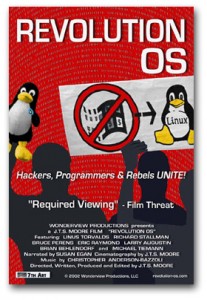
REVOLUTION OS tells the inside story of the hackers who rebelled against the proprietary software model and Microsoft to create GNU/Linux and the Open Source movement.

On June 1, 2001, Microsoft CEO Steve Ballmer said “Linux is a cancer that attaches itself in an intellectual property sense to everything it touches.”

Microsoft fears GNU/Linux, and rightly so. GNU/Linux and the Open Source & Free Software movements arguably represent the greatest threat to Microsoft's way of life. Shot in cinemascope on 35mm film in Silicon Valley, REVOLUTION OS tracks down the key movers and shakers behind Linux, and finds out how and why Linux became such a potent threat.

REVOLUTION OS features interviews with Linus Torvalds, Richard Stallman, Bruce Perens, Eric Raymond, Brian Behlendorf, Michael Tiemann, Larry Augustin, Frank Hecker, and Rob Malda. To view the trailer or the first eight minutes go to the ifilm website for REVOLUTION OS.

Two books below the line…

Continue reading “The Emergent Open Source Revolution”

40 Years of Doing Intelligence Analysis-Lessons

Analysis, Articles & Chapters, Intelligence (government), Methods & Process

Martin Petersen  Studies in Intelligence Vol 55 No 1

An advantage of getting older is increased perspective. I have been doing, thinking and writing about intelligence and intelligence analysis for almost 40 years now. The business we are in has changed a great deal in that time, but more in its form than in its fundamentals.  I want to focus on three broad topics: understanding the customer, the importance of a service mentality, and the six things I learned in doing and studying intelligence analysis during my career in the DI. While these experiences are drawn from work in the CIA, I believe the principles apply across the Intelligence Community (IC).

Understanding the Consumer: Five Fundamental Truths

The Importance of a Service Mentality

The Six Things I Learned

Read the complete article….

Phi Beta Iota: This is a pleasure to read, and useful.

See Also:

Jack Davis on Analysis (All Phi Beta Iota Posts)

New Rules for the New Craft of Intelligence

New Institutions as Bulwark Against the Corporate-Political State

Advanced Cyber/IO, Communities of Practice, Cultural Intelligence, Ethics, Methods & Process, Policies
Michael Ostrolenk Recommends...

New Institutions as the Bulwark Against the Corporate-Political State from Kevin Rollins on Vimeo.

Michael Ostrolenk and Kevin Rollins discuss the role of new media, both social media like facebook and twitter, as well as niche magazines. Ostrolenk says that such forums help new ideas because they “remove barriers to entry and support [new idea] generation.

Five minute video

Complex Societies Collapse When Commodity Prices Go UP and Financial Speculation Returns Go DOWN

Analysis, Communities of Practice, Corruption, Cultural Intelligence, InfoOps (IO), Intelligence (government), IO Sense-Making, Key Players, Policies, Power Behind-the-Scenes/Special Interests, Threats
John Robb

JOURNAL: Oil >$100 Crunch time ahead (again)?

The last time the price of oil topped $100 a barrel for an extended period, we ended up in a global financial meltdown.  Is this time any different?

Not much.

All of the excessively financial leverage and fraudelent derivative wealth we had during the last melt down is still in place.  Total debt to GDP levels in the US are about the same (370% of GDP or so).  No reforms were made on Wall Street.  Nobody at fault for the fraud that led to the last melt down went to jail, so behaviors haven't changed.

We're worse off than before.  Read rest of article…

This is classic Tainter (the excellent anthropoligist/historian).  He posited that complex societies only collapse when the costs of basic inputs increase at the same time the returns on investments in complex institutions/etc. turn negative. So, with oil going up again, we are seeing basic input costs rise.   It's also clear that our twin overheads Government and Global Finance are well past the point they delivered positive returns for additional complexity.  Worse, they are colluding, via cronyism, to prevent any meaningful changes.

See Also:

Review: The Collapse of Complex Societies

noble gold