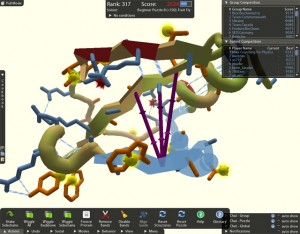
Today's issue of Nature contains a paper with a rather unusual author list. Read past the standard collection of academics, and the final author credited is… an online gaming community.
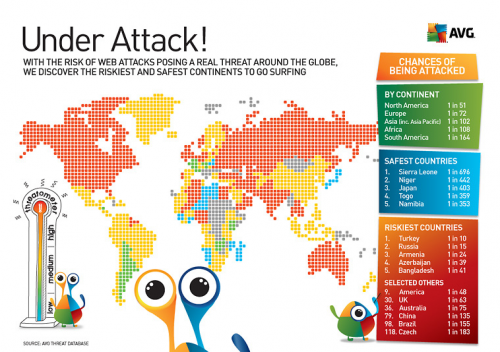
Here’s an interesting study by AVG on internet security, asking “Where in the World are you most likely to be hit by a malicious computer attack or virus?”.
Apparently, and surprisingly to me, the answer is “not Africa” or South America.
“During the last week of July, AVG researchers compiled a list of virus and malware attacks by country picked up by AVG security software. This means we have compiled data from over 127 million computers in 144 countries to determine the incidence rates of virus attacks by country.”
Dirk Singer, of AVG sent over the list of African countries, here they are country-by-country. As you can see, sub-saharan Africa is compatively ‘safe’ compared to other areas of the World. Your chances of being attacked while surfing the web in each country are:
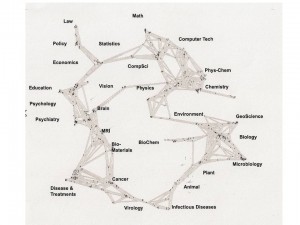
Phi Beta Iota: Most serious analysts now understand Citation Analytics 101. It's time to move to Citation Analytics 202, and there is no better way to introduce the art of the possible than by pointing to Kevin W. Boyack, Katy Borner, and Richard Klavans (2007), “Mapping the Structure and Evolution of Chemistry Research (11th International Conference of Scientometrics and Infometrics, pp. 112-123.
Full Article with Color GraphicsGraphic as Printable Single Page PPT
There are several take-aways from this article, which is more or less the “coming out” of the Klavens-inspired infometrics field now that he has won his law-suit and has unchallenged access to all Institute of Scientific Information (ISI) access [this was one of the sources we used to win the Burundi Exercise before the Aspin-Brown Commission in 1995].
While senior Pentagon officials resort to bluster in hopes of preventing the WikiLeaks website from posting any more secret Afghan war documents on the Internet, security experts say there is a lot the U.S. military could have done to prevent the classified documents from being leaked in the first place.
Steps range from the sophisticated — installing automated monitoring systems on classified networks — to the mundane — disabling CD burners and USB ports on network computers.
“The technology is available” to protect highly sensitive information, said Tom Conway, director of federal business development at computer security giant McAfee. “The Defense Department doesn’t have it, but it is commercially available. We’ve got some major commercial clients using it.”
Full Article Below the Line (Not Easily Available on Internet); Lengthy Comment Follows Article
(clipped from full article) Bangladeshi farmers have to go through numerous hardships. Natural calamities cannot be avoided. However, if the farmer knew when to expect one and thereby take appropriate preventive measures, maybe some of his crops could be saved. Besides natural calamities, he is always running the risk of crop infestations and rainfall that is either too low or too high, thereby producing poor yields. Due to poor education, many farmers may be following the practices of his fore-fathers blindly, without looking for better agricultural methods or practices.
Without proper information, a farmer whose crops have been infested by pests, for example, would think that this is the end and that his crops are only destined to die. This would mean a bad income that year, and no food for his family.
So what if this farmer was armed with easy access to the correct information at the correct time? This could lighten his load by ridding him of numerous uncertainties during his agricultural process and thereby raise his family's living standards. A better living standard for the farmers would mean a more developed Bangladesh.
BIID , with support from UNDP, has teamed up with Grameenphone by setting up Community Information Centres all over the country. In the pilot phase, 10 Centres had been opened in various locations, but the aim is to scale this up to more than 1000 locations in the country.
The Japanese company Blest has developed one of the smallest and safest PLASTIC-to-OIL conversion machines out on the market today. It's founder and CEO, Akinori Ito is passionate about using this machine to change the way people around the world think about their plastic trash. From solving our landfill and garbage disposal issues to reducing our oil dependancy on the Middle East, his machine may one day be in every household across Japan.
While holding up a bag of trash, he states, “It's a waste to throw away, isn't it? This is a treasure.”
Comment: a comment from a YouTube viewer asking the energy-use of this machine is highly relevant, especially for poorer regions and it would have been better to have included much more info in the video. However, it's interesting to think that those in the trash recycling business may have received a new economic prospect.