
From 2003, making the rounds now among the earnest.
Product Description
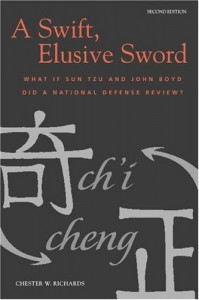
A study of national security and military strategy by Col. Chester Richards (USAF Ret.), suggests that ancient strategic wisdom may help solve the dilemma confronting the U.S. military: spending on defense exceeds that of any combination of potential adversaries, but the services still face cancellation of weapon systems and lack of funds for training, spares, and care and feeding of the troops. Richards suggests U.S. military leaders can break out of the “dollars equals defense” mindset, and create more effective forces. The second edition contains a new forward written in response to the effects that the September 11, 2001 terrorist attacks against the United States have engendered in the U.S. military.
Free Online
From the Inside Flap
The author would like to thank General Charles Krulak, U.S.M.C. (Ret.), former Commandant of the Marine Corps, General Pat Garvey, NYNM, Charles A. Leader, Franklin C. Spinney, Major Don Vandergriff, U.S.A., Colonel Michael Wyly, U.S.M.C. (Ret.), and Major Chris Yunker, U.S.M.C. (Ret.) for their invaluable contributions and input. The views in the final product are those of the author.

Paying interest on reserves was intended to prevent “inflation,” but it is having the opposite effect, contracting the money and credit that are the lifeblood of a functioning economy. The whole economic model is wrong. The fear of price inflation has prevented governments from using their sovereign power to create money and credit to serve the needs of their national economies. Instead, they must cater to the interests of a private banking industry that profits from its monopoly power over those essential economic tools.
Whether by accident or design, federal policymakers still have not got it right.
I recall that Viet-Nam era secret writing was blown by an Admiral in his memoirs, causing all future terrorists and secret police to photocopy incoming and outgoing mail. This appears to be publicity we could have done without.
‘The capability of doing mass tracking is possible.’
EXTRACT
Around the world, TruePosition markets something it calls “location intelligence,” or LOCINT, to intelligence and law enforcement agencies. As a homeland security tool, it’s enticing. Imagine an “invisible barrier around sensitive sites like critical infrastructure,” such as oil refineries or power plants, TruePosition’s director of marketing, Brian Varano, tells Danger Room. The barrier contains a list of known phones belonging to people who work there, allowing them to pass freely through the covered radius. “If any phone enters that is not on the authorized list, [authorities] are immediately notified.”
Ohio, Pennsylvania and Florida Lead List of “Toxic 20” States with Most Toxic Air Pollution from Power Plants
Worst States: OH, PA, FL, KY, MD, IN, MI, WV, GA, NC, SC, AL, TX, VA, TN, MO, IL, WI, NH, IA
WASHINGTON (July 20, 2011) — Residents of Ohio, Pennsylvania and Florida live in states with the most toxic air pollution from coal- and oil-fired power plants, according to an analysis by the Natural Resources Defense Council.
The study used publicly-available data in the Environmental Protection Agency’s Toxics Release Inventory (TRI). The analysis, entitled “Toxic Power: How Power Plants Contaminate Our Air and States” was jointly released today by NRDC and Physicians for Social Responsibility (PSR).
Among the key findings:
Nearly half of all the toxic air pollution reported from industrial sources in the United States comes from coal- and oil-fired power plants.
Power plants are the single largest industrial source of toxic air pollution in 28 states and the District of Columbia.
Koko Observes (in American Sign Language): The above is an excellent example of isolated concern that is going nowhere–never mind the blatant corruption of Congress. If it were combined with a 360 degree toxicity survey showing food poisoning, toxic chemicals in everyday materials, and so on, this would be a great deal more useful. If all of that were integrated into a true cost global game (or in this case, national game), there would be a compellingly useful basis for public outrage one district at a time.
I like your story line, if only because you reach a conclusion that closely parallels one of my own. Coming off a very different base, I found myself convinced that we are at the cusp of a transformative moment, caught between a control oriented, rationalistic awareness (consciousness) of ourselves and our world, verging into an interactive, self organizing consciousness. And “cusps” are always painful and disorienting, which would seem to be an accurate, albeit mild, characterization of our times.
— extract from the end advanced here—
The real issue was that The Millennium Organization was not a “new program” – it was a profound paradigm shift. And if Thomas Kuhn has taught us anything it is that paradigm shifts are counterintuitive, painful and always the last thing that anybody in their right mind would care to do. Even worse shifting paradigms is not something you can think or reason yourself into. You can’t plan it, design it, program it, manage it, nor control it. The journey forward follows a very different route. I believe there are any number of useful approaches – but none of them come from the Old Proactive Toolbox. I think.
In a Linux Weekly News story, currently only available to subscribers, an analysis of Linux 3.0 contributors reveals that Microsoft was the fifth largest corporate contributer to Linux 3.0. While only 15h overall, that still puts Microsoft behind only Red Hat, Intel, Novell, and IBM in contributing new code to this version of Linux.
To be exact, Microsoft developer K. Y Srinivasan gets the credit for helping to improve Linux. Of course, as you might guess, neither Srinivasan nor Microsoft are doing this due to any particular love tor Linux per se.
The vast bulk of Microsoft’s contributions has been to its own Hyper-V virtualization hypervisor drivers. Hyper-V is Microsoft’s 64-bit hypervisor-based virtualization system. It’s Microsoft’s answer to VMware and Linux’s own native Kernel-based Virtualization Manager (KVM).
Phi Beta Iota: This is interesting–and disappointing. Microsoft could be doing so much more. OpenBTS, Open Data Access, Open Spectrum, and Open Source Intelligence (now M4IS2) are rapidly approaching take-off points that will see them join Free/Open Source Software and Open Hardware. Microsoft could be central to all of this, but it evidently chooses not to. It recent waste of Sir Richard Branson in delivering platitudes to their huge event is a real let-down.