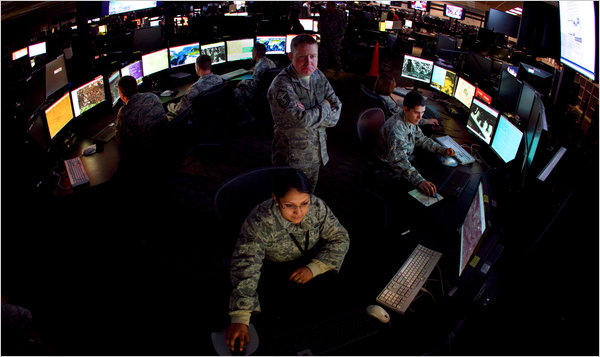
Interesting, but also fails to mention we do not train our analysts on the
basics, know your enemy……we are so focused on technology we forget
that the basics are still the best way to view the situation…..
When military investigators looked into an attack by American helicopters
last February that left 23 Afghan civilians dead, they found that the
operator of a Predator drone had failed to pass along crucial information
about the makeup of a gathering crowd of villagers.
When military investigators looked into an attack by American helicopters last February that left 23 Afghan civilians dead, they found that the operator of a Predator drone had failed to pass along crucial information about the makeup of a gathering crowd of villagers.
Click on Image to Enlarge
But Air Force and Army officials now say there was also an underlying cause for that mistake: information overload.
A check in your wallet does you very little good. It represents opportunity, sure, but not action.
Most of us are carrying around a check, an opportunity to make an impact, to do the work we're capapble of, to ship the art that would make a difference.
No, the world isn't fair, and most people don't get all the chances they deserve. There are barriers due to income, to race, to social standing and to education, and they are inexcusable and must fall. But the check remains, now more than ever. The opportunity to step up and to fail (and then to fail again, and to fail again) and to continue failing until we succeed is greater now than it has ever been.
As Martin Luther King Junior spoke about a half a lifetime ago,
“We are now faced with the fact, my friends, that tomorrow is today. We are confronted with the fierce urgency of now. In this unfolding conundrum of life and history, there is such a thing as being too late. Procrastination is still the thief of time. Life often leaves us standing bare, naked, and dejected with a lost opportunity. The tide in the affairs of men does not remain at flood — it ebbs. We may cry out desperately for time to pause in her passage, but time is adamant to every plea and rushes on. Over the bleached bones and jumbled residues of numerous civilizations are written the pathetic words, “Too late.”
It's a good think Ike is dead… else he would realize his nightmare survived. Chuck
Newsday January 13, 2011 Pg. 34
The Military-Industrial-Congressional Complex
Eisenhower warned against the influence of arms production, but did we listen?
By Bob Keeler
EXTRACT: Now, the deficit has caused some unexpected voices to say, ever so softly, that everything is on the table – including defense cuts. Last week, Gates talked about plans to slow the defense budget's growth by $78 billion over five years. That dainty nibble is a start, but we need big bites. A group called the Sustainable Defense Task Force has laid out ways to cut $1 trillion in 10 years. That's better.
The Obama administration's $78 billion cut to US defense spending is a mere “pin-prick” to a behemoth military-industrial complex that must drastically shrink for the good of the republic, a former Reagan administration budget director recently told Raw Story.
. . . . . . .
The ‘Ponzi scheme' of ‘artificial prosperity'
Stockman, who described himself as a libertarian during a recent interview with Reason.tv, told Raw Story that the economy got into this mess because of the public and private sectors' addiction to “guns and butter Keynesianism,” an economic policy that amounts to a Ponzi scheme that has ballooned since 1990.
“If we see what's going on carefully, we've reached the final unmasking of the Keynesian illusion, that Keynesianism is really nothing but borrowing, stealing from the future to induce consumption today,” he said. “There are no multipliers. Every one of these programs we've had from ‘cash for clunkers' to housing purchase credits have disappeared as soon as they expired and simple shifted activities in time by a few months.”
Stockman explained that before 1980, it took about $1.50 of new borrowing — public or private — to generate $1 of GDP growth. By the mid-1990s, it was $2.50 or $3 of borrowing for a $1 of GDP growth. By 2007, before the big collapse and meltdown finally came, $7 of public and private debt was added to the national balance sheet in order to get $1 of GDP growth.
“When you get to the point of $7 of borrowing to get $1 of income, you're obviously on an unsustainable path and pretty close to hitting the wall, which more or less we have,” he said.
Phi Beta Iota: Drawing down the military-industrial complex will immediately produce two highly undesireable masses of unrest: pissed off unemployed veterans who own a gun and know how to use it; and pissed off pasty-faced short fat bald white guys with no marketable skills who either own a gun or know where to buy one. We agree that the military budget needs to be cut by $200 billion or more–however, it must be done strategically, with clear-cut plan for both assuring every veteran of a job, with priority to amputees, and for redirecting our energies into homeland development before we spent another dollar on foreign development. We've blown it for nearly three-quarters of a century. This is now about strategic design–do it, or lose what's left of the Republic.
Among the first security issues of the year is the release of information about China’s military capabilities and the recent release of the U.S. defense budget request, which is not coincidental . Each year, when key decisions are made about the coming annual DOD budget, we see media reports about China’s new potential and physical military ambitions and weapons programs. They arise from statements by U.S. military commanders, anonymous Pentagon sources and conservative think tank pundits. The intent is to create a “boogeyman,” to depict the Chinese as nine feet tall and America as a “Lilliputian.”
I remember this same bizarre scenario took place during the Cold War. At that time, I had a bit of responsibility from time to time looking at these issues and especially the bureaucratic warfare between the military establishment and the intelligence community analysts who had to provide assessments about how far the Soviets were ahead of America and who in reality were behind us. The interagency fights were often fierce with billions of dollars at stake along with real command over new resources, programs and especially planes and ships – whether needed or not. There was the prospect of a nice rich job in the defense industry if your program won out.
Today, the kabuki is not much different but the reality of today’s security challenges is dramatically different in substantive ways.
China- US: CJCS Admiral Mullen said today that China's high-tech military capabilities, including the radar-evading stealth J-20 fighter, focus on America.
China has every right to develop military capabilities, Mullen said, adding that he cannot understand why many appear to target the United States despite North Korea's being an evolving threat to the region and to the United States. If Pyongyang obtains long-range nuclear missile capabilities, its provocations may become more catastrophic, Mullen stated, adding that China must pressure North Korean leadership to cease development of intercontinental ballistic missiles and expansion of nuclear weapons capability.
Comment: It is difficult to accept at face value that Admiral Mullen does not understand the Chinese obsession with the threat from the United States.
Taking the statement at face value – and not as an act of political manipulation – it implies that the J2 and J5 staffs have failed to brief him about the origins of Chinese national defense strategy since the death of Deng Xiao Ping. If the Chairman's statement is genuine and not posturing, it is astonishing.
This is something I posted in the “state of the world” conversation with Bruce Sterling on the WELL…
I give talks on the history and future of media, and on the history, evolution, and history of the Internet. I gave the talk this week to a small group gathered for lunch in a coworking space here in Austin, and after hearing the talk a technologist I know, Gray Abbott, suggested that I say more about the coming balkanization of the network as the most likely scenario. The Internet is a network of networks that depends on cooperative peering agreements – I carry your traffic and you carry mine. The high speed Internet is increasingly dependent on the networks of big providers, the telcos or cable companies like AT&T, Sprint, Verizon, Time Warner, and Comcast. They all see the substantial value supported by their networks and want to extract more of it for themselves. They talk about the high cost of bandwidth as a rationale for charging more for services – or metering services – but I think the real issue is value. When you see Google and Facebook and Netflix making bundles of money using your pipes, you want a cut. And if you’ve also tried to get into the business of providing content, it’s bothersome to see your network carrying other competing content services, including guerilla media distribution via BitTorrent.