Review: Chasing the Flame–Sergio Vieira de Mello and the Fight to Save the World

4 Star, Asymmetric, Cyber, Hacking, Odd War, Atrocities & Genocide, Civil Society, Diplomacy, Disaster Relief, Insurgency & Revolution, Peace, Poverty, & Middle Class, United Nations & NGOs

Chasing FlamePrimary Research Well Done, Lacks Synthesis

Samantha Power

Book loses one star–perhaps unfairly–for not integrating secondary sources and using the *combination* of this extraordinary biography and the Brahimi Report and other core documents, to illuminate why the UN desperately needs a United Nations Open-Source Decision-Support Information Network (UNODIN).

+ Sergio Vieira de Mello (henceforth SVM) spent forty-years as a UN gad-fly, and his resume of tens of short assignments interspersed with a handful of 2-3 year assignments is a testimony to all that is wrong–not with him, but rather–with UN recruitment, training, continuity of operations, and lack of decision support.

+ The book opens with the observation that Paul Bremer (the ultimate US dilettante who set us back five to ten years while losing tens of billions of dollars) refused most of SVM's suggestions, especially on setting timelines (the same ideas General Garner adopted before he was fired by Dick Cheney and replaced with Bremer). We are told his last words were “Oh shit” and I somehow doubt that.

+ Vague mandates were a constant problem (see Peacekeeping Intelligence: Emerging Concepts for the Future for a full discussion of why the Brahimi Report still needs to be implemented, so the mandate can be informed, the force configured based on ground truth, etc.)

+ UN got into “governing” for the first time in Kosovo, and was completely ill-equipped for the task.

+ SVM reflected with the author that the world was too big to ignore but too complex to manage quickly or cheaply. Later in the book he is cited as recognizing that the UN is so dysfunctional that governments work around it (while foundations beg for effective focal points for their giving totaling $500B a year), but that governments are not prone to support long term interests in eradicating the ten high level threats as lain out in A More Secure World: Our Shared Responsibility–Report of the Secretary-General's High-level Panel on Threats, Challenges and Change

+ SVM was an impressive scholar. He finished first out of 198 at the Sorbonne in Philosophy. He did a Masters in moral philosophy (a tautological redundancy I would have thought) and then a doctoral in two levels, one in 1974 and one in 1985. It was here that he understood that governments are not adept at preventing crises nor as rebuilding failed societies.

– First level doctorate: “The Role of Philosophy in Contemporary History,” with key line “Not only has history ceased to feed philosophy, but philosophy no longer feeds history.”

– Second “Etat” doctorate: “Civitas Maxima; Origins, Foundations, and Philosophical and Practical Significance of the Supranational Concept.” Those wishing to learn more about the failure of the nation-state and the mistakes of Westphalia can begin with The Health of Nations: Society and Law beyond the State with Web of Deceit: The History of Western Complicity in Iraq, from Churchill to Kennedy to George W. Bush as the aperitif, and Betrayal of Trust: The Collapse of Global Public Health as the strong finish.

+ He composed his speeches on hotel note pads, observing that if he could not fit his argument to a hotel pad, he probably did not know what he was trying to say.

+ At this point I have a note, overall a very good use of biography to offer a “sense” of the UN, but lacking in synthesis, recommendations, or secondary sources.

+ Early in the book and throughout, one senses that Lebanon is the UN's modern birthplace, and where it has been permanently hospitalized if not euthanized.

+ SVM is quoted as saying that constructive change required “a synthesis of utopia and realism.” I urge the reader to visit Earth Intelligence Network to see this being implemented.

+ Pages 87-89 provide a marvelous condemnation of satellite surveillance as a panacea. SPOT Image which does ten meter or 1:50,000 multispectral imagery, identified land “suitable for resettlement.” Actual ground inspection failed the satellite findings, which did not see the land mines or the malarial mosquitoes.

+ SVM valued local staff, actively cultivated their inputs regardless of rank or function, and he is described as having a keen eye for symbolism.

+ We learn from this book that UN “teams” are assembled in an ad hoc fashion reflecting the whims and past good relations of the ubber boss, and I for one recognized what chaos and discontinuity this represents for all elements of the UN System.

+ We learn that when the UN arrives the cost of everything skyrockets, not least because UN employees get $140 a day, which in the specific instance of Cambodia or Kosovo, I forget, was the average ANNUAL income for any given person. I point to William Shawcross's unforgettable Deliver Us from Evil: Peacekeepers, Warlords and a World of Endless Conflict. Read my review of that book to see the relevance.

+ SVM proves clever in one instance, suggesting that smugglers not only be hired to get around a blockage against blankets, but that they be given dignity in the form of a UN consultant certificate. From many such accounts the author excels at painting a portrait of a complex and very intelligence UN official.

+ It is at this point that I check the index to discover that neither the word “information” nor the word “intelligence” nor the compound word “decision-support” appear.

+ The author cites SVM as saying that he was fed up with American bullying–I can certainly understand that–and that the hardest part of peacekeeping was internal peacekeeping (within the UN's dysfunctional family).

+ It is here I note: “At every turn: ‘We don't know; ‘We don't have the information; ‘We are too few to certify….'”

+ Then I see the golden nugget, on page 219, in his words: “We are so remarkably ill-informed. We go into a place, we have no intelligence, we don't understand the politics, and we can't identify the points of leverage. See the PKI book cited above, and also the forthcoming book, PEACE INTELLIGENCE: Assuring a Good Life for All, with a Foreword by MajGen Patrick Cammaert, who with this book and a decade of effort, got many at the UN to understand that Brahimi had it exactly right: intelligence is decision support using legal ethical open sources, and it has nothing to do with espionage. The raw book is at OSS.Net/Peace, just add the www. at the beginning.

+ The book continues with many vignettes where the UN elements are uninformed, therefore they do poor planning (lousy mandates, crummy force structures, no tactical combat charts for landing zones, etc) and hence they are often over-whelmed.

+ SVM saw a need for and proposed that the UN address the constant law enforcement gap by maintaining a roster of pre-trained and available multinational police, judges, lawyers, and prosecutors. See Policing the New World Disorder: Peace Operations and Public Security, my review includes notice of the fact that most UN “police,” e.g. those from Nigeria, can neither read nor drive.

+ We learn that SVM was acutely aware of how the UN's reputation for competence plummeted in the 1990's and how he learned in East Timor was that Legitimacy was Performance Based. As a side note, when East Timor went down I led one of 40 different efforts to answer the same three questions: 1) where are the bodies; 2) where can we land; and 3) who is is coming when, and what are they bringing. That was when I realized the need for a Multinational Decision-Support Center. On legitimacy, see The Search for Security: A U.S. Grand Strategy for the Twenty-First Century

+ The book comes to a close with several useful notes.

– Law and order gap a constant recurring theme.

– SVR saw Iraq as a peer nation meriting respect rather than patronizing from the US

– Excellent discussion of the days leading up to the attack on the UN headquarters; to the dismissal by the US of all UN requests for information or security, and the realization, too late after the attack on the Jordanian embassy, that the UN HQ was a “soft target.”

– KUDOS to LtCol John Curran, whose foresight and rehearsal to include identification of all relevant helicopter med-evac landing zones, ensured that no one died for lack of very rapid medical evacuation. I certainly hope the UN put him for a Legion of Merit, at the very least.

The Epilogue is bland.

+ UN is a broken system.

+ SVM said “the future is to be invented.”

+ Legitimacy matters

+ Spoilers must be engaged

+ Fearful people must be made more secure

+ Dignity is cornerstone of order

+ Outsiders must bring humility and patience.

Two other books (see also my many lists):
High Noon 20 Global Problems, 20 Years to Solve Them
Plan B 3.0: Mobilizing to Save Civilization, Third Edition
Review: Declaring Independence–The Beginning of the End of the Two-Party System

4 Star, Electoral Reform USA

Declaring IndependenceBest Available Primer for Third Party, March 9, 2008

Douglas Schoen

Edit of 1 July 2008 to change transpartisan to non-partisan, add flyleaf notes from second reading, and delete observations found wanting by Amazon visitors.

This is without question a very important book, a companion to both Spoiling for a Fight: Third-Party Politics in America and Running On Empty: How The Democratic and Republican Parties Are Bankrupting Our Future and What Americans Can Do About It. After a second reading, I now see this book as a primer in a class of its own and understand the author's background with greater appreciation.

One important comment: Both candidates are “keep the `bi-partisan' spoils system” alive candidates. They are of, by, and for the elites, and they are both out of touch with global reality such as depicted in A More Secure World: Our Shared Responsibility–Report of the Secretary-General's High-level Panel on Threats, Challenges and Change. Barack Obama is a Manchurian candidate, a Trilateral Commission “House Negro” (as his own pastors of color have put it); see Obama – The Postmodern Coup: Making of a Manchurian Candidate for details.

Following my fly-leaf notes are a few observations, cut in half from my earlier review.

+ 75% of American voters are dissatisfied with the way things are going and generally do not trust either the political parties or the federal government–misery is at an all time high as is distrust
+ Voters “crave” real solutions
+ The time is right for a third party ticket, and the NYC race of Mayor Bloomberg in 2005 is the model
+ 3 out of 5 voters dislike BOTH parties
+ 61% feel they are not living the American dream
+ Being “on message” does not cut it–interaction and authentic tough focus on issues is demanded
+ Non-partisan solutions, with common sense, addressing tough problems, are demanded
+ Democracy in a crisis because the system itself lacks credibility (both political and federal)
+ Governor Schwarzenegger is on the right track
+ Half of all registered voters thing a 3rd party is a good idea
+ Restless & Anxious Moderates (RAM) are the swing vote
+ Fiscla discipline with a balanced budget, and being in touch with voter values, essential
+ Top two reasons people are Independents are both ANTI-PARTY: vote issues and candidate, not party
+ Parties are polarized, people are not
+ Need new fresh blood, open minds
+ 3rd parties are *not* odd man out, have a rich history
+ Ballot access is critical, needs 800,000 signatures
+ If not already done for the following states by today (1 July 2008), they are off the books: Colorado, Massachusetts, Oregon, Maine, Pennsylovania, Delaware (because of registration deadlines)
+ Internet blogging, YouTube, and texting (as well as ads to cell phones) have changed the dynamic
+ Democratic dirty tricks against Nader detailed (I am personally aghast–like Rove on McCain)
+ Nonpartisan Citizens Union could be a group to watch (see also Reuniting America)
+ Citing David Colarusso to Newsweek: “Web 2.0 has the potential to actually compel candidates to be genuine (page 141)
+ Independent must craft authentic grassroots citizen-based movement, field candidates for governor
+ Colin Powell is strongest candidate (author may not know Mrs. Powell has demanded, and received, a promise never to run), followed by Mike Bloomberg (I favor Powell back as Secretary of State, with his integrity this time)
+ Win or lose, a solid Independent candidacy will be able to influence the debate as well as the election (in the Electoral College, or in the House of Representatives) and lead a body of opinion thereafter.

FACT: Dick Cheney hijacked the White House and no one is willing to hold him accountable. BOTH the Democratic floormats and the Republican foot soldiers should be run out of office. I have no wish to impeach Dick Cheney. He simply needs to be removed from office and never again allowed to betray the public trust.

Sidenote:
REFS:
Vice: Dick Cheney and the Hijacking of the American Presidency
The One Percent Doctrine: Deep Inside America's Pursuit of Its Enemies Since 9/11

FACT: Congress abdicated its Article 1 responsibilities, a sin for which Al Gore especially culpable in failing to support the McKinney House resolution to re-do Florida. Every one of these folks merits an independent challenge.

REFS:
The Broken Branch: How Congress Is Failing America and How to Get It Back on Track (Institutions of American Democracy)
Breach of Trust: How Washington Turns Outsiders into Insiders
…and…
Society's Breakthrough!: Releasing Essential Wisdom and Virtue in All the People
The Tao of Democracy: Using Co-Intelligence to Create a World That Works for All

In my view, Mike Bloomberg is the only truly credible independent, see my review of his own book, Bloomberg by Bloomberg. If I had one minute with Mike Bloomberg, this is what I would say:

1) Win or lose, you can *be* the catalyst for creating an “open books” alternative government at all levels

2) $20 each from 25 million Americans buys our government back, make it a subscription and we can migrate the new system to the rest of the world

3) A nonpartisan coalition sunshine cabinet, each person leading thousands of citizen wisdom councils focused on each Cabinet's respective areas of concern, will change the debate and inform America overnight

4) A balanced budget online, where everyone can debate and then see aggregated differences by zip code and party affiliation (anonymous otherwise) will enable strong leadership.

That's it. All we need is a really rich guy willing to stake the new system (Perot did not), be authentic, and LISTEN.Declaring Independence

Review: Biocapital–The Constitution of Postgenomic Life

5 Star, Capitalism (Good & Bad), Change & Innovation, Country/Regional, Economics, Environment (Solutions), Nature, Diet, Memetics, Design, Survival & Sustainment, Values, Ethics, Sustainable Evolution

Amazon Page

Kaushik Sunder Rajan

5 of 5 stars.  Treasure Trove that Ends with USA-India Axis of Good

March 9, 2008

I've been struggling with this book, published in 2006, for months. Today I realized I could combine my notes with a handful of key index entries to create a more useful synthesis. I end with ten other books I have reviewed that augment this one.

My first impression of the book was soured by the absence of any mention of green chemistry, ecological economics, or ecology of commerce. I've known about citation analysis clusters since 1970, but I grow increasingly frustrated by the fragmentation of knowledge and the constantly growing barriers between schools of thought within political-legal, socio-economic, ideo-cultural, techno-demographic, and natural-geographic.

An important early distinction is between industrial-cost for profit capitalism and commercial speculative capitalism. Toward the end of the book I finally encountered the author's emphasis on national priorities, and I for one condemn all seeds that do not reproduce naturally. In agriculture, economy, energy, health, my bottom line is that anything that retards the eradication of hunger, poverty, sustainment, or individual and social health gains, is inherent against the laws of God and man.

Early notes include:

+ Information science plays huge role in genomics. I am reminded of the convergence in the 1990's among cognitive and information science, nano-technology, bio-technology, and earth science. I have a later note, “life sciences becoming information sciences.”

+ Although E. O. Wilson is not cited, the author is on a clear convergence in taking about how valuation is a vital aspect of getting it right. I think of India as IT rich and farm poor–they are allowing the aquifers to drop a meter a year because farmers can sell a tanker-full of water for $4, which is insane, and 2,000 farmers a year commit suicide in the face of drought and debt. Valuation is a critical national function.

+ This work falls within a new category of reading that I have been increasingly impressed by, “ethnographic,” or the study of localities and particularities to map global system that is not generic, homogenized, or blurred..

+ As the author does not cite Paul Hawken or Herman Daly, I draw the distinction between the author's focus on “natural capitalism” as of the privatization of biocapital and the patenting of gnomes, and the purer definition, of natural capitalism as one that understands the true costs over the lifetime of the materials being used including water (4000 liters of water Bangladesh cannot afford to export in a designer cotton shirt), and that makes the case for going green to create gold.

+ The author views biocapital as a combination of circuits of land, labor, and value; and biopolitics.

+ Life sciences are being “overdetermined” by speculative capitalism. I agree, and apart from India's symbiotic relationship with the US, I would like to see India develop a special relationship with Cuba and with the global academic community to take patents away from speculators and carpet bagging profiteers with no morality.

+ Technoscience changing laws (I am reminded that Google is now a suprnational entity that no government understands or regulates, something similar is happening in technoscience where Recombinant DNA technology is undermining the future of life.

+ Political economy is an epistemology.

+ Life, labor, & language–biology, political economy, philology central to the knowledge of and management of humanity.

+ VERY IMPORTANT: Game requires playing in FUTURE in order to stimulate and guide present. Visit Earth Intelligence Network to read about Medard Gabel's EarthGame that for $2M a year can offer this up across the ten threats, twelve policies, and eight challengers, with embedded budgets of all organizations (governments, corporations, international and non-governmental, and charitable foundations).

+ Market valuation buries ethics, defines “allowable” ethics. Author touches, and I really respect this, on the moral value of information. Later on in the book the author cites Michael Fischer on “ethical plateaus.”

+ The author addresses the “social lives” of biological materials and biological information (note: I violently oppose Google's biomedical information initiative–we may as well become their zombies). In this vein, “ownership” of any of the bio-information constrains seamless sharing, enhancement, and I would add privacy. [Easy answer: CISCO AON on individual recyclable server-routers so individuals control all the information–medical, financial, etc. at their point of creation.] If CISCO will not do this, then India needs to.

+ Useful detailed discussion of conflicts & costs of privatized information versus information as a public good. The author makes case for blurring of lines and avoidance of either/or binary approach. I've already solved this: information in the aggregate should be public, while individual instances are private. Simple example: average spare parts costs can be derived from the aggregate while protecting the individual prices paid by any one of the contributors. AON, not Google, is the key.

+ The author emphasizes that the genome data demands robust detailed medical history to be valued. He contrasts India bio-ethics versus US. Sidenote: computational ethics are just as crucial.

+ I like, very much, the India public sector laboratories. I firmly believe that all health and education should be free, a public good similar to public safety.

+ Biocapital is complicated by context, distance, culture, financial, and technical variances among the competing parties.

+ I credit the author with this but I may have drawn it out: if we now see the value of collective intelligence, why are we having so much trouble seeing the value of collective intellectual property (the Creative Commons not-with-standing)?

+ Biopolitics centers of life (citing Foucault), accounting for and taking care of the population at large are central.

+ Political ecologies at all levels, gifting versus indebtedness, unions as a factor. UNIONS as a major factor. Vision fundamental. Direct links among ideology, capital, and locality.

+ Excluded populations (e.g. HIV not eligible…) can cause them to be consumed populations.

This is a deep complicated book hard for the lay reader (which I am), so to do it justice, I am resorting for the first time to a short list of key terms from the index that more represent the content:

belief systems
bioethical issues
biopolitics
biotechnology industry
capitalism, biocapital as new phase
diseases and illnesses
drug development marketplace
economic issues, multiple forms of currency
ethnographic research
genomics bioethics and industry
global market terrains
hype, capitalism
information ownership
intellectual property
life sciences
market value and non-market value
patient-in-waiting
populations, classification of
production issues
promissory biocapitalist futures
public domain issues
research issues
social issues
speed issues
temporality issues
therapeutic development
value access to
vision, commercial value

This is a pretty spectacular book, and someone did a great job across the board in presenting it.

Other books I would recommend:
Ecological Economics: Principles And Applications
The Ecology of Commerce
The Future of Life
Plan B 3.0: Mobilizing to Save Civilization, Third Edition
The leadership of civilization building: Administrative and civilization theory, symbolic dialogue, and citizen skills for the 21st century
How to Change the World: Social Entrepreneurs and the Power of New Ideas, Updated Edition
The Wealth of Networks: How Social Production Transforms Markets and Freedom
Society's Breakthrough!: Releasing Essential Wisdom and Virtue in All the People
Collective Intelligence: Creating a Prosperous World at Peace

Vote and/or Comment on Review

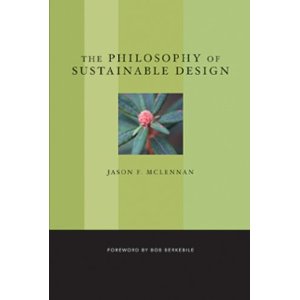
Review: The Philosophy of Sustainable Design

5 Star, Change & Innovation, Complexity & Catastrophe, Consciousness & Social IQ, Decision-Making & Decision-Support, Nature, Diet, Memetics, Design, Strategy, Survival & Sustainment, Values, Ethics, Sustainable Evolution

Amazon Page

Can Be Considered “Ref A” or the Prime Directive, March 9, 2008

Jason F. McLennan

I came late to bioneering, after I was inspired by Herman Daly's Ecological Economics: Principles And Applications, Brian Czech's Shoveling Fuel for a Runaway Train: Errant Economists, Shameful Spenders, and a Plan to Stop them All; and everything by Paul Hawkin, but especially The Ecology of Commerce.

I have had an interest in the intersection of global science, sustainable political and social and economic orders, and the vulnerability of the nation-state in the face of growing complexity for some time, and many of my other reviews focus on these literatures, as well as the literatures of collective intelligence, global assemlages, wealth of networks, localized resilience, and so on.

I make mention of that broader literature to add emphasis to my view that this book is one of the most extraordinary I have ever encountered. I made a mistake when I first got it months ago and put it sight unseen into my “hard and dense, save for intercontinental trip.” This book is not hard, not dense, and it is both easy to read and intellectually elegant. I can easily see this book as the single mandatory first year or summer pre-reading at any level–undergraduate or graduate–along with contextual books such as:
High Noon 20 Global Problems, 20 Years to Solve Them
Plan B 3.0: Mobilizing to Save Civilization, Third Edition

The Future of Life
The leadership of civilization building: Administrative and civilization theory, symbolic dialogue, and citizen skills for the 21st century and
Collective Intelligence: Creating a Prosperous World at Peace

The sixteen chapters and five appendices are elegant–concise, clear key points, short, just the right mix of photos (including color in a center spread) figures, and text.

The publisher has been criminally remiss in failing to load the varied items that Amazon allows, such as the table of contents. I am increasingly disenchanted with publishers and of the view that Amazon should get into the book publishing business, sending digital copies to FedExKinko's, helping authors self publish (full disclosure: BOTH Fred Smith at FedEx and Jeff Bezos at Amazon blew me off–these guys are simply not serious about innovation).

Preface: Philosophical Beginnings
Chapter 1: The Philosophy of Sustainable Design
Chapter 2: The Evolution of Sustainable Design
Chapter 3: The Principles of Sustainable Design (Biomimicry)
Chapter 4: The Principles of Sustainable Design (Human Vitality)
Chapter 5: The Principles of Sustainable Design (Ecosystem/Bioregional)
Chapter 6: The Principles of Sustainable Design (Seven Generations)
Chapter 7: The Principles of Sustainable Design (Energy/True Cost)
Chapter 8: The Principles of Sustainable Design (Holistic Thinking)
Chapter 9: The Technologies and Components of Sustainable Design
Chapter 10: Shades of Green–Levels of Sustainability
Chapter 11: Productivity and Well-Being
Chapter 12: Greening Your Organization
Chapter 13: Green Economics
Chapter 14: The Sustainable Design Process–Holistic Thinking
Chapter 15: The Aesthetics of Sustainable Design
Chapter 16: The Future of Architecture
Appendix A: The Green Warrior Reading List
Appendix B: Who's Who in Green Design
Appendix C: The Phases of Green Design
Appendix D: The Elements of Green Design Methodology
Appendix F: The Principles of Sustainable Design–Summary

I put this book down with several thoughts:

1) Enormously impressed with the University of Oregon in Eugene, to the point of trying to get my oldest to take his computer and creative skills there.

2) Profoundly delighted with the deep philosophical underpinning that one finds throughout the book, without pretense or pomposity.

3) The one appendix I would have liked to see that is not there is the one entitles: Green to Gold–Bottom-Line Dollar Savings Over Time, and then a whole range of the elements of sustainable design by climate zone.

This is an extremely satisfying book to read. My last throught: it's time to write the Operating Manual for Spaceship Earth. Read more about this at Earth Intelligence Network. This book by Jason McLennan is a perfect model for what the larger systems book should strive to be.

See also the literatures under panarchy, resilience, sustainability.

Vote and/or Comment on Review

Review: Resilience and the Behavior of Large-Scale Systems

5 Star, Complexity & Resilience

ResilienceSuperb, Dated, Needs Reissuance, March 8, 2008

Lance H. Gunderson

I would normally take away one star for failing to recognize Herman Daly's contribution to Ecological Economics and Paul Hawkin's contributions to the ecology of commerce (and most especially “true cost” as an essential metric) but realizing that I came late to this book (it was published in 2002), and respecting the extraordinary value herein, I left it at five stars.

The book should be reprinted after a proper literature search (I grow tired of citation cabals, these folks–20 contributors–need to get out more) and a simple capstone Executive Summary added for the busy policy-maker. The Literature Cited should be consolidated into a single annotated and much expanded syntopical bibliography.

Most importantly, the book was inspired by the Beijer International Institution for Ecological Economics realizing that resilience is the key unifying concept for both ecological and social systems; and that there was a need for demonstrated concepts of ecological resilikence including an understanding of alternative stable states and disturbances.

The book is fully satisfactory and my take-away is that all of the contributors, overseen by the likes of Lester Brown, Medard Gabel, Herman Daly, and Paul Hawkin, are part of the solution and must be fully integrated in the creation of the EarthGame that will one day deliver real-time science and near-real-time stable state options.

It is very well-organized, and the authors are all uniformly competent at presenting the obligatory case studies from which they draw their conclusions.

Theory, metaphors, models, stability disturbances, resilience, are all discussed at length. Stessors are multiplicative not additive. [A better summation is found in Charle's Perrows Normal Accidents: Living with High-Risk Technologies, to wit:

+ Simple systems have single points of failure easy to diagnose and correct

+ Complex systems have multiple points of failure that interact in unpredictable ways and are very hard to fix

+ We have created constellation of complex systems interacting in ways we simply do NOT understand, and therefore we are subject to cataclymic unanticipated break-downs almost impossible to fix.

The book ends with an excellent summary, of value in and of itself, with these key points discussed:

+ Pathology of constancy versus visibility of variability.

+ Diversity & stability versus diversity & resilience

+ Short versus long term sustainability

+ Vulnerability increased as sources of novelty are edliminated and cross-scale functional replication is reduces.

Last two key thoughts:

+ We can increase novelty (I added the word in my own mind, “artificially”

+ Resilience occurs at multiple scales.

This book is recommended for use in undergraduate and graduate instruction, and if the original sponsor cared to fund an update, I have some specific suggestions that would make a new book much more valuable to connecting true costs, real-time science, and digital gaming as well as digically orchestrated independent action (imagine a range of gifts table online, specific down to the district level, with needs from $10 to $100 million, that all foundations, corporations, non-governmental organizations, and individuals (80% of the giving) could use to “opt-in” and turn micro-boxes of need “green.”)

I have over 70 lists including one focused on environmental degradation (high level threat to humanity) so I will end with links to just ten books, but there are many many more.

See also:
A More Secure World: Our Shared Responsibility–Report of the Secretary-General's High-level Panel on Threats, Challenges and Change
The Battle for the Soul of Capitalism
Ecological Economics: Principles And Applications
The Ecology of Commerce
The True Cost of Low Prices: The Violence of Globalization
The Three Trillion Dollar War: The True Cost of the Iraq Conflict
The Blue Death: Disease, Disaster, and the Water We Drink
Pandora's Poison: Chlorine, Health, and a New Environmental Strategy
Blue Frontier : Saving America's Living Seas

See also books I have written, edited, or published. They are also free online but the Amazon versions are much more exciting to engage.

Review: Panarchy–Understanding Transformations in Human and Natural Systems

4 Star, Change & Innovation, Complexity & Resilience, Democracy, Stabilization & Reconstruction, Survival & Sustainment, Values, Ethics, Sustainable Evolution

PanarchyMixed Feelings–Mix of Brilliance and Gobbly-Gook, March 8, 2008

Lance H. Gunderson

On balance, Resilience and the Behavior of Large-Scale Systems (Scientific Committee on Problems of the Environment (SCOPE) Series) is the better book but this one is the thicker heavier more math-laden pretender–the problem is they have their own citation cabal, and while the bibliography is much broader and deeper than the above recommended book, there are too many gaps and an excessive reliance on obscure formulas that I have learned over time tend to be smoke for “I don't really know but if I did, this is the formula.

Also published in 2002, also with 20 contributors, this book lost me on the math. As someone who watched political science self-destruct in the 1970's when “comparative statistics” replaced field work, foreign language competency, and actual historical and cultural understanding, and a real-world intelligence professional, I'd listen to these folks, but I would never, ever let them actually manage the totality.

The book is the outcome of a three year effort, the Resilience Network as they called themselves, and there are some definite gems in this book, but it is a rough beginning. Among other things, it tries to model simplicity instead of complexity, and continue to miss the important of true cost transparency as the product and service end-user point of sale level, and real-time science that cannot be manipulated by any one country or organization (Exxon did NOT make $40 billion in profit this year–that is a fraction of the externalized costs, roughly $12 against the future for every $3 paid at the pump–that level of public intelligence in the public interest in missing from this book).

Page 7, “Observation: In every example of crisis and regional development we have studied, both the natural system and the economic components can be explained by a small set of variables and critical processes.” This rang all of my alarm bells. If I did not have total respect for what the authors and funders are trying to do, that sentence alone would have put this book firmly into my idiocy pile.

I just do not see in this book the kind of understanding of the ten high-level threats to humanity interaction with one another, such as can be seen free online or bought via Amazon, A More Secure World: Our Shared Responsibility–Report of the Secretary-General's High-level Panel on Threats, Challenges and Change, nor do these distinguished practitioners of their own little “club” see the strategic coherence of identifying ten core policies from Agriculture to Water that must be harmonized at every budget level, nor the irrelevance of anything we do unless we can persuade the ten demographic challengers with an EarthGame online that delivers real-time science and near-real-time cost-benefit analysis.

I find several of the authors to be a bit too cavalier in their dismissal of the contributions of economists, ecologists, and others.

Theories of change and next cycles are useful. Concepts of cascading change and collapsing panarchies are good. Log number of people in Figure 4.1 is very good.

In discussing adaptive response to change these learned scholars appear to have no clue of what is possible in delivering neighborhood level granularity of data for online social deliberation and models for gaming. There are early light references to deliberative democracy, but right now these folks have models in search of data in search of players. I did like the discussion of the larger model for levels of discourse, but WikiCalc and EarthGame are a decade ahead of this book's contents (which I hasten to add, was started in 1998 and published in 2002).

Table 11-1 on page 310 was so useful I list its row descriptors here, Factors and Adaptation and Possible Effect on Resilience (the latter not replicated here.

Factors:
Biota
Diversity-spacial
Diversity-production strategies
Energy sources
External resources
Mental models
Population structure
Savings
Scale
Technology

This is no where near the 10-12-8 model at Earth Intelligence Network, but I see real value here, and the need for a cross-fertilization. The fatal flaw in this book is that they confuse the failure of expertise with the failure of democracy–if we can achieve electoral reform and eliminate the corruption inherent in most governments, and certainly that of the US government which is broken and “running on empty” while every incumbent sells their constituents out to their party or special interests, it would be possible to connect data, change detection, alternative scenario depiction, and deliberative democracy at the zip code level.

Gilberto Gallopin, Planning for Resilience, is alone worth the price of the book, in combination with above and the closing summary, which is also a real value. My final note: too much gobbly-gook (to which I would add, “and no clue how intelligence-policy-budget connections are made and broken.

The key to eradicating the ten high level threats to humanity, among which environmental degradation is number three after poverty and infectious disease, is not better science–it is better democracy, participatory democracy, combined with moral capitalism. Below are a few titles to help make this point.

These 20 contributors are all part of a future solution, but they cannot be allowed to drive the bus.

See also (apart from my many lists):
Running On Empty: How The Democratic and Republican Parties Are Bankrupting Our Future and What Americans Can Do About It
Breach of Trust: How Washington Turns Outsiders into Insiders
Vice: Dick Cheney and the Hijacking of the American Presidency
The Battle for the Soul of Capitalism
Green to Gold: How Smart Companies Use Environmental Strategy to Innovate, Create Value, and Build Competitive Advantage
The Philosophy of Sustainable Design
The New Craft of Intelligence: Personal, Public, & Political–Citizen's Action Handbook for Fighting Terrorism, Genocide, Disease, Toxic Bombs, & Corruption
Collective Intelligence: Creating a Prosperous World at Peace

Review: Reconciliation–Islam, Democracy, and the West

5 Star, Biography & Memoirs, Politics, Religion & Politics of Religion, Truth & Reconciliation

BhuttoBeautiful powerful voice, mind, soul, and face,  March 7, 2008

Benazir Bhutto

The book opens with the author's detailing of the many ways in which the government refused to protect her, to include the banning of armored vests, cell phone jammers, etc. While I consider her foolish to have not used modern technology to reach more people safely, she died a martyr's death and this book ably represents her legacy.

This is an elegant, articulate, easy to read, carefully documented overview of the history, geography, culture, and disturbances that have defined the billion Muslims of today.

The author completely avoids any confrontation with Saudi Arabia, the regime that I hold responsible, along with Egypt, then followed by all those as discussed in the following three books:

Web of Deceit: The History of Western Complicity in Iraq, from Churchill to Kennedy to George W. Bush
The Looming Tower: Al Qaeda and the Road to 9/11 (Vintage)
Breaking the Real Axis of Evil: How to Oust the World's Last Dictators by 2025

I share with the author the diplomatically stated view that Western colonialism, followed by Western support of dictators against democracy, set the world back fifty years. In reinforcement of this point, but focused on the unnecessary Cold War, see The Fifty-Year Wound: How America's Cold War Victory Has Shaped Our World and The Sorrows of Empire: Militarism, Secrecy, and the End of the Republic (The American Empire Project).

It is in this context that the author finds it reasonable for many Muslims to welcome, not the attacks on the US, but the new-found US recognition of vulnerability. Of course this Administration is oblivious, and we have wasted blood, treasure, and spirit, but the fact of the matter is clear the titles of these two books:

The Unconquerable World: Power, Nonviolence, and the Will of the People
A Power Governments Cannot Suppress

Overall the book is replete with quotations from the Quran, fully three quarters of the end-notes. This is one of the most thoughtful, methodical accounts I have ever seen of the history, geography, and misdirection of the entire Muslim world, more often than not at the hands of the West or secular dictators it installed and supported.

An essential part of the book is the refutation of the Saudi Arabian rejection of tolerance and the terrorist confusion of jihad as struggle with jihad as unjust war killing civilians.

The last half of the book is a catalog of countries I am going to list because I was surprised by the range–these are countries where a combination of colonialism run amok, and indigenous secular and clerics vying for power.

Afghanistan
Algeria
Argentina
Bangladesh
Comoros
Congo
Egypt
Greece
Guatemala
Iraq
Lebanon
Libya
Morocco
Pakistan
Persian Gulf
Tunisia

Having provided a magnificent tour of the horizon, she then devotes a very deep chapter to Pakistan's history. She concludes the chapter concerned about Taliban incursions deep into Pakistan, but cited Iqbal, “Tyranny cannot long endure.”

Next the book gently slams Sam Huntington's “clash of civilization” into the ground, breaks every rib with a different contrasting scholar, and most admiringly, with pointers to Pippa Norris, Ronald Inglehard, Stephen Walt, and Richard Rubenstein.

Finally, the author concludes with what must now be regarded as her death-bed wishes for the future of Pakistan, of Islam, and of modernization. She considers modernization to be exclusive of extremism, and I for one, reflecting on the specific figures from Medard Gabel, E. O. Wilson, and Lester Brown, am happy to assert that for one third of what we spend on war, we could create heaven on earth. Combine that with the trillion a year that corporations and dictators loot through corruption, and the $500 billion of more than foundations squander willy nilly for lack of a strategic spending plan, and you get into real money.

She prays for more community responsibility and charity, for education and women's rights. And transparency of military budgets, for better election monitoring, for a Reconciliation Corps (see the superb book by USN Captain Doug Johnston, Faith-Based Diplomacy: Trumping Realpolitik

Her final two wishes are for the Gulf States to jump-start the Muslim renaissance, and for a Palestinian state (to which I would add, and the restoration of Lebanon as the Tibet or Paris of the Middle East).

There are so many other books I would like to tie to this one. Here are the two I have left within Amazon limits:
The Fortune at the Bottom of the Pyramid: Eradicating Poverty Through Profits (Wharton School Publishing Paperbacks)
Collective Intelligence: Creating a Prosperous World at Peace

Two years ago, after reading Prahalad's book, I realized my dstiny was to be intelligence officer to the five billion poor. Today an Indian Brigadier pointed out to me that three of the five are split between China and India. That will guide my next year or two.

See all my other reviews and lists for a free graduate survey of reality and what is to be done to move away from the war and scarcity frame of reference to a prosperous world at peace frame of reference (at one third the cost in blood, treasure, and spirit).

[Additional extraneous observations dropped into comment.]

For this reason I end with the three things I would like to the USA to agree to in the near future:

1) Funding from ASD SOLIC for five positions necessary to establish the Office of the Assistant Secretary General for Decision Support, reporting to the Undersecretary for Safety and Security. We get all the raw information, we give back decision support that can be shared and is not secret.

2) Conversion of the rapidly vacating Coalition Coordination Center into a Multinational Decision Support with access to all information in all languages all the time THAT IS NOT SECRET to serve as provider of reach back strategic, operational, tactical, and technical intelligence to all stabilization & reconstruction, humanitarian assistance, and disaster relief operations.

3) Use of the MDSC to create a global range of gifts table covering the ten high-level threats to humanity and the twelve core policies (learn more at Earth Intelligence Network), such that the UN can call an annual givers conference and publicise $1 trillion a year in needs from $10 to $100 million, all online and accessible for both individuals (80$ of the giving) and organizations.

India now understands that a call center and a virtual network using Telelanguage.com, registering 100 million volunteers covering 183 languages and able to teach the five billion poor “one cell call at a time,” is the fastest way to create stabilizing wealth.

This is the BEGINNING of a new history one powered by public intelligence, itself comprised of collective, peace, and commercial intelligence, and in phase two, gift, cultural, and Earth intelligence.

I put down this book well satisfied with the Swedish concept as taught to me in Stockholm: Multinational Multiagency, Multidisciplinary, Multidomain Information Sharing (M4IS) and Multinational Decision Support. We are going to answer this great lady's prayers, for the best of reasons, to give all of our children seven generations of hope into the future.

noble gold