Detaining My Partner: A Failed Attempt At Intimidation At 6:30 am this morning my time – 5:30 am on the East Coast of the US – I received a telephone call from someone who identified himself as a “security official at Heathrow airport.” He told me that my partner, David Miranda, had been “detained” at the London airport “under Schedule 7 of the Terrorism Act of 2000.” David had spent the last week in Berlin, where he stayed with Laura Poitras, the US filmmaker who has worked with me extensively on the NSA stories. A Brazilian citizen, he was returning to our home in Rio de Janeiro this morning on British Airways, flying first to London and then on to Rio. When he arrived in London this morning, he was detained.
Endless war is the basis for the abrogation of our civil liberties, the suspension our legal guarantees, and the assault on journalism. It is the cancer that is destroying our democracy, and our passivity is what makes it possible.
We are in the endless war because of the stupidity of American foreign policy beginning with the Reagan Administration, which was notably inept. And, thanks to Dick Cheney and the Neocons, we have transformed what was once a deep affection for Americans in the Arab world, which I experienced in the two years I lived in Egypt in the 70s, into! a deep and abiding hatred which will endure for generations.
They Hate Us, They Really Hate Us MARC LYNCH, Associate Professor of Political science and International Affairs at George Washington University – Foreign Policy
Saudi Arabia: Today, Saudi Foreign Minister Prince Saud al-Faisal said in a statement, “To those who have announced they are cutting their aid to Egypt, or threatening to do that, (we say that) Arab and Muslim nations are rich… and will not hesitate to help Egypt.”
Prince Saud made the statement upon his return from France, where he held talks with President Francois Hollande, who strongly condemned violence in Egypt.
7 Stars Life Transformative Foundation Work for Everything Else
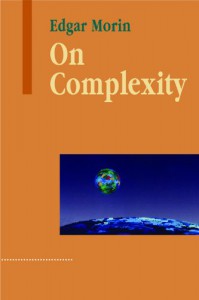
This is a remarkably coherent book about the most important topic for all of us, the matter of complexity and more to the point, thinking about complexity. I certainly recommend it most strongly, along with two other books by the same author that I have reviewed:
The Foreword by Alfonso Montuori is easily the equal of the main body by Edgar Morin, and I am totally awed by the mastery demonstrated in Montuori's synthesis and framing of Morin's work. I venture to say that I would not have gotten as much from the main body without the structure of the Foreword.
Montuori, always drawing on Morin, emphasizes a number of core concepts that I note down:
01 We must abandon the architectural or machine metaphor that assumes a foundation or base for what is actually a complex complete whole that can be viewed from any point.
“[Poetry] should strike the Reader as a wording of his own highest thoughts, and appear almost as a Remembrance…” (John Keats)
“And then your life, the life you are telling me about, becomes a short story that had force only because it was viewed from a particular slant, your slant, which you found within the one language you speak…” (The Magician Awakes)
“The greatest sum is no sum at all. It isn’t the addition of facts or numbers. It’s the willingness, for a little while at first, to suspend judgment and consider there are mythic qualities in existence that come from us…myths greater than machines…and in order to give voice to the myths we need to go where poets go. We need to go there badly. For our own sake, we have to put that peculiar precision that splits a tiny particle into smaller and smaller pieces on the shelf for a little while…” (The Magician Awakes)
American President Obama says he deplores the Egyptian junta’s decision to massacre peaceful protesters and declare martial law.
If he deplores it so much, why is he paying for it?
It is no secret that Egyptian strongman el-Sisi and the soldiers he is sending to slaughter protesters are on the US payroll.
According to official estimates, US taxpayers give the Egyptian military 1.3 billion dollars per year in direct military aid. When various forms of indirect aid are taken into account, including money from US puppet states in the Persian Gulf, the real annual total is in the billions.
This lavish US funding has allowed Egypt’s military to balloon into a monster that controls between one-quarter and one-third of the Egyptian economy. That is why Egypt is economically moribund.
Click on Image to Enlarge
Military spending kills economies, as shown by Dr. Robert Reuschlein of RealEconomy.com. Money wasted on militaries, which are non-productive organizations, is stolen from the productive sector. In societies with large militaries, the best scientists, engineers, and other experts stop producing valuable goods and services, and spend their lives figuring out how to destroy things and kill people. And poorer people, instead of becoming productive citizens, are trained to mindlessly obey orders and kill on command. Many of them suffer severe psychological damage that renders them non-productive.
In Egypt, the military’s economic hegemony creates even more problems.
Egypt has inherited a millennia-old authoritarian bureaucratic tradition. Pharaohs, emirs, presidents-for-life, and generals serve as dictators, and their bureaucratic lackeys have the high-status, high-paying jobs. Productive people are considered mere peasants and tradesmen, inferior in status to the bureaucrats.
British colonialism, which imposed a new layer of foreign bureaucracy, worsened the problem. Bright young Egyptians were trained to believe they were owed government jobs when they graduated from college. Widespread belief that “the government owes me a high-paying non-productive job” persists in Egypt. And the military officers and their cronies are the biggest and most bloated parasites.
Peace Operations in Africa: Lessons Learned Since 2000
Given that since 2000 there have been over 50 peace-centered operations conducted in 18 African countries, this brief asks a simple question — what key lessons have we learned from these missions? In answering the question, the brief hones in on seven particular lessons learned, including 1) peace operations must be part of an effective political strategy and not a substitute for one, 2) strategic coordination between a variety of actors is crucial to enhancing the effectiveness of operations, and 3) maintaining legitimacy in the eyes of the ‘relevant audiences' is crucial.

 Escalation of Attacks on News-gathering Process and Journalism by US-UK Gov’t