Reference: National Open Source Enterprise

Director of National Intelligence et al (IC)
0Shares
Online at FAS
Online at FAS

The National Open Source Enterprise (NOSC) of April 2006 is all that is left of the Jardines Fiasco.  Here are our comments.

1.  Illustration is wrong.  OSINT is both its own discipline and the FOUNDATION for all of the other disciplines.  It is especially valuable as a gap filler and in taking care of all the consumers that do not get classified decision support.  That needs to be central message.

2.  Imperative for Open Source fails to cite the Aspin-Brown Commission that found IC to be “severely deficient” and recommended that OSINT be a “top priority” for both DCI attention and for funding.  It also fails to cite the 9-11 Commission Report, pages 23 and 413, calling for a separate Open Source Agency co-equal to and independent form the CIA.

3.  The five goals are good ones.  The DNI Open Source Center is inflated in Goal Two and should be removed.  In Goal 3 there has been no inventory of open source capability and this needs to be a priority, recommend DIOSPO point this out and volunteer to take on the task.  OSC cannot be trusted with this task for multiple reasons.

4.  Requirements system must be BOTH part of the all-source system and also available at the unclassified level to all consumers including foreign governments and non-governmental organizations.  Requirements entered at the high side that can be cleared for the low side should go there, and all requirements at the low side should be mirrored to the high side.  Ben has it right at SOCOM—using COLUSEUM not only got the analysts used to putting in OSINT requirements, but it gave Ben the satisfaction metrics he needed to prove 40% of ALL SOF GWOT EII are being answered by OSINT.

5.  No progress appears to have been made on harvesting state and local information, that probably needs its own committee, consider bringing in a National Guard Colonel on reserve duty, ideally with a law enforcement badge in real life, to run that NOSC sub-committee.

6.  Ditto on international partnerships.  The UN would be the perfect partner for DIA, via the Situation Centre.

7.  Goal Four: OSC is in violation of the broadest possible dissemination.  Anything that is classified should not be allowed to count toward OSINT production.

8.  Goal Five: Stupid to use a Lockheed sales mark (SkunkWorks®).  Change to Innovation Center.  Goal 5.2 needs to be beefed up.  EarthGame™ as designed by Medard Gabel, #2 to Buckminster Fuller, is perfectly suited to meeting and furthering goals 5.3 and 5.4.  The UN State of the Future project and Millenium Goals can be tied into this.

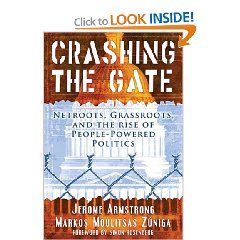
Review: Crashing the Gate–Netroots, Grassroots, and the Rise of People-Powered Politics (Hardcover)

4 Star, Civil Society, Culture, Research, Intelligence (Collective & Quantum), Politics
0Shares

Amazon Page
Amazon Page

4.0 out of 5 stars Great on Internet Saving Democracy, Lose It Assuming Democratic Party Will Be There,

March 31, 2006
Jerome Armstrong
This is an absolutely superb book, one of the finest reviews, in a readable form, of all that ails this Nation. The authors are like fighter pilots, performing incredible feats of daring-do, right up to the point where they crash and burn by suggesting that the Democratic Party can win anything at all.

I read a lot–almost exclusively non-fiction about information, intelligence, emerging threats, anti-Americanism, the lack of strategic culture, white collar crime, and the negative impact of US domestic political machinations on our national security and prosperity. This book is one of the single most extraordinary overviews I have ever seen, and if you buy and read only one book this year, this is the book.

I bought the book on faith, but for those who wish that the publisher had done a proper job of posting the table of contents, let me just post that information.

American Reality covers corporate cons, theocons, neocons, and other losers

This Ain't No Party starts with Divided We Fail and then discusses how each of the major movements (labor, environment, women) failed.

The Gravy Train is about white-collar crime–the beltway mafia, the commission mafia, the media, propaganda against our own.

Laying the Groundwork is best summed up by the quote from Mahatma Gandhi on the first flyleaf: “First they ignore you, then they laugh at you, then they fight you, then you win.” We WILL win–there are not enough guns on the planet, or enough places for white collar crooks and crooked politicians to hide, to keep us down or avoid our justice.

Civil War discusses the Dean machine and the path to “Netroots.”

The book concludes with Inside the Gate, which I have mixed feelings about–the authors have some thoughtful ideas on challenging every Republican, but they miss the boat completely in failing to understand that the Democratic political leadership is just as corrupt, slightly more stupid, and much less ruthless and effective.

That leads to my two critiques that take away one star, but I certainly do consider this book a must read and the authors to be geniuses and thought leaders:

1) Peter Peterson, in Running on Empty: How the Democratic and Republican Parties Are Bankrupting Our Future and What Americans Can Do About It does a much better job of laying out the prevailing mood across America, which is essentially, “a pox on both parties.” They have both main-lined bribery, they both lack ethics, vision, strategy, and a commitment to the public interest, and neither party is suited for managing America. What the authors forget, perhaps because of their focus on the Dean revolution (which failed–as did the more electable Edwards). John Kerry was the epitaph of the Democratic Party, and Hillary Clinton will be its gravestone.

2) The authors make the mistake, from the above starting point, of thinking this is about mobilizing a bigger Democratic base against the Republicans. That will not work. Base on base, the Republicans will win every time in this era; in part because the Democrats have given up faith (see my review of the utterly brilliant The Left Hand of God: Taking Back Our Country from the Religious Right by Rabbi Michael Lerner). As I tried to tell Dean and then Edwards and then Kerry, you do not beat a bigger dog with another dog, you beat them with a dog-catcher. There is only ONE dog-catcher issue in this country, and it is this: does EVERYONE's vote count? The answer is no. Hence, I see the author's well-intentioned guidance going down the drain UNLESS they write a second book, which I eagerly encourage, that does two things this book does not do:

a) Show how an American Independence Party, to be launched on the 4th of July, can have a federalist organization that includes conservative Democrats, moderate Republicans, Greens, Libertarians, Independents, and Couch Potatoes all as self-organized units that come together with one goal, and one goal only: crushing the extremist religious-corporate right, and restoring the concept of moral representative democracy to America. Any Congressman who fails to leave either the Republican or Democratic Party, who fails to join the new party, should be defeated in 2008.

b) The authors could write a handbook for organizing the people through a national budget simulation that brings out the issues and demonstrates what Paul Ray has known all along (see my review of “Cultural Creatives” and Google for “New Political Compass”): every issue can attract a mix of ideological views where consensus can be achieved. The problem with our two main parties today is that their corruption eliminates honest representations (see my review of “Breach of Trust” in which the author discusses how forcing Members to vote on the “party line” dishonors their obligation to represent their District). I am prepared to contribute financially if these two authors will establish a web site where we can create a virtual coalition government, with all “wings” of the American Independence Party represented, and where we can use a national budget simulation (it's not policy until its in the budget”) to sort out our spending priorities inclusive of elimination of the double-deficit and a shift of $100B a year toward waging peace. Ralph Nader's book “Crashing the Party” has some good ideas-why can't we do this under the author's guidance, and also pick a coalition cabinet that challenges both Republican and Democratic candidates to do the same and participate in cabinet-level debates under the League of Women Voters?

This is a super book, but the authors repeat the mistake Joe Trippi made early on (see my review of The Revolution Will Not Be Televised: Democracy, the Internet, and the Overthrow of Everything: the Internet will not save the Democratic Party. Using the Internet to create a new umbrella party will, however, save democracy. The two should not be confused. The Democratic Party today is Republican Lite, and not worth saving. Bring on book two-I'll buy the first 100 copies!

EDIT of 11 Dec 07: Lou Dobbs on CNN is calling for all Americans disenchanted with the two party system to register as independents. This seems to be catching on. Reuniting America is hot (Unity08 is not–last gasp of the two-party spoils system). If 100 million voters come back to vote after dropping out these past eight years, it is game over on corruption, and a new day for democracy.

Vote on Review
Vote on Review

Review: Turmoil and Triumph My Years As Secretary of State (Hardcover)

5 Star, Diplomacy
0Shares

Amazon Page
Amazon Page

5.0 out of 5 stars His views on intelligence (secret bad, open good)–Of Lasting Value,

March 31, 2006
George P. Shultz
This is one of those rare memoirs that combine ease of reading, common sense, and substantive greatness. Much much easier to absorb that Henry's Kissinger's turgid prose.

Although no longer in print, there are a number of copies floating around, and as long as I was using the book for a new article on strategic intelligence, I thought I would offer up my notes from the flyleaf for the Amazon community. My page numbers are from the 1993 hard cover edition.

Secretary Shultz is a former Marine and says early on in the book that his wife is part of a “package deal.”

Some extremely thoughtful views on competition in the information age, and very strong explicit angry statements against the “cult of secrecy.” Clearly understands the revolution in communications and information technology. p 18

Has some real issues with flaws in raw open source information loaded with unfiltered bias. p. 26

First director of OMB, p. 29, does not evince concerns over the disappearance of the Management function over the years.

Crisis management still not making proper use of open sources of information including commercial imagery, p. 44

CIA under Bill Casey too independent and unreliable. p. 50

Diplomatic “gardening” consists of SecState visiting counterparts on their home turf. p. 128

Vatican intelligence, p. 150

Emphasis throughout on values, integrating cultural policy, cultural strategy, cultural warfare

Firehose of information, nothing offered by intelligence or by information technology managers helped deal with it. p. 272

CIA “wild plan” for Surinam, p. 297

CIA “out of control” in mining Nicaraguan harbors, p. 307

Faulty intelligence to the President, p. 312

Intelligence pattern over time: first alarming and then vague, -. 425

On Strategic Defense Initiative, going to a briefing only to be asked, “Is the Secretary cleared?” Dumbfounded by this. p. 492

“So much for our intelligence” faulty biography on Soviet Premier Tikhonov, p. 493

State/Schultz versus Defense/Weinberger “poison” sapped government cohesion, p. 498

Security reviews, ridiculous impositions, p. 544

CIA botches Yurchenko, p. 595

Intelligence cooking the books, p. 619

Bottom line: Intelligence let this Secretary of State down, and does not appear to have gotten any more competent since then despite a doubling of its budget from $25M to $50M or more (some estimates suggest $70B total).

If you are interested in grand strategy, unified national security (using ALL of the instruments of national power wisely), and the vagaries of a really rotten Presidential inter-agency management process, this book is well worth buying used.

Vote on Review
Vote on Review

Review: America at the Crossroads–Democracy, Power, and the Neoconservative Legacy (Hardcover)

Democracy, Politics, Power (Pathologies & Utilization)
0Shares

Amazon Page
Amazon Page

3.0 out of 5 stars A few gems, generally light-weight and shallow,

March 29, 2006
Francis Fukuyama
This book has several gems that keep it from dropping to a two, but it also has a number of rather severe warts that prevent it from going to a four.

The gems first:

1) Although we have seen all too many history of the neo-cons, who seem to adopt policies of convenient (failing on the left, they move to the right, where nuttiness is an easier sell), I liked the concise summary of key concepts (preemption, regime change, unilateralism, and benevolent hegemony) and the distinction between the neocon theory and the Bush practice. To this I would have added a penchant by both to substitute ideological fantasy for real-world intelligence, and a predilection to lie to the public (and Congress) to achieve short term ends regardless of the long-term consequences.

2) I also liked his brief description of the concentric circles around terrorists, including radical religious terrorists (some would equate the extreme right evangelicals in the USA with the extreme left evangelicals led by Bin Laden), naming as the author does the sympathizers, fellow-travelers, the indifferent, the apolitical, and those sympathetic in varying degrees to the West. It is helpful for the author to address, at least in passing, that extremism flourishes when the middle drops out–when the mass of people are indifferent or apolitical, they give the extremists on the left and right a free ride to lunacy at public expense.

3) The author focuses two chapters on the need to reform American soft-power institutions, while also reforming international institutions helpful to applying power on behalf of legitimacy. He is appropriately critical of the many members of the United Nations whose power is illegitimate, 44 of them being dictators.

4) Finally, on page 164, he has a moderately interesting graphic that illustrates Legitimacy versus Effectiveness among internationally active institutions, and also lists the relative merits of formal versus informal mechanisms, clearly implying that legitimacy comes at a cost of flexibility and non-accountability.

Now for the warts:

1) This is a lightweight series of undergraduate lectures. A graduate level person can skim this double-spaced pint-sized book in an hour.

2) The author has been publicly castigated by Charles Krauthammer, in an Op-Ed “Fukuyama's Fantasy,” for fabricating a specific quote for which there is a television and audio record to support Krauthammer's accusation. While I am no fan of Krauthammer's ideological view, I do agree that this fabrication lends support to those who suggest that the author is loose with the truth and in a revisionist/self-apologist mode.

3) Intellectually, from a multi-disciplinary perspective, this work is at best a C+ for a graduate level personality. The author leaves out too many important references. On the subject of whether sovereignty should be respected or displaced, anyone who fails to integrate the brilliant work of Philip Allott, The Health of Nations: Society and Law Beyond the State (see my review of this work for a concise summary), is simply not serious about deep discussion of the need to restructure international affairs and the increasingly integrated globe where local threats impact on global stability, and global illegalities impact on local stability. It is time to overturn the Treaty of Westphalia and revisit some of the pioneering work from the 1970's (e.g. Richard Falk), in order to develop new political-legal, socio-economic, ideo-cultural, and techno-demographic constructs for sharing our wisdom (The Tao of Democracy: Using Co-Intelligence to Create a World That Works for All) and sharing our planet, humanity, and rule book (High Noon 20 Global Problems, 20 Years to Solve Them).

Having read and reviewed over 600 books and a few seminal DVDs relevant to the themes this author has reviewed, I put the book down with two thoughts:

1) Premature fame of an author is a burden on the uninformed reader. Like Tom Clancy, who had exactly one great book in him, and then had to rely on a series of ghost writers and co-authors, this author could benefit from making better use of industrious graduate students able to give him more “due diligence” to broaden the value of his mature reflections.

2) In consequence, this book misses so much relevant information that I am at a complete loss as to how to summarize the gaps concisely but will take a stab at it, consistent with my “lists” here on Amazon:

a) The author focuses on the neoconservative legacy and its relation to power and democracy, but in so doing, completely misses the larger discussion of virtual colonialism, predatory immoral capitalism, the costs of the Cold War, the treasonous decisions by Wall Street to rely on laundered drug money for liquidity and of US politicians to rely on cheap oil to win elections and keep the bribes coming, and other major issues. While the author does single out the Millennium Report of the United Nations, he does so in the context of the ideological debate over whether one should use power to address symptoms or root causes. He ignores completely the possibility that immoral and irrational US policies, spending (double deficit) and behavior may have something to do with our impending demise.

b) Strategy is not a word that appears in this book, at least not to where I could see it (it is not in the index either). While the author talks about soft power with a bow toward Joe Nye, e.g. The Paradox of American Power: Why the World's Only Superpower Can't Go It Alone and he talks about alliances versus freedom of action, this book is devoid of the kind of strategic thinking that Colin Gray, author of Modern Strategy, would look for in a work such as this purports to be.

c) Democracy in America is not discussed.

d) The book is antiseptic. The author starts with a fabricated quote from Krauthammer and ends with a quote from Madeline Albright (the one that repressed alarming reports on terrorism) about how Americans should lead because they can “see further” than other nations.

I recommend Clyde Prestowitz's Rogue Nation: American Unilateralism and the Failure of Good Intentions Peter Peterson's Running on Empty: How the Democratic and Republican Parties Are Bankrupting Our Future and What Americans Can Do About It Jonathan Schell's The Unconquerable World: Power, Nonviolence, and the Will of the People and Tom Coburn, Breach of Trust: How Washington Turns Outsiders Into Insiders as well as all books by Max Manwaring, Ralph Peters, and myself.

Vote on Review
Vote on Review

Review: The Left Hand of God–Taking Back Our Country from the Religious Right (Hardcover)

5 Star, Religion & Politics of Religion
0Shares

Amazon Page
Amazon Page

5.0 out of 5 stars

Slams Left for Unilaterally Disarming and Fearing its Compassionate Side,

March 29, 2006
Michael Lerner
I have little patience for one and two line reviews that praise (or condemn) a book without any substantive evidence that the book was actually read. My reviews are summative and evaluative, and this is a book that merits careful reading and carefully articulated reviews.

The author provides an absolutely top-notch discussion of how the extreme religious right was able to align with the corporate and media right to seize power and sideline the much larger middle class population. At one point the author notes that the wealthy can afford to be sanctimonious, they can afford to get their abortions in other countries. The book subtitle could be modified to say “from the Religious Right and the Immoral Politicians and Corporate Magnates that Bribed Them.”

The book is most valuable for providing a common sense indictment of the Democratic leadership, labeling them corrupt and ignorant for thinking that they can only win by being “Right Lite” and failing to distinguish the Loving Left from the Rich and Religious Right.

Especially helpful to me was the author's detailed discussion of how the Left went “secular” after the 1960's, that brief moment when a critical mass of America believed that “love not war” was in fact the right guiding principle. He points out how the elite intellectual left estranged itself from the labor left while also being secularly scornful of the religious left.

He praises Martin Luther King and the original civil rights movement that welcomed white support as embodying all that was good about spiritually-bonded social activism.

He goes on to note that in later years, as black activists excluded whites, feminists excluded men and alienated normal moms, and anti-war and environmental activists became angry and critical rather than loving and embracive, it all went down hill. The Left disintegrated as a socially and politically relevant force.

Among his strongest points is his assertion that the Left has “unilaterally disarmed” and given up its most powerful weapon, a spiritual vision of a world in which the Golden Rule prevails, and America stands for morality, generosity, and non-intrusive nurturing.

He lambastes the Left for being afraid of its softer feminine side, fearing to appear weak when that strong feminism or the generous side is precisely what is required to confront the radical “rational” right (rational in this case means de-humanizing, for people are treated as “trade goods” not as humans with spiritual and minimal mandatory quality of life needs). Indeed, the author cites Kant's statement that true rationality must be universalized, i.e. American “exceptionalism” is NOT rational, simply imposed.

Other books have talked about the need to add environmental and social bottom lines to the economic bottom line; this author integrates those ideas here.

His bottom line is that love and kindness and championing both a spiritual vision and the primacy of human rights and dignity are an intangible value that should not be restricted to church or family, but should characterize all aspects of the economy and the political decision process.

He demands–and I buy into this completely–that the Left, armed with faith (not nutty faith, but community-oriented faith) must refuse to accept the “collateral damage” that comes from predatory immoral capitalism or unilateral imperialist militarism.

He touches on the difference between science and scientism; the latter devoid of any sense of the humanities or faith (see my review of E. O. Wilson's Consilience for that great author's discussion of why the sciences need the humanities).

A few unique observations from the author before summarizing his public policy goals:

1) Bill Clinton got it, Hillary Clinton tried it as a spouse and abandoned it as a Senator (why she will not win as a Presidential or Vice Presidential candidate), and Al Gore, ubber secularist, never got it at all. Left unsaid, but clear to me, is that Senator John Edwards does get it, and his current focus on poverty is perfectly matched to this book's vision for a caring new left that is embrasive of the bottom and the center.

2) Marx had more spiritual wisdom in his early writings than most people realize, and was originally founded in a moral revulsion against the costs of capitalism on the commoditization of humans (see my review of Lionel Tiger, Manufacture of Evil: Ethics, Evolution, and the Industrial System). Where Marx went wrong, and where the post World War II Left went wrong, was in secularizing itself and failing to use religious faith as a catalyst and sustaining element for activism.

The author ends with some very specific prescriptions that I consider to be sensible, implantable, affordable, essential, and-and-contrary to those reviewers who demean the author-to be a absolutely vital to those seeking to restore balance and sanity to this country in the 2006 and 2008 elections. Any candidate who fails to integrate this book and its vision into their campaign is going to be fighting blind in one eye, with at least one arm tied behind their back. The varied covenants, the separation of church, state, and science (see my review of the The Republican War on Science), the Global Marshall Plan, the Nonviolent Peace Force, these are all ideas that are validated by just about every one of the 600+ books on national security that I have reviewed for Amazon these past six years.

The author ends on a reflective note, stating that no candidate, no elected President, can achieve the needed change on their own. There must be a considerable body of public opinion that stands up and demands the change, that holds the Wall Street and Enrons and Exxons of the world accountable, that holds Congress accountable for bribery and holds Dick Cheney accountable for lying and for no-bid multi-billion awards to Halliburton.

See Conspiracy of Fools: A True Story and Vice: Dick Cheney and the Hijacking of the American Presidency

While there are other books that are meaning to me with respect to the future of this country, this is the one single book that I do not believe can be ignored by any candidate hoping to restore democracy and morality to America.

On the failure of fundamentalist religion, see
American Fascists: The Christian Right and the War On America
American Theocracy: The Peril and Politics of Radical Religion, Oil, and Borrowed Money in the 21stCentury

Vote on Review
Vote on Review

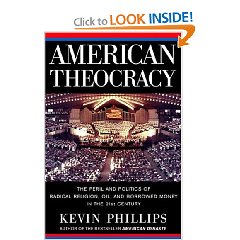
Review: American Theocracy–The Peril and Politics of Radical Religion, Oil, and Borrowed Money in the 21st Century (Hardcover)

5 Star, Corruption, Economics, Misinformation & Propaganda, Religion & Politics of Religion
0Shares

Amazon Page
Amazon Page

5.0 out of 5 stars Brilliant integration of oil, debt, religion, Bush, and crime,

March 29, 2006
Kevin Phillips
This is a five-star book that offers up two very serious values:

1) There is no other author who has written in such depth, over the course of four books, on the Republican party, the Bush dynasty, and the inter-relationship between the religious right and corporate wealth. This Republican is as serious an analyst as any that can be found. he joins Clyde Prestowitz, Paul O'Neil, and Peter Peterson as “go to guys” for when Senator John Edwards forms the American Independence Party and breaks away from the idiot Democrats and the Clinton mafia.

2) The author has done his homework and very ably integrated, with all appropriate footnotes and index entries, three broad literatures, two of which I have read multiple books on (oil and debt), one on which I have not (radical US religion–fully the equal of Bin Laden and suicidal terrorists, these folks just send others to do the dying for them).

So I have to say, given that this is a serious book by a serious author, why so many obviously loosely-read individuals writing short dismissive reviews? I have to conclude he has touched a nerve. When I used to appear on NPR, before I was kicked off for condemning Israeli lobbyists and suggesting that the common Arabs (the real people, not the sadistic opulent corrupt House of Saud or the other dictators) never got a fair shake from the US, I would get hate calls and mail from what I now realize were know-nothing radical right-wing religious nuts. We'd get into the issues, and I would ask, “what books have you read on this?” only to be told, “There is only one book that matters, the Bible.”

Well, this author has helped me understand where the Bush constituency comes from: these are the folks that graduated from rote reading of the Bible to the “Left Behind” fiction series. They are the intellectual equals of the Islamic kids learning to be suicide bombers by reciting old Arabic they don't understand.

If you do not have the time or money to buy all the other books I have reviewed, spanning emerging threats, the lack of strategy and the inappropriate force structure, the anti-Americanism that we spawn, the corruption of Wall Street and the shallowness of white collar law enforcement, the end of cheap oil, the end of free water, the rise of pandemic disease, the coming date with destiny when the 44 dictators we support are overthrown and the US pays the price for its long-term nurturing of all but three of them….this book brings a lot together. It avoids only two really important topics: the environmental implications such as covered by TIME Magazine in the 3 April 2006 cover story on Global Warming; and the minutia of how America is no longer a real democracy–not only do most voters not vote, but once elected, most Congressman are corrupted immediately by lobbyists.

The author, who is uniquely qualified to sum this all up in this book because of his three prior books centered on the Bush Family, oil, and wealth, does a tremendous job of outlining how oil money ultimately bought the White House and Congress. If you have time for two other books, I recommend Crossing the Rubicon: The Decline of the American Empire at the End of the Age of Oil in which a former LAPD investigator makes a case for indicting Dick Cheney for fabricating the march to war on Iraq under the delusion that we would get another ten years of “cheap oil” and Twilight in the Desert: The Coming Saudi Oil Shock and the World Economy in which it is clearly documented that both Congress and the White House knew in 1974-1975 that Peak Oil was over, and they concealed this for another 25 years in order to keep the bribery coming–this was nothing less than a treasonous betrayal of the public interest worthy of retrospective impeachments for all concerned. The books by moderate Republicans Prestowitz (Rogue Nation: American Unilateralism and the Failure of Good Intentions) and Petersen (Running on Empty: How the Democratic and Republican Parties Are Bankrupting Our Future and What Americans Can Do About It) should be read as well as Brand Hijack : Marketing Without Marketing which is about why Paul O'Neil quit the Bush Administration–he realized that ideological fantasy and Dick Cheney had displaced a reasoned policy process, the Cabinet, and Congressional concurrence…..

This is a very bad time. This book is as good as any at setting the stage for intelligent people to campaign and vote in 2006 and 2008.

EDIT 7 Dec 07: Since I wrote this review, several gems are newly available:
American Fascists: The Christian Right and the War On America
Piety & Politics: The Right-Wing Assault on Religious Freedom
God's Politics: Why the Right Gets It Wrong and the Left Doesn't Get It (Plus)
Vice: Dick Cheney and the Hijacking of the American Presidency

and on and on and on….

Vote on Review
Vote on Review

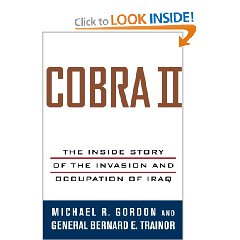
Review: Cobra II–The Inside Story of the Invasion and Occupation of Iraq (Hardcover)

3 Star, Iraq, War & Face of Battle
0Shares

Amazon Page
Amazon Page

3.0 out of 5 stars Fascinating Authorized Details, Missing Core Information,

March 29, 2006
Michael R. Gordon
EDIT of 11 Dec 07: my original comments have been validated. Adding links now that this feature is available, and a few additional references.

The index in this book is *terrible*, my first clue, as the #1 Amazon reviewer of non-fiction about national security, that something is amiss. There is no bibliography. That's my second clue. The footnotes are solid on interviews and Op-Eds, and abyssmal on books by other people–we'll give them a bye on that one, considering this a primary reference that is a partial picture.

The one theme that comes across, and it is partly motivated by a proper sense of restoring honor and reputation for the Army, is the constant degree to which Army officers gave the civilians good advice, only to see it ignored. The Army Chief of Staff got it right on post-conflict nation-building and needed manpower; the Army flags got it right in telling Bremer that that single dumbest thing he could do was disband the Army and put 100,000 pissed off Iraqis with guns on the street–but by golly, Bremer went ahead and did it.

Overall I do not find this book worthy of four stars (not even close for five) for the following reasons:

1) It is largely a white-wash, granted with lots of excellent detail, but it tells the story from the CINC and DCINC points of view, and I have previously reviewed those books and found them lacking in complete candor and full detail.

2) The book completely ignores all the negatives that have long-since been documented–the fact that Charlie Allen at CIA did send in 35 line-crossers and proved conclusively there were no Weapons of Mass Destruction; the fact that Chalabi was a thief and a liar fired by CIA and then used by Iran as an agent of influence to lick the ears of the neo-cons and persuade Rumsfeld (with help from the Mossad, which knew a coincidence of interest with the Iranians when they saw one) that it would be roses in the streets and a cheap war. The book completely ignores the peak oil imperatives that drove Cheney and the ugly post war realities including Paul Bremer “losing” $20 billion in loose cash, and Afghanistan becoming the source of 80% of the world's heroin (turned into #4 quality by our ally Pakistan).

2) The book ignores technical details that are my litmus test for full veracity. The fact that the White House and the military refused to put a Ranger battalion in to block Bin Laden's ground escape, tracked by CIA for four days (see my review of Jawbreaker: The Attack on Bin Laden and Al-Qaeda: A Personal Account by the CIA's Key Field Commander), the fact that Rumsfeld very stupidly gave the Pakistani's an air corridor to evacuate their officers and they instead evacuated 3,000 Taliban and Al Qaeda from Tora Bora in one night)….the list goes on.

The book gets the high points right (misreading of the foe, dysfunction of US military bureaucracy, over reliance by Rumsfeld on technology, the failure to recognize reality once in (insurgents instead of parades), and the Bush disdain for nation-building) BUT the authors also soft-shoe all the other issues, of which I see three:

1) The Administration lied to Congress, the American People, and the United Nations. A memo is now out in Lawless World that shows clearly that Bush and Blair agreed to go to war and all that followed was posturing–certainly an impeachable offense if ever there was one. See Weapons of Mass Deception: The Uses of Propaganda in Bush's War on Iraq.

2) Tommy Franks did not give a rat's ass what the Joint Chiefs thought, and Franks was chosen to do exactly that, while the Chairman of the Joint Chiefs was chosen because he would accept the role of floor mat rather than doing what any self-respecting officer should do, which is resign and be noisy in public.

3) The book fails to do as good a job as The Price of Loyalty: George W. Bush, the White House, and the Education of Paul O'Neill or State of War: The Secret History of the CIA and the Bush Administration in showing just how mendacious and dysfunctional was the Cheney-Rumsfeld coup d'etat within the White House. David Ropkoph's Ruling the World, several other books, make it quite clear that Condi Rice and Colin Powell were rolled, George Tenet was a raving sycophant, and our military was too eager to please, while Congress was pathologically absent without leave (AWOL).

The authors really would have done a vastly superior job had they actually read and integrated the varied books, e.g. Squandered Victory: The American Occupation and the Bungled Effort to Bring Democracy to Iraq, the various books readily available on the web of lies that led to war, on the incompetence of George Tenet, etc.

In all of this we do not see an adequate assessment of the role of Iran in carrying out what may be the greatest strategic deception of modern history, nor do we see any evaluation of the political-legal, socio-economic, ideo-cultural, or techno-demographic cost to America. This book closes as if the war is virtually over, the Army is reconstituted rather than hollow, and its time to discuss the lessons learned over a double scotch. Not so fast, bubbas.

In 2007 we have, apart from multiple books detailed how and why Bush and Cheney should be impeached, an entire literature on their alledged high crimes and misdemeanors on 9-11, and the follow gems:

Vice: Dick Cheney and the Hijacking of the American Presidency
The One Percent Doctrine: Deep Inside America's Pursuit of Its Enemies Since 9/11
A Pretext for War: 9/11, Iraq, and the Abuse of America's Intelligence Agencies
Running on Empty: How the Democratic and Republican Parties Are Bankrupting Our Future and What Americans Can Do About It
The Broken Branch: How Congress Is Failing America and How to Get It Back on Track (Institutions of American Democracy)
Breach of Trust: How Washington Turns Outsiders Into Insiders

This is not all on Cheney and the neo-cons. Any Congress stupid enough, limp enough, to allow Paul Wolfowitz to contradict the Chief of Staff of the U.S. Army on a topic about which Wolfowitz remains copmpletely ignorant, is not a Congress fulfilling its Article 1 responsibilities. The whole lot of them should be dismissed in 2008, and we should start over with Independents in charge and leadership psotions in both the Congress and the Cabinet aportioned across at least five distinct parties.

Vote on Review
Vote on Review