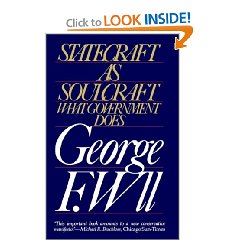
Although George Will can be an extremist in some of his views, he has a good mind and is gifted as an author and orator. This is nowhere more evident than in this collection of 20th century essays, where he focuses on “statecraft as soulcraft.” Thomas Jefferson understood that an educated citizenry was a Nation's best defense, and the Vietnamese have clearly demonstrated that a nation with a strong strategic culture can defeat the United States when it practices the American way of war (lots of technology, little public support for the war). Today we are beginning to understand that the moral aspects of national character are 3-5 times more important than the physical and economic and technical aspects. Michele Borba's new book, Building Moral Intelligence, together with George Will's dated but still powerfully relevant book, comprise the urgently needed elementary education for all adults who would be responsibile citizens–or leaders of citizens.
Gives Citizens More Intelligence Than FBI Can Handle,
February 16, 2003
Steven Emerson
The FBI–as shown by the recent Congressional testimony of its Director–is still hapless, flailing and clueless when it comes to understanding the specifics of terrorist fund-raising, recruiting, training, and planning based in the USA. Pakistanis are fleeing to the Canadian border as this review is being written, because they know something the FBI is unwilling to compute: the greatest threat is not Al Qaeda, but rather Hamas and militarized Pakistanis, most of whom are legitimate US residents.Steve Emerson, who first made history in the mid-1990's with his Public Broadcast Service documentary on mullahs in American mosques calling for the murder of Americans deep in the heartland of America, has produced a “citizen's handbook” that is vastly superior to anything the FBI or the White House has been able to offer its taxpayers–and we can buy this for under $12, which compares rather favorably with the $3 billion or so we pay for the FBI, and the $35 billion or so we pay for national intelligence overall.
There are really three stories in this book, which I urge every American–and every other citizen of the world–to read.
First, and most importantly, the book documents the wide-spread and robust network of Islamic “charities” and other front organizations–the most important based in Texas where they have been ignored–that do fund-raising for terrorism overseas as well as terrorist recruiting and training in the US. The map at the end of the book showing over 50 terrorist nodes in over 30 US cities, is along worth the price of the book. *More than 20% of the addresses and phone numbers in a top terrorist's phone book, when captured, where in the US.*
Second, the book provides insights into why the US Government is failing in the war on terrorism. The reasons for failure are balanced between policy failures–a pure unwillingess to confront Pakistan, Saudi Arabia, Syria, Iran and other governments that nurture terrorists–and intelligence failures, including such mundane things as refusing to demand police record checks on individuals from countries known to be exporting terrorists, and poor relations (and a lack of unilateral clandestine penetrations) with key intelligence services such as the Sudanese, which knew about the “Day of Terror” well in advance but did not tell us…and if it did tell us, our Intelligence Community failed to notice and failed to communicate the warnings.
The third story in this book is about sources and methods and mindsets, and the bottom line is this: an open mind can use open sources of information to such advantage, that it makes our closed source and closed mind bureaucracy look pitiful in comparison. The US taxpayer is not getting their money's worth from the US Government with respect to national security expenditures.
Finally, although perhaps not intended by the author, his insights are helpful in identifying four specific strategic psychological operations (PsyOp) or “cultural outreach” themes that the US should have been pursuing these many years since the Soviets left Afghanistan: 1) Arab-Afghans isolated and despised; 2) Arab arrogance in relegating all Pakistani's to “untouchable” nonentity status; 3) Oneness of umma fanatically pursued actually attacks and undermines the many varied Muslim cultures, especially non-Arab Muslim cultures; and 4) US has made mistakes–in crime, in morality, in support for repressive regimes–and seeks to change in the true spirit of the Koran.
The book's documentation of the crimes against the US of the American Muslim Council, to name just one ostensibly legitimate organization that is revealed in this book (which has been “lawyer-checked” and is bullet-proof against false claims of slander), and other similar “charitable” organizations, constitutes “citizen intelligence” at its best. Every Muslim in America should read this book before donating another dollar to any organization pupporting to be helping Muslims.
There is one other cautionary note: the book addresses the specific strategy of bin Laden and other terrorist leaders of deliberately seeking out Muslim youth with US passports who can be used as couriers and suicidal volunteers. The actual examples provided–real people with real terrorist support missions–easily destroy the common misperceptions of terrorists as “foreign.” As the author documents, they are within us, they are of us, and what we are doing now to defend ourselves is not likely to work in this context.
This is an easy to read, informative book with an excellent map, several tables of Islamic extremist organizations based in America, good notes and a good index. I recommend it without reservation.
I look for three things in a book on national security in the information age: 1) does it offer deep insights into specific personalities or situations not available from any other book; 2) does it highlight deficiencies in the process or substance that are not well understood by the public; 3) and finally, does it add anything to the larger discussion of war and peace in the 21st Century. On all these counts, Halberstam satisfies. Indeed, having read his book several months ago, I have put off reviewing it because I wanted to spend more time pulling the nuggets out–as those who follow my reviews know, they are both evaluative and summative.This book validates most of what General Wes Clark says in his own memoir, “Waging Modern War,” and thus in that sense alone it has great value: the Army was unwilling to trust the US General walking in Eisenhower's shoes with either ground troops or helicopters, and also unwilling to fight in mountains. This is such a terrible self-condemnation of America's most important Armed Service that every citizen should be shuddering.
The second major theme I drew from this book was one that the author highlights toward the end of the book when he quotes Madeline Albright, then Secretary of State, as saying (on page 409), “We're just gerbils running on a wheel.” For this the U.S. taxpayer pays $500 billion dollars a year? For gerbils? In combination with Pentagon deception of the President in railroading General Clark out of NATO early, and a wide variety of other practices between personalities in Washington that would get you fired in any serious corporation, the overall impression that one draws of the Washington foreign policy and national security establishment is one of inattention alternating with craven back-stabbing. This is not an environment that is operating at peak efficiency, nor can it be trusted to act in the best interests of the voter and taxpayer.
A third theme, and this impressed/depressed me tremendously, is that of journalism and open sources of information getting it right early, only to be ignored. The author–Halberstam–takes great care to tell a story of respect for the accomplishments of another journalist, Roy Gutman of Newsday, whose headline on 21 November 1991, “Yugoslavs Need West's Intervention,” was the beginning of a series of insightful articles that had little impact at the time. Joining the insights of journalists was the ignorance of history by politicians–Halberstam comments particularly on the lack of European understanding of just how recognition of Croatia was the opening of a Pandora's Box of genocide. I was especially struck, throughout Halberstam's accounting, as to how crafty the Balkan players were, how able they were at deception and distraction, and how inept the Americans and the Europeans were at interpreting the situation and the ploys–with massive genocidal consequences.
A fourth theme that was not emphasized by the book, but which I would highlight based on a passing observation by the author with regard to the lack of television coverage, has to do with the absolute imperative for America and Europe to have both a strong television industry that can go into the dark places where today only adventurers like Robert Young Pelton (“World's Most Dangerous Places”) dare go–while at the same time governments need a “ground truth” cadre of observers who are accustomed to and can survive instability and combat, and are not trapped like rats in Embassies, reporting reality second or third hand. We simply don't know. We simply do not have trusted observers–or TV cameras–in 80% of the places where we most need to have reliable independent observation.
Finally, there were a number of recurring points across the whole book, points where I ended up making annotations:
1) Civilian-military relationships are not marked by trust
2) Presidential teams tend to lack depth, have no bench
3) Washington promotes the least offensive, not the most talented
4) Bush Sr. got no bounce from Gulf War–this is suggestive today, as the son follows the father's path.
5) Satellite imagery was used to detect Haitians building boats–this struck me as so symbolic of all that is wrong with the US intelligence community–rather than someone walking the beaches and seeing and sensing directly, we use satellites in outer space, at great cost, to do remote viewing…
6) Trust, Truth, and Morality–Halberstam may not mean to say this, but my reading of his book, influenced by Joe Nye's book on “The Paradox of American Power,” was just this: all the money and all the military hardware in the world will not win a conflict in the absence of trust among the civilian-military players; truth about the fundamentals on the ground; and a morality that empowers tough decisions early enough to prevent genocide.
The book ends on a mixed note–on the one hand, observing that prior to 9-11 (and many would say, even after 9-11) America has distanced itself from the world; and on the other, noting that this is a very strong country, slow to anger, slow to rouse, but when roused, capable of miracles. More upbeat than I expected, I was almost charmed by the author's optimism, especially in light of the many books he has written about the corridors of power and the pitfalls of American adventures overseas.
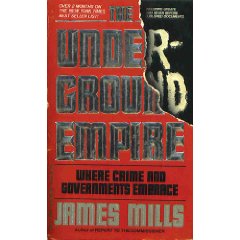
There are two kinds of government crime against the taxpayer, and both are wide-spread and costly to the taxpayer. There is corporate corruption, the buying of politicians, such that decisions are made that in effect transfer the taxes paid by individuals (who carry every government's costs) to unethical corporations focused on profit at any cost (to others). This book documents the second kind of crime: where government agencies charged with protecting the taxpayer from drugs or crime or terrorists or other threats, themselves become allies with criminals, and seek to profit from crime while permitting field officers to go bad, steal money, and become nothing more than officially sanctioned criminals. If and when each Nations cleans house within its “secret world,” the ethics of intelligence, and how to police the police, will be among the most fearsome challenges to be addressed.This extraordinary book, at 1165 pages (1974 edition) is a deeply documented, thoughtful, credible account of the second kind of corruption. It is strongly recommended for purchase by anyone who pays taxes.
Vote on Review
Of Lasting Value, Relevant to Today's Technical Maze,
January 27, 2003
Charles Perrow
Edit of 2 April 2007 to add link and better summary.
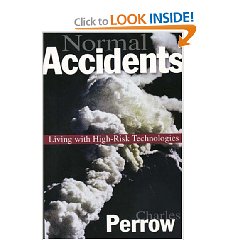
I read this book when it was assigned in the 1980's as a mainstream text for graduate courses in public policy and public administration, and I still use it. It is relevant, for example, to the matter of whether we should try to use nuclear bombs on Iraq–most Americans do not realize that there has never (ever) been an operational test of a US nuclear missile from a working missle silo. Everything has been tested by the vendors or by operational test authorities that have a proven track record of falsifying test results or making the tests so unrealistic as to be meaningless.
Edit: my long-standing summary of the author's key point: Simple systems have single points of failure that are easy to diagnose and fix. Complex systems have multiple points of failure that interact in unpredictable and often undetectable ways, and are very difficult to diagnose and fix. We live in a constellation of complex systems (and do not practice the precationary principle!).
This book is also relevant to the world of software. As the Y2K panic suggested, the “maze” of software upon which vital national life support systems depend–including financial, power, communications, and transportation software–has become very obscure as well as vulnerable. Had those creating these softwares been more conscious of the warnings and suggestions that the author provides in this book, America as well as other nations would be much less vulnerable to terrorism and other “acts of man” for which our insurance industry has not planned.
I agree with another review who notes that this book is long overdue for a reprint–it should be updated. I recommended it “as is,” but believe an updated version would be 20% more valuable.
I've seen the comments about the “sad decline” and I do not agree. I found the hard cover book not only entertaining and well-structured, but it did something even more important: got my third grader to read it cover to cover.I can see where there is a need for both this kind of entertaining “just the highlights” kind of book, and a second more detailed less illustrated book–that is for the publisher to decide. For myself, this version is modern, entertaining, and therefore it draws the reader in. Glad we bought it.
Vote on Review