EXTRACT: Although it's perfectly fair to call Barack Obama an empty suit and a manufactured product, that's what Presidents have always been. The Truman Doctrine was entirely the work of George Kennan, and Truman introduced it with a famous speech he didn't write. Once the Doctrine was actually implemented, George Kennan immediately disowned it and became a vocal critic. (Fast forward two terms and you've got Eisenhower warning about a Military Industrial Complex. Kennedy later delivered a strange speech about Secret Societies that's also essential reading.)
The Great Architect of the Universe always had his doubts, too. On December 21st, 1963, Harry Truman publicly voiced his reservations about the CIA. What follows is a complete transcript of his statement…
Tariq Ali London Review of Books, 11 December 2010
Last year’s recipient of the Nobel Peace Prize escalated the war in Afghanistan a few weeks after receiving the prize. The award surprised even Obama. This year the Chinese government were foolish to make a martyr of the president of Chinese PEN and neo-con Liu Xiaobo. He should never have been arrested, but the Norwegian politicians who comprise the committee, led by Thorbjørn Jagland, a former Labour prime minister, wanted to teach China a lesson. And so they ignored their hero’s views. Or perhaps they didn’t, given that their own views are not dissimilar. The committee thought about giving Bush and Blair a joint peace prize for invading Iraq but a public outcry forced a retreat.
For the record, Liu Xiaobo has stated publicly that in his view:
(a) China’s tragedy is that it wasn’t colonised for at least 300 years by a Western power or Japan. This would apparently have civilised it for ever;
(b) The Korean and Vietnam wars fought by the US were wars against totalitarianism and enhanced Washington’s ‘moral credibility’;
(c) Bush was right to go to war in Iraq and Senator Kerry’s criticisms were ‘slander-mongering’;
(d) Afghanistan? No surprises here: Full support for Nato’s war.
He has a right to these opinions, but should they get a peace prize?
The Norwegian jurist Fredrik Heffermehl argues that the committee is in breach of the will and testament left behind by the inventor of dynamite whose bequests fund the prizes: ‘The Nobel committee has not received prize money for free use, but was entrusted with money to give to the pivotal element in creating peace, breaking the vicious circle of arms races and military power games. From this point of view the 2010 Nobel is again an illegitimate prize awarded by an illegitimate committee.’
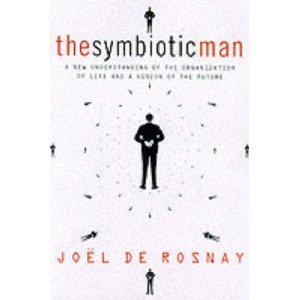
In this Future Shock for the new millennium, de Rosnay, director for strategy for the Science and Industry Complex in Paris, predicts the coming of what he calls the “Cybiont”: a global “macroorganism” that encompasses humanity, the environment and technology. The culmination of de Rosnay's earlier work (The Macroscope; The Paths of Life; The Planetary Brain), this book became a bestseller upon its initial publication in France in 1995. The author regards the computer as a “macroscope,” an instrument that lets humans view larger trends and that will eventually take on a life of its own; he quotes Stephen Hawking's view that computer viruses and other electronic “intelligence” may actually be developing into forms of life. For mankind to survive, we must establish close symbiotic relationships with our technology and its emerging self-generated intelligence and with nature, he says. Unfortunately, de Rosnay fails to consider very deeply what constitutes consciousness, a subject many other scientists have investigated, or artificial intelligence. He also seems to overestimate humans' willingness to sacrifice their private interests to achieve long-term, communal goals. De Rosnay does, however, present many provocative ideas like “fractal time” and “time bubbles,” and he discusses interesting and thus far fairly esoteric advances in technological sensory perception and even brain-computer connections. This book doesn't come together as a convincing vision of the future, but it certainly provides readers with many challenging ideas to mull over, and it may encourage them to consider their individual roles in the greater scheme of things.
Amazon Page (English)
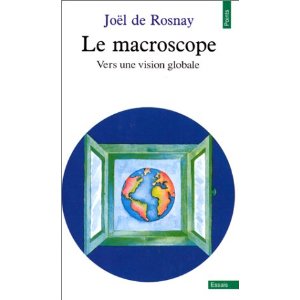
The Macroscope; The Paths of Life; The Planetary Brain
in US: The macroscope: A new world scientific system
I did a guest post for Pegasus Communications last week, providing an appetizer for my book. Below is a slightly longer version — with examples restored. If you’re looking for a taste of what it’s about, read on.
What would it mean if we knew how to face challenging situations with a high likelihood of achieving breakthrough outcomes?
EXTRACT: Since the early nineties, I’ve sought to understand how we turn difficult, often conflicted issues into transformative leaps of renewed commitment and achievement. I’ve used whole system change practices — methods that engage the diverse people of a system in creating innovative and lasting shifts in effectiveness. I’ve co-convened conferences around ambitious societal questions like: What does it mean to do journalism that matters for our communities and democracy? And I’ve delved into the science of complexity, chaos, and emergence – in which order arises out of chaos – to better understand human systems. In the process, I have noticed some useful patterns, practices, and principles for engaging the natural forces of emergent change. Here are a few highlights:
All change begins with disruption.
Engaging disruption creatively helps us discover differences that make a difference.
Wise, resilient systems coalesce when the needs of individuals and the whole are served.
EXTRACT: The practice of collective reflection helps surface what matters to individuals and the whole. It can generate unexpected breakthroughs containing what is vital to each and all of us.
EXTRACT: Joel de Rosnay, author of The Symbiotic Man, introduced the notion of “the macroscope”. Just as microscopes help us to see the infinitely small and telescopes help us to see the infinitely large, macroscopes help us to see the infinitely complex.
Project Syndicate provides the world’s foremost newspapers with exclusive commentaries by prominent leaders and opinion makers. It currently offers 39 monthly series and one weekly series of columns on topics ranging from economics to international affairs to science and philosophy.
Project Syndicate is committed to maintaining the broad intellectual scope and global reach that readers need to understand the issues and choices shaping their lives. As a result, Project Syndicate's commentators reflect the world in all its variety of professions, national and cultural backgrounds, and political perspectives. Past and current contributors include: