Human-centered computing should be–but is not today–about connecting all humans with all information in near-real-time, while providing back office tools that elevate the human brain and more properly plan information and communications technologies in a support role. See for example our Citizen-Centered Graphics and all of the OSS/EIN Books. Where the emergent meme is off-target is in focusing on the relationship of the computer to the individual, rather than the whole. Hacking Humanity is the new meme.
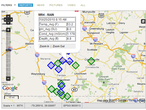
+ Collect information from cell phones, news and the web.
+ Aggregate that information into a single platform.
+ Visualize it on a map and timeline.
Crowdmap is designed and built by the people behind Ushahidi, a platform that was originally built to crowdsource crisis information. As the platform has evolved, so have its uses. Crowdmap allows you to set up your own deployment of Ushahidi without having to install it on your own web server.
STOCKHOLM, Sweden, Aug. 15 (UPI) — The founder of WikiLeaks says he will seek a publishing license for his controversial operation in Sweden where whistleblower protections are strong.
Phi Beta Iota: The Nordic nations have consistently been “smarter” and more ethical than the US and all others. Wikileaks has made many mistakes of judgment, as our esteemed colleague Steve Aftergood of Secrecy News has noted in “Wikileaks Fails Due Diligence Review,” but it can safely be said that the US, the UN, and all others are too easily found to be in violation of the “rule of law” they claim to represent. In our own experience, US Ambassadors spend too much time sweeping dirt under the rug and lying for their government (not their country–America the Beautiful does not want liars as Ambassadors), and the UN is an incestuous bog of little fiefdoms that “live and let live” without the ability to police the integrity of its own professionals. Wikipeaks exists–and is gaining traction–precisely because those who object to its leaks have failed to maintain their own integrity.
In 2010 Interdependence Day will be celebrated in a dynamic global city and cultural melting pot at the heart of Europe.
> INTERDEPENDENCE DAY
In a world where global interdependence is not simply an aspiration of idealists, but a brute fact of the forces that bind us together— global warming, financial capital, AIDS, telecommunications, crime, migration, and terrorism—many people still think in narrow, insular terms.
Reality is global, but consciousness too often remains local — constrained by town and nation.
In the year 2000, a small group of scholars, civic and political leaders, and artists from a dozen nations met to design a program that might help raise consciousness around the realities and possibilities of interdependence. Their efforts were given impetus by the tragic events of September 11, 2001, and the group created a project that would:
> Make September 12, the day following the memorial of 9/11, an international celebration of interdependence “Interdependence Day”
> Draw up a “Declaration of Interdependence”, making clear that both liberty and security require cooperation among peoples and nations and can no longer be secured by sovereign nations working unilaterally;
> Develop a Civic Interdependence Curriculum that would make interdependence a central concept in Civics and Social Studies programs in middle and high schools in as many schools around the world as possible.
The U.S. Geological Survey is using funds from the American Recovery and Reinvestment Act to support a student who’s investigating social Internet technologies as a way to quickly gather information about recent earthquakes.
In this exploratory effort, the USGS is developing a system that gathers real-time, earthquake-related messages from the social networking site Twitter and applies place, time, and key word filtering to gather geo-located accounts of shaking. This approach provides rapid first-impression narratives and, potentially, photos from people at the hazard’s location. The potential for earthquake detection in populated but sparsely seismicly-instrumented regions is also being investigated.
Social Internet technologies are providing the general public with anecdotal earthquake hazard information before scientific information has been published from authoritative sources. People local to an event are able to publish information via these technologies within seconds of their occurrence. In contrast, depending on the location of the earthquake, scientific alerts can take between 2 to 20 minutes. By adopting and embracing these new technologies, the USGS potentially can augment its earthquake response products and the delivery of hazard information.
“The majority of the world’s designers focus all their efforts on developing products and services exclusively for the richest 10% of the world’s customers. Nothing less than a revolution in design is needed to reach the other 90%.” —Dr. Paul Polak, International Development Enterprises
Imagine connecting item & service-requests to those lacking basic needs into a global online and mobile market forum like a Craigslist.org merged with Kiva+ SMS/txt message capabilities, something like Ushahidi, Wikimapia, as well as GoogleEarth-like & SecondLife-like 3D map to post photos and messages of requests and successful transactions without a centralized “middle-man” who manages everything.
Example: An African farmer needs a part for 1950’s Romanian pump. An aid worker posts need via UNICEF Rapid SMS. A Romanian engineer volunteers to make the part; a German pays for FedEx from Romania to Nigeria; a tourist commits to personally delivering it and posting a photograph of the farmer and repaired engine online to close out need.
It would be designed so that anyone could add “affordable” items (that meet a particular criteria) to the list. Please email earthintelnet |at| gmail.com if you have suggestions. For more info on the concept, see page 7 of the Earth Intelligence Network overview draft and this global range of nano-needs graphic. On 7/21/10 Craig Newmark of Craigslist.org sent this email: “..a number of people say they're working on similar efforts,” but he did not specify. Another great example is Practical Action's “Practical Presents” store where a goat, fish cage, farm tools, and many more products can be purchased for donation.
Global Range of Needs Index/Map/Forum could include the following items:
+ Cheap colloidal silver-treated water filters: see Potters Without Borders & Potters for Peace
+ Lifestraw, the one person water filter that can be worn around the neck
The International Development Design Summit is an intense, hands-on design experience that brings together people from all over the world and all walks of life to create technologies and enterprises that improve the lives of people living in poverty. Unlike most academic conferences, we emphasize the development of prototypes, not papers and proceedings. In moving the technologies on the path from idea to implementation to impact we aim to create real ventures, not just business plans. IDDS is part of the revolution in design that aims to encourage, promote, and build more research and development resources that focus on the needs of the world’s poor. We draw inspiration from several current models of innovation, design and community empowerment: co-creation, cross-disciplinary collaborations and crowd sourcing.
IDDS is a diverse group of people. We come from more than 20 countries around the world—from Asia, Africa, Europe, North America, South America, and Central America. We are students and teachers, professors and pastors, economists and engineers, masons and mechanics, doctors, welders, farmers, and community organizers. One of the things that makes IDDS a special conference is this richness of backgrounds. It is a conference about innovation, and we believe that innovation thrives in the intersections of disciplines that come from bringing together such an eclectic group.
We believe very strongly in the idea of co-creation: the concept that it is better to provide communities with the skills and tools to become innovators and develop new technologies themselves rather than to simply providing the technologies. We believe that developing the capacity for innovation and creativity is critical for long-term sustainable improvements in the quality of life in a community. It is our goal to demonstrate a model where a user-based community of active, creative designers can invent, innovate and inspire each other to create new technologies.
But not all of our participants are from communities in the developing world. Nearly half of the our participants are students, and we hope to inspire them with the opportunity to interact with field practitioners and to see that inventiveness is not restricted to those with formal education. IDDS also provides a forum where they can meet with like-minded people who are driven by the same desire to make an impact in the world. It is our hope that by creating a diverse global network we can empower individuals and their communities to tackle the tough problems that reside in the developing world.
For this year’s event, the focus has shifted from the creation of technologies to their dissemination. Co-sponsors MIT, Franklin W. Olin College, and Cooper Perkins will be joined by the 2010 host institution, Colorado State University, in developing and implementing the curriculum. IDDS 2010 aims to guide project teams through the process of becoming viable ventures. Curriculum includes key principles from the Global Social and Sustainable Enterprise program at CSU, the D-Lab program at MIT and the Design Stream at Olin College.