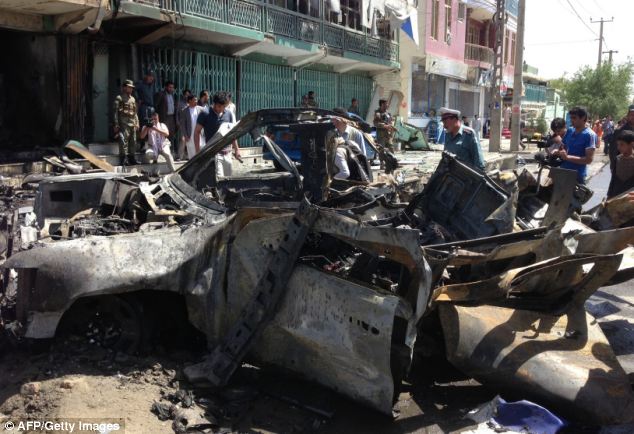
Muslim militant group, Hizb-e-Islami, claimed responsibility for attack
U.S. Defense Secretary confirmed two of the dead are US soldiers
Nationality of four civilian contractors not yet officially announced
Powerful explosion rattled buildings on the other side of Kabul
Identity of dead Americans has not yet been released
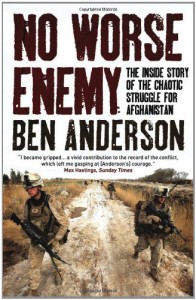
I didn’t plan on spending six years covering the war in Afghanistan. I went there in 2007 to make a film about the vicious fighting between undermanned, underequipped British forces and the Taliban in Helmand, Afghanistan’s most violent province. But I became obsessed with what I witnessed there—how different it was from the conflict’s portrayal in the media and in official government statements.
. . . . . . .
In February 2013, on his last day at the helm of NATO forces in Afghanistan, General John R. Allen described what he thought the war’s legacy will be: ‘‘Afghan forces defending Afghan people and enabling the government of this country to serve its citizens. This is victory, this is what winning looks like, and we should not shrink from using these words.’’
The US and British forces are preparing to leave Afghanistan for good (officially, by the end of 2014), and my time in the country over the last six years has convinced me that our legacy will be the exact opposite of what Allen posits—not a stable Afghanistan, but one at war with itself yet again. Here are a few encapsulated snapshots of what I’ve seen and what we’re leaving behind.
It's an excellent book because it condenses profound wisdom into a short list of key concepts, which makes them easier to remember and easier to build upon. Broad societal change will never come about as long as the general public is left out of the loop. And they need things condensed for them. They don't need to see the big picture in all it's detail. They only need to see it well enough that they will start recognizing truth from lies and traditional folly from emerging wisdom. They can learn the details as they go, just like the rest of us did. And McCarty's books is excellent for that purpose. It's written for the general reader.
But this article is not a book review. I already know something about the ideas she covers in her book, and I want to use them in a way that she didn't use them. I want to apply these 10 ideas to the ideas from another book. Conservatives Without Conscience, by John W. Dean.
Dean's book makes use of the latest findings of social scientists when it comes to the individual and group dynamics of authoritarians. These findings have been confirmed time and again by other social scientists, so there's no question about their conclusions. They have been validated by the latest cognitive science.
Douglas Rushkoff is a media theorist and the bestselling author of Present Shock: When Everything Happens Now. His earlier books include Life Inc, Program or Be Programmed, and Media Virus. He made the PBS Frontline documentaries The Merchants of Cool, The Persuaders, and Digital Nation, and speaks around the world about media, technology, and change.
This is wonderful news. One of those little social acupunctures that allows the 99 per cent to speak out effectively — don't buy their stuff. Go to: http://www.buycott.com/ to download. I urge all my readers to do so and shop accordingly.
Phi Beta Iota: Story is worth reading. Jim Turner (former #2 to Ralph Nader) and others thought of this term “buycott” years ago, and there have been many websites striving to align social values with purchasing habits, but this appears to be the first one that actually puts it all together, and against the two greatest evils less Wal-Mart in the US constellation of evils. Now imagine if this gets to the point that public intelligence can not only identify all the owners and managers of specific firms, but also their stockholders, and refuse service to them as they appear. You cannot eat money. The 1%, for lack of ethical grounding, are using up the 99% seed corn at a much faster rate than they realize. Their airplanes and cars will not be refueled; their chefs will not be able to buy food, deliveries to their mansions will be short-circuited, etc….
I have been reflecting on the past twenty years, and the remarkable resistence of the US Intelligence Community, seemingly impervious to all manner of reform recommendations, be they presidential, congressional, or public. Reform is not transformation. This from Dr. Russell Ackoff, a pioneer in systems thinking and reflexive practice:
Reformations and transformations are not the same thing. Reformations are concerned with changing the means systems employ to pursue their objectives. Transformations involve changes in the objectives they pursue.
And now this from Ada Bozeman:
(There is a need) to recognize that just as the essence of knowledge is not as split up into academic disciplines as it is in our academic universe, so can intelligence not be set apart from statecraft and society, or subdivided into elements…such as analysis and estimates, counterintelligence, clandestine collection, covert action, and so forth. Rather … intelligence is a scheme of things entire. (Bozeman 1998: 177):[1]
The recent NATO Innovation Hub initiative in leveraging social media is a tiny but potentially potent transformation starting point. It reflects clarity, diversity, and integrity. After an open brainstorming session that identified 32 opportunity areas, enablers, and concerns, the team nurturing the NATO Innovation Hub settled on three areas for focus where concept papers will be developed:
-‐ Education and Training through New Media
-‐ Alternative Command and Control
-‐ Social Media Users Training
As one of the early invited participants contributing to the process, I offered the below comments toward the first draft of the concept paper for Alternative Command and Control, and am now adding to that a section on four forcing concepts or functions for transforming strategy, policy, acquisition, and operations via the alternative command and control concept.