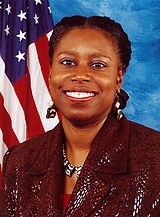
Cynthia McKinney: Fidel Castro Makes Sense, Slams Barack Obama for “Gibberish” and Moral Hazard

04 Inter-State Conflict, 05 Civil War, 06 Genocide, 07 Other Atrocities, 07 Venezuela, 08 Wild Cards, 09 Justice, 10 Security, 11 Society, Corruption, Counter-Oppression/Counter-Dictatorship Practices, Cultural Intelligence, Director of National Intelligence et al (IC), DoD, Government, IO Deeds of War, Military, Officers Call
Cynthia McKinney

Fidel Castro calls Obama UN address ‘gibberish'

Tuesday, 27 September 2011 14:28

“Who understands the gibberish of the president of the United States before the General Assembly?” Castro asked.

AFP – September 26, 2011
HAVANA – Cuba's Fidel Castro blasted Barack Obama's speech to the United Nations as “gibberish” on Monday, saying the US president used a rambling address to justify the “unjustifiable.”

In his first published column since July, the 85-year-old revolutionary icon slammed US and NATO intervention in Libya as “monstrous crimes” and said Obama — whom he called the “yankee president” — used a bully pulpit at the UN General Assembly last week to try and sway global opinion.

Fidel, who handed the presidency to his younger brother Raul Castro in 2006 due to a health crisis, has laid low in recent months, and his column published in state media was his first since July 3.

In Monday's piece he came out swinging, saying Obama distorted the situations in Syria, Iran, Iraq, Yemen, Egypt, Afghanistan, North Korea, Libya and the Palestinian conflict, and that the US leader used “a long rant to explain and justify the inexplicable and unjustifiable.”

“Who understands the gibberish of the president of the United States before the General Assembly?” Castro asked.

Castro also took issue with the “fascist methods by the United States and its allies to confuse and manipulate global opinion,” and said he was heartened by the “resistance” of his key allies Hugo Chavez and Evo Moralez, presidents of Venezuela and Bolivia, respectively, who criticized US and UN policy in their speeches.

“Has any nation been excluded from the bloody threats of this illustrious defender of international peace and security?” Castro said of Obama, whose UN quotes he cited extensively in his column.

“Who gave the United States such privileges?” Castro said.

He said countries must consider taking a stand at the General Assembly against the “NATO genocide in Libya,” an action Castro described as one of many “flagrant violations of principles.”

“Does anyone want it to be recorded that under their direction, the government of their nation supported the monstrous crimes by the United States and its NATO allies?” he said.

Washington and Havana are Cold War adversaries who have brought their mutual dislike and distrust into the 21st century, and Castro routinely makes political attacks on his ideological foe.
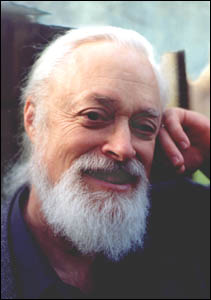

Tom Atlee: Whole System Conversations – Voice of the Whole

Advanced Cyber/IO, Analysis, Augmented Reality, Blog Wisdom, Collaboration Zones, Collective Intelligence, Communities of Practice, Counter-Oppression/Counter-Dictatorship Practices, Ethics, InfoOps (IO), IO Sense-Making, Key Players, Methods & Process, Open Government, Policies, Strategy, Threats
Tom Atlee

Whole System Conversations – and the Voice of the Whole

WHO PARTICIPATES IN “WHOLE SYSTEM” CONVERSATIONS? – PARTISANS, STAKEHOLDERS, DOMAINS, AND CITIZENS

by Tom Atlee

Consciously convened conversations have many functions. Many seek simply to get people talking with each other. Others try to bring together what they call “the whole system” to address that system's collective issues or dreams. Who is involved in these “whole system” conversations?

A “whole system”, in this case, involves all the parties who play – or could play – roles in some social unit or situation. The social unit could be a family or relationship, a group or organization, a community or a whole society. A situation might be, on the one hand, an issue, a problem, or a conflict – or, on the other hand, an inquiry, an opportunity, a shift, or simply a periodic reflection about what's happening. We can convene conversations around any of these things.

So how do we decide who the parties or players are? How do we “cut the pie” of the whole system? And, if we're ambitious, how do we elicit a “voice of the whole”?

I see four different approaches to defining who “a whole system” includes. Each approach has its own rationale and appropriate usages. They are not mutually exclusive, but are usually used more or less separately. Perhaps being aware of them and building synergies between them would enhance the power and wisdom of our conversations. These approaches include:

Read full essay.

Phi Beta Iota:  Tom Atlee is in our view the living founding father of Epoch B–there have been others before him, and there are other now, but for us, he is the spiritual center of gravity for doing the right thing now, here, in America.  Please support his work on behalf of all of us.

Tom Atlee, The Co-Intelligence Institute, POB 493, Eugene, OR 97440
http://www.co-intelligence.org  /  http://tom-atlee.posterous.com
Read THE TAO OF DEMOCRACY –  http://www.taoofdemocracy.com and
REFLECTIONS ON EVOLUTIONARY ACTIVISM – http://evolutionaryactivism.com
Please support our work.  Your donations are fully tax-deductible.

Ric Merrifield: When Metrics & Assumptions Are Wrong

03 Economy, Advanced Cyber/IO, Analysis, Commercial Intelligence, Cultural Intelligence
Ric Merrifield

Moneyball meets cater2.me and Marvin Windows

f you somehow missed it, they turned Michael Lewis’ book Moneyballinto a movie that premiered last weekend.  Given how much coverage it got, I was stunned to see it come in third place at the box office, behind the re-released Lion King of all things.

I have been aware of the book and Billy Beane since Beane turned the baseball world on its ear by proving that the old school measure of talent, batting average, was necessary but not sufficient to make the best decisions about hiring, and talent is everything in baseball – or to put it in Yogi Berra-oid terms – 90% of baseball is 50% talent.

Beane showed that things lke on base percentage, slugging percentage, even the number of walks a player gets can have greater statistical impact on the outcome of games – and of course winning is what matters in the end.  And for years, Beane was the only one managing a team this way, so he had the advantage and his team did better while spending less on their talent (because everyone was still so focused on batting averages).  Now everyone follows this model so the playing field is once again relatively level (albeit a new higher level).

Friday I was listening to NPR and they were talking about the book and the movie and why the book was such a huge hit and the person they were interviewing said it really well – he said the reason Moneyball was such an “important” book was because it rattled an entire industry by showing it the set-in-stone metrics that industry was using were not enough, and that sent ripples into other industies suggesting that they rethink their metrics as well.  In many respects, my book Rethink is a guide to helping organizations do just that.

After I heard that piece on NPR I saw two different articles in The New York Times talking about two very different companies who have followed the Moneyball/Rethink logic and offer some great examples of non-obvious changes.

Continue reading “Ric Merrifield: When Metrics & Assumptions Are Wrong”

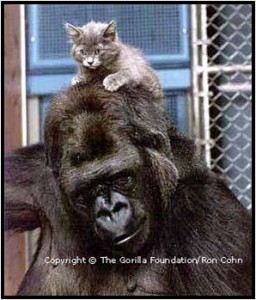
Koko: One Simple Demand — Electoral Reform — Photographic Essay in Search of the Truth

03 Economy, 09 Justice, 11 Society, Advanced Cyber/IO, Civil Society, Cultural Intelligence, Ethics, Government
Koko

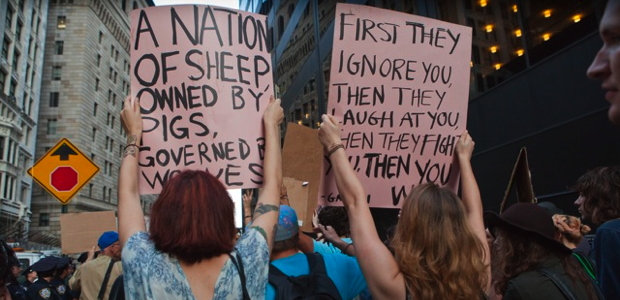
‘One Simple Demand': Scenes From the Wall Street Protests

Julie Dermansky – Julie Dermansky is a multimedia reporter and artist based in New Orleans. She is an affiliate scholar at Rutgers University's Center for the Study of Genocide and Human Rights. Visit her website at www.jsdart.com.

The Atlantic, 27 September 2011

They're calling it America's answer to the Arab Spring. In July, the anti-capitalist magazine Adbusters urged readers to “flood into lower Manhattan, set up tents, kitchens, peaceful barricades and occupy Wall Street for a few months. Once there,” it continued, “we shall incessantly repeat our one simple demand until Barack Obama capitulates.”

Click on Image to Enlarge

As planned, thousands began gathering on September 17, but 10 days into their demonstration, it's not entirely clear what that “one simple demand” might be. Many of the hand-scrawled signs lash out against corporations. But as the days go by, new issues emerge. The execution of Georgia prisoner Troy Davis four days into the protest made the death penalty into a central theme. And the NYPD has become a major target for rage, especially after Saturday's reports that a police officer (improbably named Anthony Bologna) had aimed pepper spray at a protester's face.

Photographer Julie Dermansky, who covered the protests in Tahrir Square, headed to New York after seeing videos of the Wall Street demonstrations on Facebook. These photos capture some of the scenes she encountered yesterday.

See full photographic essay.

See Also:

Continue reading “Koko: One Simple Demand — Electoral Reform — Photographic Essay in Search of the Truth”

AFIO: Bizarre System of Hiring Intelligence Contractors

03 Economy, 07 Other Atrocities, Commerce, Commercial Intelligence, Corporations, Corruption, DHS, Director of National Intelligence et al (IC), DoD, Government, Intelligence (government), Methods & Process, Secrecy & Politics of Secrecy

The Bizarre System of Hiring Intelligence Contractors

Joshua Foust – Joshua Foust is a fellow at the American Security Project and the author of Afghanistan Journal: Selections from Registan.net.

The Atlantic, 20 September 2011

This morning I testified at the Senate Committee on Homeland Security and Government Affairs' Subcommittee on Oversight of Government Management, the Federal Workforce, and the District of Columbia (a mouthful, I know) about how we can better manage and administer contractors within the intelligence community. I'm pasting a brief excerpt of my written testimony below, followed by a link to the full text of my remarks.

Every contract the government issues for a company to perform work is defined by the Statement of Work (SOW). This is a document that defines the parameters of the work the contractor will perform, including a description of the project, expected duties the contractor must fulfill, and the outputs and metrics by which performance will be measured. These are often poorly written, kept intentionally vague, and wind up not actually addressing the stated intent of the contracts.

As one example, every SOW I've had to either administer, edit, review, or write has stated as a basic metric of performance the number of employees the contractor should hire. That is, the basic means by which the government measures the contractor's performance is based first and foremost on the number of people hired to work on the contract. This has two serious consequences that affect the contracting environment: it removes the distinction between employees that would make work products better, and it confuses the number of employees with contract performance.

The frankly bizarre system of hiring intelligence contractors is born from several interdependent processes: getting a security clearance, getting hired, and getting “read on” to work at a government site. The system of getting a clearance is structured such that those with clearances are given preference above those without clearance, regardless of the relevant experience of either employee. In other words, if two candidates are competing for a job with a contractor, and one has deep relevant experience but no clearance, she will most likely lose to a candidate with less relevant experience but a current and active security clearance.

There is a great deal more to this, and I would suggest anyone interested in this topic to download both my own testimony (At SCRIBD, or PDF here), and checking out the Hearing page, which includes written remarks from Daniel Gordon from the Office of Management and Budget, DHS Chief of Intelligence Charles E. Allen, Scott Amey from the Project on Government Oversight, and Dr. Mark Lowenthal.

John Steiner: October 2011, Occupy Wall Street, Whatever Happened to the US Left?

Civil Society, Collective Intelligence, Corruption, Counter-Oppression/Counter-Dictatorship Practices, Cultural Intelligence, Ethics, Government, Officers Call, Policies, Threats
John Steiner

“American Autumn” Will Depend on People, Not Parties”

Monday 26 September 2011
by: Ron Boyer, Truthout | Interview

EXTRACT:

A few years later, with the nation plunged into what appears to be a sequel to the Great Depression and another presidential campaign season taking shape, signs of mass populist resistance to the global dominance of the robber-baron class are widely in evidence, both here and abroad. In this exclusive Truthout interview, the October2011 Coalition co-founder and physician Margaret Flowers discusses the conditions that helped bring this emerging movement of citizen activists into being and outlines the key differences between October2011's mission and that of superficially similar emerging “movements” such as Van Jones' Rebuild the Dream.

Read full interview.

Occupy Wall Street rediscovers the radical imagination


guardian,

The young people protesting in Wall Street and beyond reject this vain economic order. They have come to reclaim the future.

• Police tactics attacked as officers pepper-spray women
• Occupy Wall Street: the protesters speak

Read full overview.

Whatever Happened to the American Left?

Michael Kazin

New York Times, 24 September 2011

SOMETIMES, attention should be paid to the absence of news. America’s economic miseries continue, with unemployment still high and home sales stagnant or dropping. The gap between the wealthiest Americans and their fellow citizens is wider than it has been since the 1920s.

Read full article.

Koko: American Patriot Del Spurlock Speaks to the NAACP in Oberlin, Ohio

07 Other Atrocities, Blog Wisdom, Counter-Oppression/Counter-Dictatorship Practices, Cultural Intelligence, Ethics
Koko

Koko Signs:  A small sign of life within the comatose US democracy.

OBERLIN 2011

A Speech Given to the NAACP

at the Oberlin Inn

September 24, 2011

by

Delbert L. Spurlock, Jr.

Mr. Spurlock was introduced by Robert K. Jones (B.J.), Chief of Police, Retired Oberlin Police Department.

EXTRACT:

We live in a country that has mutated a new confederate virus, wiping out the rights fought for and won against terrible odds by the NAACP, and the unbelievably brave black plaintiffs of the South.

It is a virus that works to obliterate the memory of the contributions of the white southern judges of the old Fifth Circuit Court of Appeals.

It is a virus that has spread to Ohio through word of mouth in right-wing mega churches and by hypodermic injections of rigged electronic voting devices.

We live in a country that raises its young to be economic units incapable of escaping from a lifetime of paying off the company store.

The days ahead will be very difficult for our America and worse for its human citizens. The country we bequeath to our young people is a country without bearing, without antecedent, a country with a government most resembling the disfunctionality of the slavocracy, which all people of Oberlin should recognize.

Full Presentation Below the Line.

Continue reading “Koko: American Patriot Del Spurlock Speaks to the NAACP in Oberlin, Ohio”

noble gold