
Bahrain, Egypt-Gulf Cooperation Council (GCC), Lebanon, Libya, Libya-India, Comment on No-Fly Zones, Special Comment on Aid to Uprisings and Mercenaries
Reference: Crisis Mapping
Advanced Cyber/IO, Analysis, Augmented Reality, Autonomous Internet, Budgets & Funding, Collaboration Zones, Collective Intelligence, Communities of Practice, Counter-Oppression/Counter-Dictatorship Practices, Ethics, info-graphics/data-visualization, InfoOps (IO), International Aid, Journalism/Free-Press/Censorship, Key Players, Maps, Methods & Process, microfinancing, Mobile, Open Government, Policies, Real Time, Reform, Threats, Tools
Recommended:
see http://p2pfoundation.net/Crisis_Mapping,
part of http://p2pfoundation.net/Category:Geography
and updated via http://delicious.com/mbauwens/P2P-Mapping
Canadian Citizens Keep Lying on the Air Illegal
Advanced Cyber/IO, Civil Society, Cultural Intelligence, Government Robert F. Kennedy Jr.
President, Waterkeeper Alliance; Professor, Pace University
Huffington Post, February 28, 2011 09:54 PM
Regulators Reject Proposal That Would Bring Fox-Style News to Canada
As America's middle class battles for its survival on the Wisconsin barricades — against various Koch Oil surrogates and the corporate toadies at Fox News — fans of enlightenment, democracy and justice can take comfort from a significant victory north of Wisconsin border. Fox News will not be moving into Canada after all! The reason: Canadian regulators today announced they would reject efforts by Canada's right-wing Prime Minister, Stephen Harper, to repeal a law that forbids lying on broadcast news.
Canada's Radio Act requires that “a licenser may not broadcast … any false or misleading news.”
Continue reading “Canadian Citizens Keep Lying on the Air Illegal”
John Seely Brown’s New Culture of Learning and US Unified Community Action Network (US UCAN)
Advanced Cyber/IO, Civil Society, Collective Intelligence, Commerce, Commercial Intelligence, Cultural Intelligence
in a world of constant flux a person who is not curious is screwed.
John Seeley Brown
In the past eight weeks as I have become more familiar with Internet2’s award to build a backbone to connect upwards of 200,000 unified community anchor institutions into a national network and have put this knowledge alongside that of the peer to peer open knowledge resource Commons represented by Michel Bauwens, I had a gut feeling that somehow someway there is a connection yearning to be made between these two very disparate groups. There is nothing overly obvious in my construct. It is just a tacit feeling that there is a huge potential here.
One thing that I observed from listening to the lecture that I did not get out of the book is that there are ever evolving ways of interpreting one’s surroundings and what is happening. JSB used the same two examples of self-taught surfers in Hawaii and World of Warcraft generation of knowledge that he did in his April 2010 Power of Pull lecture. But by late June 2010 he had evolved these concepts in new interesting and refreshing ways. One point in the lecture that was quite critical indeed was the concept of study groups in the learning 21st-century terms as opposed to education the 19th century term. Success now is found to be dependent to a very large extent on one’s ability to form study groups and that these groups could enable a self-motivated socialized learning experience that a more solitary approach to some rigid curriculum could not. And of course in the world of constant technology change the idea of a rigid curriculum is found wanting.
See Also:
CONNECT First, the Collective Intelligence Will Happen Naturally
Review: The World Is Open–How Web Technology Is Revolutionizing Education
RED FLAG: State Revenue Estimates Hosed
03 Economy, 11 Society, Budgets & Funding, Government
ERRORS IN STATE REVENUE ESTIMATES GROWING IN SIZE AND FREQUENCY
WASHINGTON — States have been making more serious errors in estimating their revenues during tough economic times, according to a new report by the Pew Center on the States and The Nelson A. Rockefeller Institute of Government. This has significant implications for policy makers who need to know how much money they will have to spend on programs and services as they grapple with severe budget shortfalls.
The report, States’ Revenue Estimating: Cracks in the Crystal Ball, found that in fiscal year 2009—the first of the ongoing budget crisis—half the states overestimated revenues by at least 10.2 percent. That equated to an unexpected shortfall of nearly $50 billion in personal income, corporate income and sales tax revenues. In a year when state policy makers faced $63 billion in mid-year shortfalls—coming atop $47 billion they already had closed when crafting their budgets—this was a significant challenge. States had to close the gaps by cutting spending, increasing taxes and fees, tapping reserves and borrowing.
The study found that the primary culprit driving more serious and frequent errors is not the states’ processes, methods and techniques, but rather, the increasing volatility of the revenue streams themselves. This appears to result from states’ growing reliance on income taxes and the ways in which highly fluctuating capital gains affect income tax revenue.
Understanding America’s Decline: When…
09 Justice, 10 Security, 11 Society, Advanced Cyber/IO, Communities of Practice, Corruption, Officers Call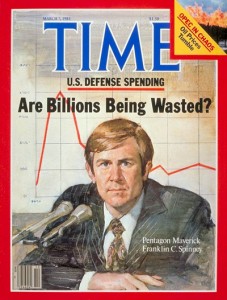
… we reward incompetence and/or lying as described below in the essay by Robert Parry?
Chuck Spinney
Gates Agrees, Bush's Wars Were Nuts
By Robert Parry, consortiumnews.com, February 27, 2011
When Defense Secretary Robert Gates told West Point cadets that you’d have to be crazy to commit U.S. troops to wars like those in Iraq and Afghanistan, media commentators quickly detected a slap at his predecessor, Donald Rumsfeld, who oversaw those conflicts.
But what about everyone else in the U.S. power structure who went along with those insane and bloody wars? Shouldn’t such people – whether they acted out of ideology or opportunism – be kept away from levers of authority that might get others killed?
For instance, what about the top editors at the Washington Post, the New York Times and a host of other establishment publications and TV outlets who hopped on the pro-war bandwagon and mocked anyone who suggested that negotiations or some less violent means might be preferable? Read more….
Phi Beta Iota: Like most others, Dr. Gates finds his integrity late in life. It was not just those who lied to the public who betrayed the public trust, but also those like Dr. Gates who kept silent. A handful of us tried to buy full page advertisements against the wars, only to have them rejected by The Washington Post, Los Angeles Times, etcetera. This is what happens when the “elite” value their membership in the elite club more than they value their integrity. Integrity matters most when you can still make a difference, not after the fact when you have reaped all you could from “going along.” At this juncture in time, the simple best thing for America–apart from Electoral Reform–would be the resurrection of integrity among our senior officials.
No Such Thing As a Good War….
09 Justice, 10 Security, 11 Society, Advanced Cyber/IO, Communities of Practice, Corruption, Counter-Oppression/Counter-Dictatorship Practices, Key Players, Misinformation & Propaganda, Money, Banks & Concentrated Wealth, Peace Intelligence, Power Behind-the-Scenes/Special Interests, Secrecy & Politics of Secrecy, True CostAdvocates of humanitarian intervention like to use Kosovo as an example of a “good” war to distinguish it from Bush's bad war in Iraq and the Bush/Obama bungles in Afghanistan. But Kosovo was a template for bungling and blowback in the wars of empire that emerged after the collapse of the Soviet Union. The below article is outlines some of the reasons why this is so.
Chuck Spinney
The Blaster
By GREGORY CLARK, Japan Times, 1 March 2011
A recent Council of Europe report says that during and after the 1998-99 Kosovo conflict, militia leaders of the Kosovo Liberation Army (KLA) tortured and killed hundreds of Serbs and political rivals in secret Albanian hideouts, removed their organs for sale and dumped their bodies in local rivers.
The report added that these people were also heavily involved in drug, sex and illegal immigrant trafficking across Europe. Yet while all this was going on, the NATO powers had decreed that Serbia should be bombed into accepting the KLA as Kosovo's legitimate rulers — rather than the more popular Democratic League of Kosovo headed by the nationalist intellectual Ibrahim Rugova advocating nonviolent independence.
Recent years have not been kind to Western policymakers. They have shown an almost unerring ability to choose the wrong people for the wrong policies. Think back to the procession of incompetents chosen to rescue Indochina from the communist enemy. Does anyone even remember their names today? Yet at the time they were supposed to be nation-savers. Read more….
Phi Beta Iota: It is now known that the World Wars were enabled by bankers intent on empowering the evil side with loans so as to force the good side to borrow heavily. Bankers–and corporate mercenary interests with zero respect for “the public interest,” have created a world of grostesque inquality instead of a prosperous world at peace. Revolution 2.0 is connecting the public–that is phase one–to be followed by phase two, an informed public that will not brook corruption.
