Olivier Zara: Free Online New Book (in French) on Paradoxical Management

Advanced Cyber/IO, Collective Intelligence, Commercial Intelligence, Communities of Practice, Cultural Intelligence, Ethics
Olivier Zara
Olivier Zara

Management de l'intelligence collective

Réseaux sociaux – Technologies 2.0

A l’évocation du mot “intelligence collective”, certains comprennent “perdre le contrôle”, anarchie, désordre,… ; d’autres comprennent innovation, résolution de problème, performance collective, valorisation des intelligences et des expertises pour mieux produire et mieux vendre.

Dans les entreprises, l’intelligence collective n’existe pas. Il faut la créer par la volonté des dirigeants (c’est une décision, une vision, un paradigme et non le constat résigné qu’on fait que cela existe ou que cela n’existe pas). Dire que l’intelligence collective n’existe pas est une vision du monde. Vouloir créer l’intelligence collective et la gérer est une autre vision du monde. Si vous lisez ce blog… vous connaissez la mienne 

Cliquez sur l'image pour agrandir

Mais, peut-on vouloir créer et gérer l’intelligence collective si on a peur de produire du désordre, de l’anarchie ? Depuis 10 ans que je travaille sur le sujet, j’ai toujours considéré que le simple fait de poser cette question était une forme de résistance au changement et que répondre à cette question était une perte de temps. Je pense aujourd’hui que je me suis trompé et, par ce billet, je vais donc réparer mon erreur.

Pour répondre à la question, je vous propose le concept de management paradoxal qui induit l’idée d’une organisation paradoxale. Le terme de  “management paradoxal” m’a été inspiré par Dee Hock, fondateur et ancien CEO de VISA via son livre Birth of the Chaordic Age. “Chaordic” est la contraction de chaos et d’ordre : http://en.wikipedia.org/wiki/Chaordic.

Voici une carte de l’organisation paradoxale montrant les 8 parties indispensables à la construction d’une entreprise performante :

Lire la présentation complète

English and Other Links Below the Line

Continue reading “Olivier Zara: Free Online New Book (in French) on Paradoxical Management”

Michelle Monk: Monsanto Protest in Las Vegas Attracts 2,000 — Meanwhile, China, Haiti, Hungary Incinerate Monsanto Corn, Millions March Against Monsanto

01 Agriculture, 01 Poverty, 02 China, 03 Environmental Degradation, 07 Health, 07 Other Atrocities, 08 Wild Cards, 09 Justice, 11 Society, 12 Water, Civil Society, Commerce, Corruption, Cultural Intelligence, Earth Intelligence, Ethics
Michelle Monk
Michelle Monk

Monsanto protest attracts 2,000 in Las Vegas

Protesters rallied in Nevada as part of a global protest against seed giant Monsanto and the genetically modified food it produces.

“March Against Monsanto” protests Saturday drew some 2,000 protesters in Las Vegas and about 150 in Reno.

Las Vegas protesters marched about one mile down Las Vegas Boulevard to the “Welcome to Fabulous Las Vegas” sign, while Reno protesters chanted and waved placards as they marched through downtown Reno.

Genetically modified plants are grown from seeds that are engineered to resist insecticides and herbicides, and to improve crop yields.

monsanto protestsMost corn, soybean and cotton crops grown in the U.S. today have been genetically modified. But critics say genetically modified organisms can lead to serious health conditions and harm the environment.

Monsanto Co. says it respects people’s rights to express their opinion on the topic, but maintains that its seeds improve agriculture.

See Also:

China Incinerates 3 US Shipments of Genetically Modified Corn

Haitian Farmers Commit to Burning Monsanto Hybrid Seeds

Hungary Burns All Monsanto GMO Corn Fields

Millions March Against GM Crops

Continue reading “Michelle Monk: Monsanto Protest in Las Vegas Attracts 2,000 — Meanwhile, China, Haiti, Hungary Incinerate Monsanto Corn, Millions March Against Monsanto”

DefDog: Russian Target #1? Dimona, Israel — Along with an Alternative History Worth Reading

02 Diplomacy, 04 Inter-State Conflict, 05 Civil War, 05 Iran, 06 Russia, 08 Wild Cards, 10 Security, 11 Society, Civil Society, Ethics, Government, IO Deeds of Peace, Military, Peace Intelligence
DefDog
DefDog

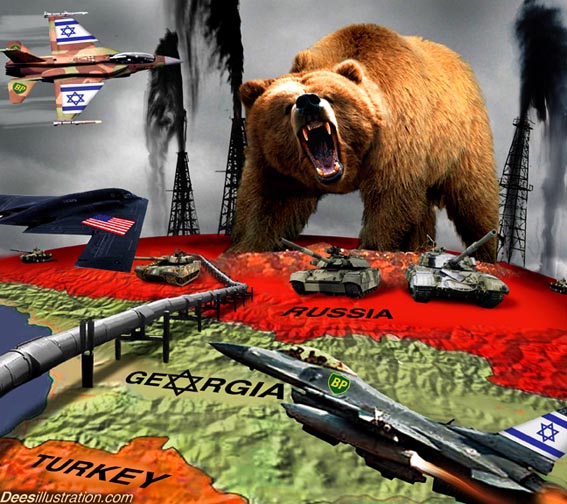
Funny how stuff gets around.  More than one source is talking about Dimona, Israel as the ideal “proportionate response” from Russia with love…  Not sure why the French are allowing false stories about chemical weapons use by Assad — and we all continue to worry about Israel and the neo-cons simulating Iranian attacks on US targets, the last thing they would be doing right now when all the cards are in their favor.

We are All Russians Now (author unknown)

Veterans Today, 27 Monday 2013

Will Putin Save The World From Israel?

Vladimir Putin

Shortly after Vladimir Putin was elected president of Russia in 2000, the murdered family of Tzar Nicholas was beatified. Until quite recently, the centers of Jewish power had hoped to preserve some idealized memories of the murderous Soviet system in the minds of the Russians, but it turned out to be a vain hope.

Because Bolshevism was formulated and executed by Jews, their power centers had retained fond hopes of being able some day to reconnect and reinstall some sort of Jewish lobby leverage in the Kremlin. These fond hopes were dashed by Vladimir Putin.

By the end of 2008, the Russians were expected to decide between two ideological systems: between Communism as represented by Stalin and his fanatical band of murderous Cheka Jews or the conservative and traditional values of old-fashioned Tzarism. Until quite recently, Stalin had remained slightly ahead of Tzar Nicholas II. “Then, however, the Tzar mysteriously pulled ahead.” (Die Welt, 17 July 2008, page 1)

After that, no further choice was necessary.

Click on Image to Enlarge
NEMO ME IMPUNE LACESSIT
No one provokes me with impunity

The Jewish Lobby was of course hoping that a Tzarist cult would never rise again. Given that the Tzar had been the great adversary of the Bolshevik Jews, the Jewish Lobby did all it could to blacken the reputation of the Tsars. Now however, the Russians again see in Tzar Nicholas II a kind of savior who, like Jesus Christ, had made an enemy of the Jews and had suffered martyrdom.

Continue reading “DefDog: Russian Target #1? Dimona, Israel — Along with an Alternative History Worth Reading”

Berto Jongman: McKinsey 12 Technologies Driving the Future — With Comment from Robert Steele

Advanced Cyber/IO, Civil Society, Collective Intelligence, Commerce, Commercial Intelligence, Earth Intelligence, Ethics
Berto Jongman
Berto Jongman

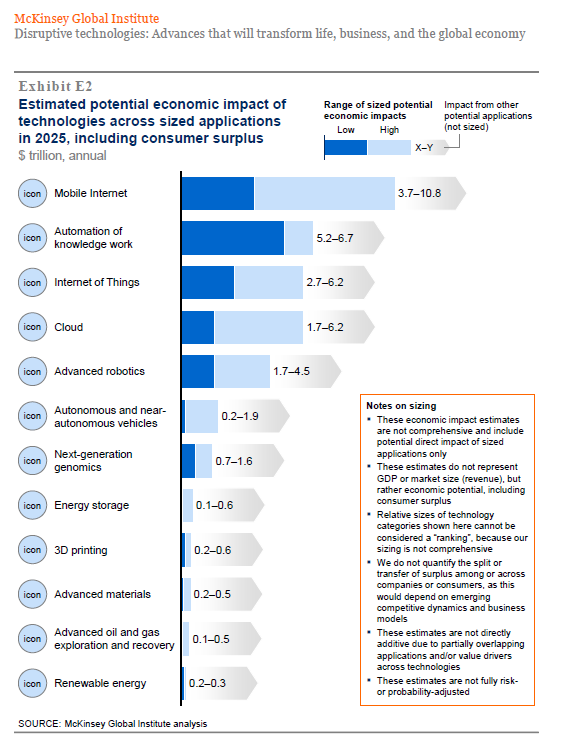
These 12 technologies will drive our economic future

Neil Irwin

Washington Post, 24 May 2013

As the chart shows, the McKinsey folks believe that the most economically significant technologies over the next decade-plus will be those already well underway in their development — the mobile Internet, largely in place in the adv

Click on Image to Enlarge

Indeed, maybe the single biggest takeaway from the study is this: The things that will have the greatest impact on the economy in the medium term aren’t the ones that seem to most excite the imagination and public interest. Instead, the potentially powerful innovations are mostly those that have been evolving for many years in new ways.

. . . . . . . .

The real economic benefits of innovation, at least over the near term, come not from the flashy, mind-blowing ideas, but from clever combinations of technologies that are just maturing with those that have been around for ages.

Continue reading “Berto Jongman: McKinsey 12 Technologies Driving the Future — With Comment from Robert Steele”

Mini-Me: End Hunger, 3D Printed Food — GMO on Steroids, Toxins Free

01 Agriculture, 01 Poverty, 07 Health, Ethics
Who?  Mini-Me?
Who? Mini-Me?

Huh?

NASA-funded research

The audacious plan to end hunger with 3-D printed food

Christopher Mims

Quartz, 21 May 2013

Anjan Contractor’s 3D food printer might evoke visions of the “replicator” popularized in Star Trek, from which Captain Picard was constantly interrupting himself to order tea. And indeed Contractor’s company, Systems & Materials Research Corporation, just got a six month, $125,000 grant from NASA to create a prototype of his universal food synthesizer.

But Contractor, a mechanical engineer with a background in 3D printing, envisions a much more mundane—and ultimately more important—use for the technology. He sees a day when every kitchen has a 3D printer, and the earth’s 12 billion people feed themselves customized, nutritionally-appropriate meals synthesized one layer at a time, from cartridges of powder and oils they buy at the corner grocery store. Contractor’s vision would mean the end of food waste, because the powder his system will use is shelf-stable for up to 30 years, so that each cartridge, whether it contains sugars, complex carbohydrates, protein or some other basic building block, would be fully exhausted before being returned to the store.

Ubiquitous food synthesizers would also create new ways of producing the basic calories on which we all rely. Since a powder is a powder, the inputs could be anything that contain the right organic molecules. We already know that eating meat is environmentally unsustainable, so why not get all our protein from insects?

If eating something spat out by the same kind of 3D printers that are currently being used to make everything from jet engine parts to fine art doesn’t sound too appetizing, that’s only because you can currently afford the good stuff, says Contractor. That might not be the case once the world’s population reaches its peak size, probably sometime near the end of this century.

“I think, and many economists think, that current food systems can’t supply 12 billion people sufficiently,” says Contractor. “So we eventually have to change our perception of what we see as food.”

Read full article with graphics, photos, video.

Continue reading “Mini-Me: End Hunger, 3D Printed Food — GMO on Steroids, Toxins Free”

David Swanson: US Census Identified & Catalogued “Anti-Government” Respondents

09 Justice, 10 Security, 11 Society, Ethics, Government
David Swanson
David Swanson

The Government's List of “Anti-Government” People

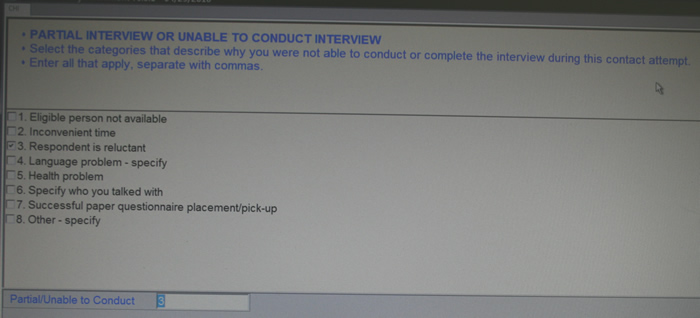
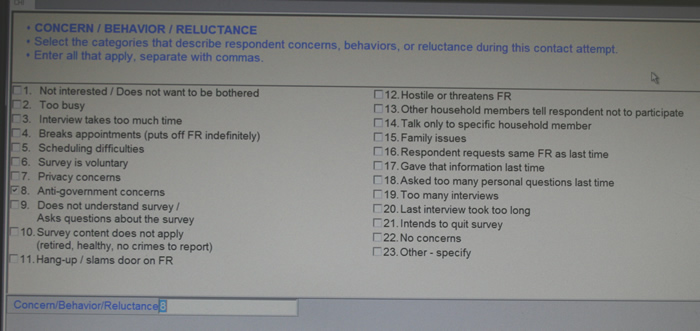
Should the U.S. government be building a list of people whom a stranger has concluded based on as little as a moment's interaction are “anti-government”?  Look at this photo of a U.S. Census laptop.  There's a box to check if a respondent is reluctant to participate in the census.

Click on Image to Enlarge

The next screen wants the census interviewer to explain the potential interviewee's reluctance:

Click on Image to Enlarge

Notice that there is a box for hostile or threatening.  That seems important.  There are boxes for just not interested or too busy.  There is a box for those who object that too many personal questions are asked.  The basics all seem to be covered.  But the Census employee is to check multiple boxes, “all that apply,” and one is  “Anti-government concerns.”  What does that mean?  What do Census workers think it means?  It clearly means something other than reluctant to give the government this information.  To be “anti-” the government sounds like someone is in favor of overthrowing the government.  And a government that thinks purely in terms of violence would inevitably interpret such a desire as one in favor of violently overthrowing the government.  But surely nobody tells a representative of the government that they favor its violent overthrow unless they don't really take themselves seriously and are not actually a threat.  So maybe this “Anti-government concerns” box is equivalent to “Seems nuts,” but what sort of training does the survey taker have in mental health?  The serious question is what lists your name goes on if somebody marks you down as Anti-government.