Six top hits on future information operations, five Phi Beta Iota references on same.
Continue reading “Future of Information Operations (IO) — Potpourri”

The truth at any cost lowers all other costs — curated by former US spy Robert David Steele.
Six top hits on future information operations, five Phi Beta Iota references on same.
Continue reading “Future of Information Operations (IO) — Potpourri”

ECONOMIC SCENE
Why Budget Cuts Don’t Bring Prosperity
New York Times, February 22, 2011
Remember the German economic boom of 2010?
Germany’s economic growth surged in the middle of last year, causing commentators both there and here to proclaim that American stimulus had failed and German austerity had worked. Germany’s announced budget cuts, the commentators said, had given private companies enough confidence in the government to begin spending their own money again.
Well, it turns out the German boom didn’t last long. With its modest stimulus winding down, Germany’s growth slowed sharply late last year, and its economic output still has not recovered to its prerecession peak. Output in the United States — where the stimulus program has been bigger and longer lasting — has recovered. This country would now need to suffer through a double-dip recession for its gross domestic product to be in the same condition as Germany’s. Read more….
Does The U.S. Really Have A Fiscal Crisis?
By Simon Johnson, The Baseline Scenario, 24 February 2011
The United States faces some serious medium-term fiscal issues, but by any standard measure it does not face an immediate fiscal crisis. Overindebted countries typically have a hard time financing themselves when the world becomes riskier – yet turmoil in the Middle East is pushing down the interest rates on US government debt. We are still seen as a safe haven.
Yet leading commentators and politicians today repeat the line “we’re broke” and argue there is no alternative other than immediate spending cuts at the national and state level.
Which view is correct? And what does this tell us about where our political system is heading? Read more….
Continue reading “US Economy, US Federal Budget–To Cut or Not to Cut?”
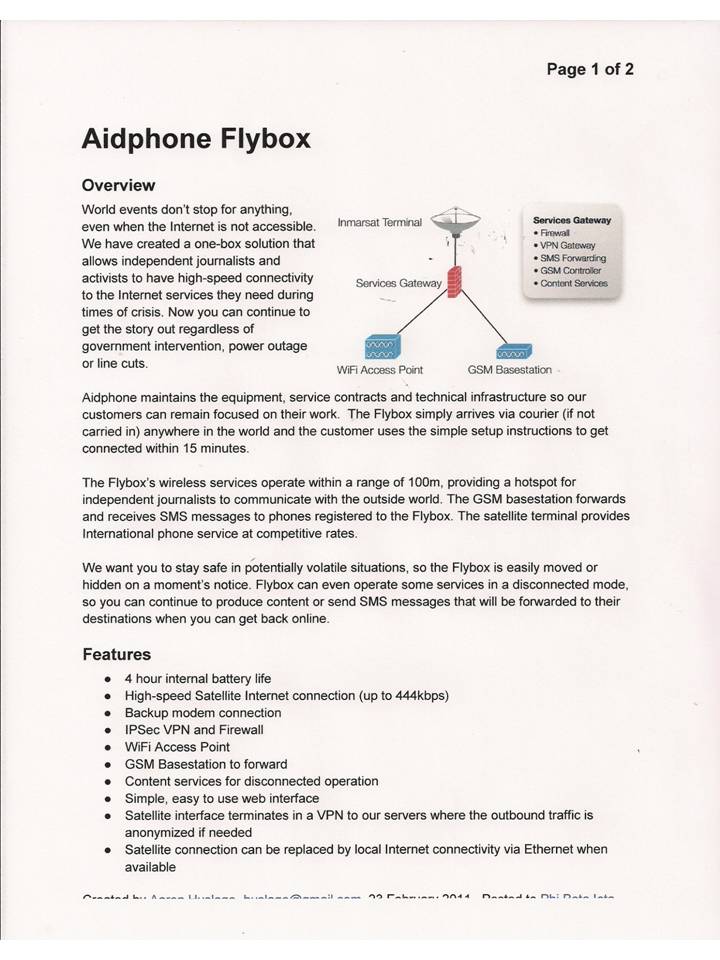
Two Pages Online . . Aaron Huslage . . ContactCon

Another blockbuster by Rolling Stone raises a basic question of just who the military views as the real enemy — the threat posed by the Taliban or the threat to its money flow posed by Congress and the American people.
Another Runaway General: Army Deploys Psy-Ops on U.S. Senators
Michael Hastings, Rolling Stone, 23 February 2011
The U.S. Army illegally ordered a team of soldiers specializing in “psychological operations” to manipulate visiting American senators into providing more troops and funding for the war, Rolling Stone has learned – and when an officer tried to stop the operation, he was railroaded by military investigators.
The orders came from the command of Lt. Gen. William Caldwell, a three-star general in charge of training Afghan troops – the linchpin of U.S. strategy in the war. Over a four-month period last year, a military cell devoted to what is known as “information operations” at Camp Eggers in Kabul was repeatedly pressured to target visiting senators and other VIPs who met with Caldwell. When the unit resisted the order, arguing that it violated U.S. laws prohibiting the use of propaganda against American citizens, it was subjected to a campaign of retaliation.
“My job in psy-ops is to play with people’s heads, to get the enemy to behave the way we want them to behave,” says Lt. Colonel Michael Holmes, the leader of the IO unit, who received an official reprimand after bucking orders. “I’m prohibited from doing that to our own people. When you ask me to try to use these skills on senators and congressman, you’re crossing a line.”
The list of targeted visitors was long, according to interviews with members of the IO team and internal documents obtained by Rolling Stone. Those singled out in the campaign included senators John McCain, Joe Lieberman, Jack Reed, Al Franken and Carl Levin; Rep. Steve Israel of the House Appropriations Committee; Adm. Mike Mullen of the Joint Chiefs of Staff; the Czech ambassador to Afghanistan; the German interior minister, and a host of influential think-tank analysts.

Jon Lebkowsky is, among many things, contributing editor of Extreme Democracy (Lulu.com, 2005). His briefing below brings up many points, among which three stand-out:
1. There is no lack of intelligence–what is lacking are the tools for achieving extreme democracy in the face of a tsunami of noise and electronic pollution, with five core functional requirements: gather data, analyze data, generate options, choose/vote, and implement.
2. The principle challenge to democracy at this point in time is not from governments, but rather from those corporations that presume to “own” the Internet and all content irrespective of who generates it.
3. Freedom Box (and what we have begun calling the Autonomous Internet) are an alternative–while he does not go into detail it is clear that there is a sufficiency of both money and knowledge to create a distributed Autonomous Internet.
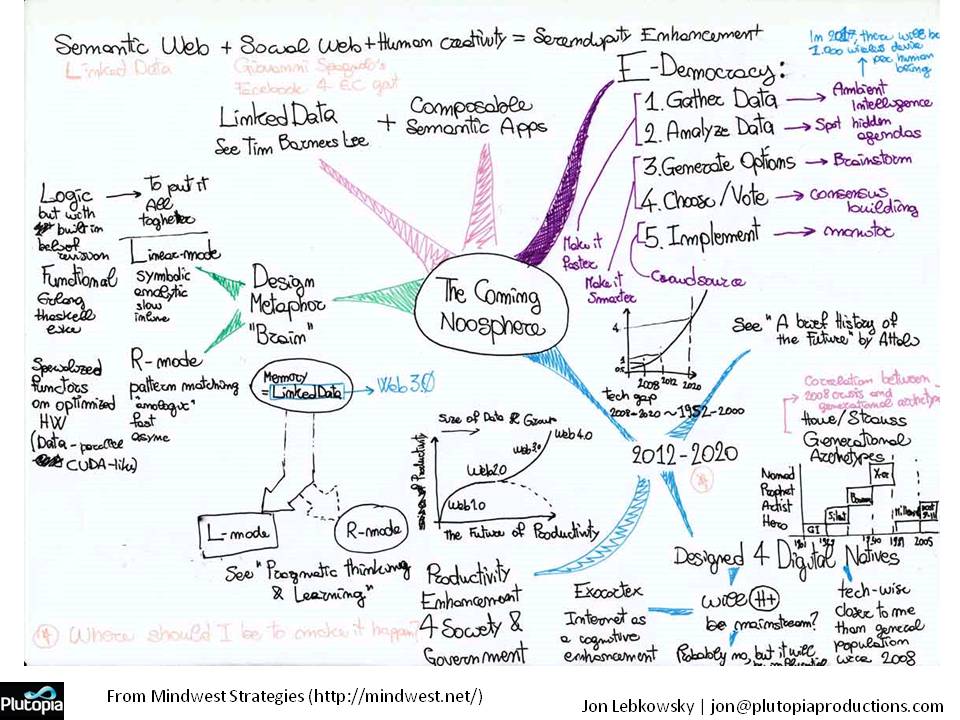
Briefing Online (Downloadable, No Notes)
See Also:

O3b Networks delivers broadband connectivity everywhere on Earth within 45 degrees of latitude north and south of the equator.
Our vast coverage area includes emerging and insufficiently connected markets in Latin America, Africa, the Middle East, Asia and Australia, with a collective population of over 3 billion people.

SatMagazine 2010 Year In Review on O3b
O3b Networks: A far-out plan to deliver the Web (CSM)
Africa, Web Access: What Google's Doing Right (ABC)
Continue reading “O3b Satellite Broadband — Google Cell Play?”