Communication through voice, sms/text, mobile internet, basic features to mobile touchscreen interfaces, GPS capabilities, and the emerging “augmented reality” features, and mobile projection.
Danish students will in the future have access to a library of more than 100 apps for mobile phones, teaching them math in a more fun and engaging way. All mobile data traffic will be free, thanks to a partnership with the national mobile operators.
If you are in Denmark, you can follow the life of a homeless man called Allan via an SMS service. Guerilla Innovation reports.
Other projects involving cell phones, aiming to raise awareness on the plight of the homeless:
— Underheard in New York – Three interns of Bartle Bogle Hegarty in New York decided to pair mobile technology with social justice, as they gave four homeless men cellphones.
— Text a donation via homeless installation in Times Square – The one-day-only installation is part of a fundraising effort for Serving the UnderServed (SUS), an organization that provides housing and other services to the homeless and disabled.
— Google offers phone numbers, voicemail to homeless – In 2008, Google made a donation of phone service to Project Homeless Connect, an effort dedicated to providing ordinary services to the very poor.
Comment: Another virtually invisible attempt in New York City is the text message service where sending “txtnyc” (space) “ss” to 368-638 will give you a menu to receive information on emergency services such as free meals, food pantries, shelter, hygiene services, etc for all NYC boroughs (“ss” stands for “street sheets“). The idea being in conjunction with free phones from say Safelink Wireless (if this is even possible) or donated Tracfones. Phones pre-installed with a directory of useful numbers to help those who are homeless to gradually climb out of extreme poverty is another idea.
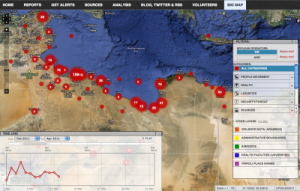
OCHA, UNOSAT and NetHope have been collaborating with the Volunteer Technical Community (VTC) specifically CrisisMappers, Crisis Commons, Open Street Map, and the Google Crisis Response Team over the past week.
The CrisisMappers Standby Task Force has been undertaking a mapping of social media, news reports and official situation reports from within Libya and along the borders at the request of OCHA. The Task Force is also aiding in the collection and mapping of 3W information for the response. UNOSAT is kindly hosting the Common Operational Datasets to be used during the emergency. Interaction with these groups is being coordinated by OCHA’s Information Services Section.
The public version of this map does not include personal identifiers and does not include descriptions for the reports mapped. This restriction is for security reasons. All information included on this map is derived from information that is already publicly available online (see Sources tab).
Click for Live Map with Substance Links
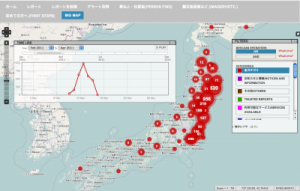
In the midst of this transition in Libya, one of the most devastating earthquakes in centuries hit northern Japan, causing one of the most destructive tsunamis in recent memory. Just hours after the earthquake, a member of Japan's OpenStreetMap community launched a dedicated Crisis Map for the mega-disaster. A few hours later, Japanese students at The Fletcher School (which is where the Ushahidi-Haiti Crisis Map was launched) got in touch with the Tokyo-based OpenStreetMap team to provide round-the-clock crisis mapping support.
Over 4,000 reports have been mapped in just 6 days. That's an astounding figure. Put differently, that's over 600 reports per day, or one report almost every two minutes for 24 hours straight over 6 days. What's important about the Japan Crisis Map is that the core operations are being run directly from Tokyo and the team there is continuing to scale it's operations. It's very telling that the Tokyo team did not require any support from the Standby Volunteer Task Force. They're doing an excellent job in the midst of the biggest disaster they've ever faced. I'm just amazed.
Tip of the Hat to Patrick Meier and Team at iRevolution.
On the evening on March 24, 2011, EFF staff activists will discuss the state of government surveillance and privacy in the United States at “Government Surveillance in a Digital World,” an event hosted by San Francisco Intersection for the Arts, with a live video stream by BAMM.tv.
One of the many topics to be discussed is the PATRIOT Act. For nearly ten years, EFF has fought to reform or repeal the overbroad authority granted to law enforcement through the PATRIOT Act, and this year, we have a chance to introduce significant reforms. Thanks to bipartisan opposition and the efforts of grassroots activists, Congress rejected a rubber-stamp reauthorization of the PATRIOT Act and instead vowed to spend three months debating reforms to this law. This gives us an incredible opportunity to speak out against the PATRIOT Act and tell Congress that we don’t want any laws that trample on our civil liberties.
Join the EFF activism team in person or online for a a wide-ranging discussion on privacy in the digital world, online free expression, and how we can work together to stop Congress from reauthorizing a PATRIOT Act that enables excessive government surveillance.
Open Source Civic Engagement Platform “Kajoo” ready to launch at SXSW
2011 is already the year of Internet-fuelled civic revolution. The
immediacy and reach of the social media now provides not just a
powerful way of connecting, but also a new sense of citizenship to
communities around the world.
Kajoo looks beyond today’s revolutions and explores what civic
engagement looks like in the age of social media. It has an engaging
interface that enables users to earn points and rewards for reporting
opportunities for civic improvement, proposing solutions, and
implementing those solutions.
Phi Beta Iota: This is the secret sauce for connecting the digital “virtual” revolutionary circles, and the same circles on the street face to face. It has been used for years at Hackers on Planet Earth (HOPE), and is a modern day version of the self-identification pins of Charles Fourier. Imagine now if every American committed to destroying the two-party tyranny and achieving Electoral Reform were to buy and wear one of these. It would create a critical mass–a constantly live, interactive, irrepressible swarm for the restoration of the Republic.