John Robb: Gold Bubble–Gold Not Welcome in New Era

03 Economy, 08 Wild Cards, Blog Wisdom, Civil Society, Commerce, Corruption, Earth Intelligence
John Robb

Nouriel “Dr. Doom” Roubini is slamming the run up in the gold market: it's the new subprime bubble only worse.  It's leveraged 25-40x not just 5-10x.  It's just another example of the global market's central planning directorate in action.  Another massive/bad investment by those with all the decision making power.  It may also be a good indicator that gold is part and parcel of the old broken economy and not something that should be welcome in the new one we're building.

Phi Beta Iota:  George Soros has this exactly right and has pulled out.  What can be understood from open sources in addition to the above is that the gold market is chock full of fraud, including gold certificates issued without gold to back them up; and very likely gold diluted with titanium by the Bank of New York under Tim Geithner.  There is also the residual matter of the Black Lily covert gold fund, of the gold to be confiscated from Libya before the rebels figure out they're dupes in a major theft, and finally–the wild card–there are rumors circulating in the gold community that a new methods has been found that will more rapidly discover all remaining gold deposits around the earth.

See Also:

Continue reading “John Robb: Gold Bubble–Gold Not Welcome in New Era”
Steven Aftergood: Open Source Intelligence Act III

Advanced Cyber/IO, Book Lists, Collaboration Zones, Communities of Practice, Defense Science Board, Director of National Intelligence et al (IC), DoD, Ethics, Hacking, InfoOps (IO), Intelligence (government), Key Players, Mobile, Officers Call, Open Government, Policies, Real Time, Serious Games, Threats, Topics (All Other)
Steven Aftergood

Phi Beta Iota:  Act I was 1988-1993.  Act II was 1993-2011.  Act III began with the publication of NO MORE SECRETS with a Foreword by Senator Gary Hart (D-CO).

Below the line in full (or click on links to originals):

OPEN UP OPEN SOURCE INTELLIGENCE

THE INSTITUTIONALIZATION OF OPEN SOURCE INTELLIGENCE


Continue reading “Steven Aftergood: Open Source Intelligence Act III”

Howard Rheingold: Editors Matter More in Cyberspace

04 Education, 11 Society, Advanced Cyber/IO, Blog Wisdom, Civil Society, Cultural Intelligence, Ethics, Media
Howard Rheingold

Infotention

“Managing attention & information”

Created and curated by Howard Rheingold

Accessibility Vs. Access: The Filter Bubble And Human Information Curation | Maria Popova On Nieman Lab

Human-driven information curation is the antidote to this algorithmic disconnect between access and accessibility:

The primary purpose of an editor [is] to extend the horizon of what people are interested in and what people know. Giving people what they think they want is easy, but it’s also not very satisfying: the same stuff, over and over again. Great editors are like great matchmakers: they introduce people to whole new ways of thinking, and they fall in love.

Read more….

Chuck Spinney: Richard Falk on USG Learning Disability

03 Economy, 04 Inter-State Conflict, 05 Civil War, 07 Other Atrocities, 08 Wild Cards, 10 Security, Corruption, Counter-Oppression/Counter-Dictatorship Practices, Cultural Intelligence, Director of National Intelligence et al (IC), DoD, Government, IO Deeds of War, Journalism/Free-Press/Censorship, Misinformation & Propaganda, Officers Call, Power Behind-the-Scenes/Special Interests
Chuck Spinney

Reasoning by analogy is powerful, but dangerous for of thinking.  Einstein, for example, showed how reasoning by analogy can unleash stunning insights , but only when properly tempered by critical observation, testing, and systematic analysis, can analogical insights lead to brilliant syntheses that literally change our view of reality.

But that benefit comes with a heavy price, because this kind of reasoning is also a very dangerous way to think.  Analogies can capture the imagination and thereby bias  the Orientation of less disciplined thinkers and decision makers to distort and twist their Observations into a vision of reality the Observer/Decision Maker wants to see.  In so doing, the distorted Orientation takes decision maker off the cliff by disconnecting his Actions from the real world.  And … for every Einstein with a highly disciplined Observation – Orientation – Decision Action loop, there are thousands of crackpots, nutcases, and charlatans trying to sell their visions of “what is” to sell their pre-concieved views of appropriate decisions and actions of action.

In the below essay, Richard Falk offers a good example of reasoning by analogy done properly.  He carefully crafts and explains a limited set of parallels between the January 1968 Tet Offensive in Viet Nam to Obama's dilemma in Afghanistan.  CS

The Tet Offensive's parallels to Afghanistan

The United States should learn from mistakes it made during the Vietnam War and withdraw from Afghanistan.

EXTRACTS:

Continue reading “Chuck Spinney: Richard Falk on USG Learning Disability”

Steven Howard Johnson: Reflections on OSINT

Advanced Cyber/IO, Blog Wisdom, Budgets & Funding, Collective Intelligence, Communities of Practice, Cultural Intelligence, Ethics, Hacking, InfoOps (IO), Intelligence (government), Methods & Process, Open Government, Policies, Resilience, Strategy, Threats
Steven Howard Johnson

Phi Beta Iota:  Mr. Johnson is the author of Integrity at Scale, free online, whose many ideas are being integrated into the vision for a Smart Nation Act and the hub of the Smart Nation, an Open Source Agency and global Multinational, Multiagency, Multidisciplinary, Multidomain Information-Sharing and Sense-Making (M4IS2) network of networks.  He is a party to the on-going push to establish the Open Source Agency and create a more competent and ethical America.

– – – – – – -BEGIN REFLECTIONS- – – – – – –

As I look at the Open Source idea, I find myself experiencing a fair amount of dissonance between a methodological vision of open source intelligence, at one level, and at a very different level, an aspirational vision that sees it as a way of disinfecting a misguided and corrupt set of bureaucracies.

One mission is potentially endorsable by the powers-that-be.  The second mission is not.  Ask people to endorse both and it isn’t likely that either will move forward. If corruption prevention is to be the mission, the open source agency will have to find a home outside of government.  If transparency of intelligence is the mission, then perhaps it can find a home inside government.

My second source of dissonance has to do with design and scale.  Open source intelligence is potentially as vast as all the server farms Google will ever own.  How does a relatively modest site, squeezed in between State and Watergate, ever acquire the heft to handle the challenge?  The scope of the mission and the scope of the agency seem out of sync with the scope of the real estate footprint.

Continue reading “Steven Howard Johnson: Reflections on OSINT”

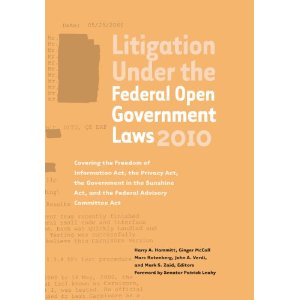
Review: Litigation Under the Federal Open Government Laws 2010 from the Electronic Privacy Information Center

07 Other Atrocities, 10 Security, 11 Society, Advanced Cyber/IO, Civil Society, Counter-Oppression/Counter-Dictatorship Practices, Cultural Intelligence, Director of National Intelligence et al (IC), DoD, Ethics, Government, InfoOps (IO), Intelligence (government), Law Enforcement, Military, Secrecy & Politics of Secrecy
Amazon Page

Electronic Privacy Information Center (Author), Marc Rotenberg (Editor), Harry A. Hammitt (Editor), Ginger McCall (Editor), John A. Verdi (Editor), Mark S. Zaid (Editor)

5.0 out of 5 stars Critical USEFUL Reference, Handbook, Citizen Manual,August 22, 2011

I'm exploring a major campaign to expose illegal actions across the Defense Office of Hearings and Appeals and the Defense Intelligence Agency in particular, and in talking to the Electronic Privacy Information Center (EPIC) leadership got a chance to understand just how vital and USEFUL this guide is.

Senator Patrick Leahy, co-sponsor of the OPEN Government Act of 2007, and many others are on record as considering this the single most indispensable tool in any citizen's toolkit.

For myself, having seen the capricious, arbitrary, and often unethical and even abusive manner in which DIA Personnel “cooks the books” and manipulates job announcements and screening decisions, and having been personally privy to enormous abuse by the Director of the Defense Office of Hearings and Appeals and a specifc group of his subordinates, consider this manual essential to my own search for justice.

Although I will use it more to inform myself so I can assist the specialist lawyers in making the most of what I know in their probing inquires at DIA and DOHA, I certainly recommend it to any citizen that has a specific concern that is not getting a fair hearing.

I also recommend the publisher and experts that put it together, the Electronic Privacy Information Center (EPIC). Many folks do not realize that they have been one of the leading champions of open government, and have also been one of the leading champions in exposing fraud, waste, and abuse that has been concealed by secrecy.

The US Government, in my view, as a general observation, is out of control and no longer representative of We the People. This is the handbook for citizens to use in holding every branch of the federal government accountable for its misbehavior and its dereliction of duty in failing to represent the public interest as opposed to the interest of its very big stakeholders who are recipients of the tax dollar rather than contributors to the treasury of the Republic.

Arm yourself with this knowledge, and go into battle confident in the righteousness of your cause.

See Also [Amazon book link still broken]:

Piercing the Veil of Secrecy: Litigation Against U.S. Intelligence by Janine Brookner

Vote and/or Comment on Review

Marc Andreessen: US Education Crisis–Young and Old

03 Economy, 04 Education, Advanced Cyber/IO, Articles & Chapters, Commerce
Marc Andreessen

Why Software Is Eating The World

Wall Street Journal, 20 August 2011

EN ESPANOL DOCUMENTO 5 PAJINAS

This week, Hewlett-Packard (where I am on the board) announced that it is exploring jettisoning its struggling PC business in favor of investing more heavily in software, where it sees better potential for growth. Meanwhile, Google plans to buy up the cellphone handset maker Motorola Mobility. Both moves surprised the tech world. But both moves are also in line with a trend I've observed, one that makes me optimistic about the future growth of the American and world economies, despite the recent turmoil in the stock market.

In short, software is eating the world.

. . . . . . .

Continue reading “Marc Andreessen: US Education Crisis–Young and Old”

noble gold