
Owl: Rendition Flights Database Updated & Persistent

07 Other Atrocities, 09 Terrorism, Corruption, Government
Who?  Who?
Who? Who?

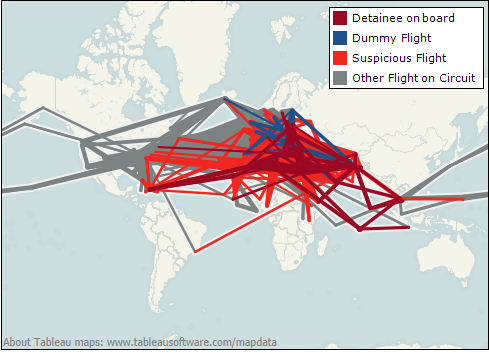
“Rendition Flights Database has been compiled in collaboration with Reprieve, and represents the world's largest set of public flight data relating to those aircraft suspected of involvement in the global network of renditions, secret detention and torture. The interactive here has been produced in collaboration with Craig Bloodworth from The Information Lab, and allows users to search for, and visualise, renditions flights from the underlying database…We hope that by bringing together the data into one place, researchers across the globe will be able to help build a clearer picture of the movements of aircraft associated with the renditions network. In particular, we hope to identify those flights which can be linked to known or suspected detainee transfers between secret detention sites, or which may have played a subsidiary role in servicing the global system of secret detention and interrogation.
Click on Image to Enlarge

The Rendition Flights Database currently contains flight data on 122 US-registered civilian aircraft, as well as some military flights into Guantanamo Bay. In total, the current version of the database contains over 11,000 individual flights, many of which have been logged by more than one source of data. Of particular importance have been the results of a Freedom of Information project by Access Info Europe and Reprieve, that has unearthed significant new flight data on renditions aricraft. This has not been integrated before now, and sits in our Database alongside data from Eurocontrol, Council of Europe and European Parliament investigations, and a range of other sources. As the project develops, new data will be integrated as it is released into the public domain.”


Rendition Flights Database

SchwartzReport: Half of USA In or Near Poverty — And It Is Getting Worse

01 Poverty, 03 Economy, 06 Family, 07 Health, 11 Society

schwartz reportHere is the latest in the breakdown of the middle class. As you read this, remember the Pew study on women, and the lower cohort in poverty. We are becoming a second world country, with a crumbling infrastructure, an uber-rich class, an oversized military, and what amounts to a growing impoverished prole class mesmerized by sports, values politics, consumerism, and American idol shows.

The growing irrelevancy of the traditional structures of American governance can easily be seen in our corrupt barely functioning Congress, increasingly made up of people who see Federal politics as not a career culmination, or an act of public service but, instead, as a stepping stone to commercial success and celebrity.

Half of America is in or Near Poverty — and It’s Getting Worse
PAUL BUCHHEIT – Nation of Change

Continue reading “SchwartzReport: Half of USA In or Near Poverty — And It Is Getting Worse”

SchwartzReport: Corporate Cabal Taking Over World Food and Water Supplies — Until the Riots — Will Vigilantes Begin Hunting Down and Killing Monsanto Executives?

01 Agriculture, 01 Poverty, 03 Economy, 06 Family, 07 Health, 07 Other Atrocities, 08 Proliferation, 09 Justice, 10 Transnational Crime, 11 Society, 12 Water, Civil Society, Commerce, Earth Intelligence, Government

I have decided to focus today's SR on GMOs and the transgenic sector because it represents such a clear example of the geopolitical shift we are living through: the Ascendence of the Non-geographical corporate states.

NGCSs are not just corporations, in a business sense, that we mean when we say, corporatocracy. These transnational entities are so big and so powerful that they are essentially states, literally countries without geography. They have their own foreign policies; their own goals that may have little to do with the policies of the country where they happen to be based. They control the political structure and write the laws that govern them, and judge them. They are the emerging world powers.

This transfer, is not a continuation of the chain of family, to tribe, to village, to duchies and the like, to nations. The NGCS springs from the business world. Its priority is profit. In its most extreme manifestation nothing else really is a factor.

Nowhere is the transfer of national power over to the NGCSs clearer than in what is happening in food and water. Parts of this trend are known, but the overarching strategy the NGCSs are following, and the tactics they are using are rarely seen as the coherent whole they are.

Monsanto, BASF, Bayer, Dow, DuPont and Syngenta. They are usually described as chemical pesticide companies but, I think, a better way to see them is as a corporate cohort making an aggressive attempt to gain domination over the world's food and water supplies.

Continue reading “SchwartzReport: Corporate Cabal Taking Over World Food and Water Supplies — Until the Riots — Will Vigilantes Begin Hunting Down and Killing Monsanto Executives?”

Berto Jongman: Non-Conventional Violence and Non-State Actors

05 Civil War, 07 Other Atrocities, Civil Society, Cultural Intelligence, Non-Governmental
Berto Jongman
Berto Jongman

Report: Non-conventional armed violence and non-state actors: challenges for mediation and humanitarian action

By  Ivan Briscoe

May 2013

Executive summary

Some of the most lethal episodes of armed violence in recent years have taken place in countries that do not suffer from conflict according to its conventional definitions. At the same time new armed conflicts in Mali and Syria appear to be shaped not just by political differences, but also criminal motives, jihadist ideology and an extraordinary level of violent factionalism.  The hybrid character of both armed violence and conflict stands at the heart of current global security concerns.  But the specific challenges posed by armed violence in non-conflict settings have yet to receive a coherent response from peace and development professionals. The coercive power exerted by non-state armed groups over communities and territories, and their connection with transnational networks make it hard to negotiate anything more than short-term deals aimed at reducing violence or providing humanitarian relief. Legal provisions to protect civilian lives are particularly difficult to enforce.  Hostility towards these groups from states and the international community is deep and widespread, particularly when they are associated with terrorist acts or organised crime. However, this report outlines four areas of future research in policy and programming that would be highly relevant to the work of organisations devoted to peace and humanitarian affairs: the nature of an outreach strategy to armed groups, the legal instruments that are available, the sort of community engagement that should be sought, and the approach towards formal economic and political structures. Establishing a broad network of practitioners, scholars and policymakers is suggested as a means to make progress on all these fronts.

PDF (8 Pages)

John Maquire: One Year Away from Global Food Riots + US Food Fraud RECAP

01 Agriculture, 01 Poverty, 02 Infectious Disease, 03 Economy, 03 Environmental Degradation, 06 Family, 07 Health, 07 Other Atrocities, 09 Justice, 11 Society, 12 Water, Commerce, Corruption, Earth Intelligence, Government

John MaguireWe Are Now One Year Away From Global Riots, Complex Systems Theorists Say
What’s the number one reason we riot? The plausible, justifiable motivations of trampled-upon humanfolk to fight back are many—poverty, oppression, disenfranchisement, etc—but the big one is more primal than any of the above. It’s hunger, plain and simple. If there’s a single factor that reliably sparks social unrest, it’s food becoming too scarce or too expensive. So argues a group of complex systems theorists in Cambridge, and it makes sense.

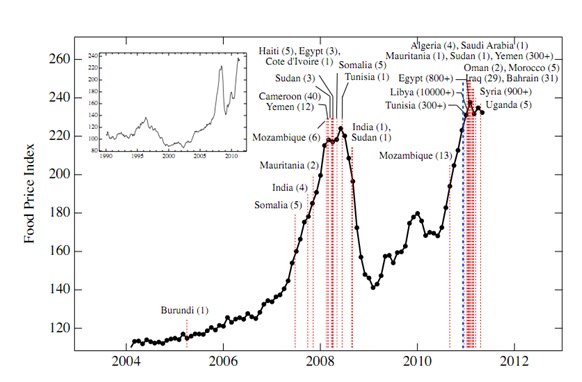
In a 2011 paper, researchers at the Complex Systems Institute unveiled a model that accurately explained why the waves of unrest that swept the world in 2008 and 2011 crashed when they did. The number one determinant was soaring food prices. Their model identified a precise threshold for global food prices that, if breached, would lead to worldwide unrest.

Click on Image to Enlarge

The MIT Technology Review explains how CSI’s model works: “The evidence comes from two sources. The first is data gathered by the United Nations that plots the price of food against time, the so-called food price index of the Food and Agriculture Organisation of the UN. The second is the date of riots around the world, whatever their cause.” Plot the data, and it looks like this:

Pretty simple. Black dots are the food prices, red lines are the riots. In other words, whenever the UN’s food price index, which measures the monthly change in the price of a basket of food commodities, climbs above 210, the conditions ripen for social unrest around the world. CSI doesn’t claim that any breach of 210 immediately leads to riots, obviously; just that the probability that riots will erupt grows much greater. For billions of people around the world, food comprises up to 80% of routine expenses (for rich-world people like you and I, it’s like 15%). When prices jump, people can’t afford anything else; or even food itself. And if you can’t eat—or worse, your family can’t eat—you fight.

Continue reading “John Maquire: One Year Away from Global Food Riots + US Food Fraud RECAP”

Sheila Casey: Dave McGowan Photo Essay on Boston False Flag Theater

07 Other Atrocities, Collective Intelligence, Commerce, Corruption, Government, IO Deeds of War, Law Enforcement, Media
Sheila Casey

Dave McGowan has written the best thing I've seen on the actors at the Boston bombing.  I challenge anyone who can claim an IQ above 80 to read this and still believe that this was a genuine attack with real victims, real blood, real terrorists.   McGowan's not only a great researcher and writer, he manages to be laugh-out-loud funny at the same time.  Of course, given the obvious absurdity of the stories we've been told, humor comes pretty naturally in this situation.   There are 6 parts, with lots of photos, all linked on his home page.  This is not to be missed!

. . . . . . . .

I need to add that Dave clearly changes his views as he progresses through the six part series.  In the first part, he writes:

I need to be very clear here in stating that I am not arguing that no one was injured in the attack and that there was no real suffering. That undoubtedly was not the case.

but by the 6th part, having spent many days wading through photos and news reports, he no longer believes that there are any real victims.  He writes:

…these are people who have sold their souls and sold out their country. They are beneath contempt and nothing I have to say about them should really offend anyone.

(Part 1)  Debunks major reported injuries with photos of alleged victims, shows how shrapnel allegedly shredded clothes without drawing blood.

Continue reading “Sheila Casey: Dave McGowan Photo Essay on Boston False Flag Theater”

Michel Bauwens: Open Source Energy in France

03 Environmental Degradation, 05 Energy, Design, Economics/True Cost, Hardware
Michel Bauwens
Michel Bauwens

A status report on the Open Source Energy project in France

A contribution from Geoffroy Levy from Nantes:

A few words about a French project named Open Source Energy. This project is intended to enable the design of open hardware solutions to capture the different kinds of energies available all around us (from the environment or from human activities). A first module to transform and to store electricity from renewable sources is being designed: the ENERCAN (opensourceenergy.wordpress.com/lenercan-v1). This first brick is the starting point of a large scale design process toward the creation of new solutions inspired by old or forgotten ones and improved by the use of high-tech devices. The project is not about large and costly devices but about simple, open and cheap modules that can be replicated to capture every stream of available and lost energies, even the smallest one.

Besides designing the modules, the team took part in several events related to design or DIY in order to promote the project and to share with others.

Continue reading “Michel Bauwens: Open Source Energy in France”

noble gold