America is divided by two very different views of government
Saturday, January 15, 2011
— as usual for him, is a clear and articulate presentation of the Order Left position. Like his counterparts on the Order Right, it is long on proscription and short on empathy—lots of shoulds, theys, and inevitables, some but few mights, wes, and possibilities. In this particular instance Order Left Krugman attacks his equally narrow Order Right adversaries over taxes and health as examples of a general indictment of political failure and takes no notice of the free right or the free left.
I admire Krugman as an exponent of his confined view and, when I accept his premises, often agree with him. Nonetheless, he leaves out or minimizes, in this and other columns the fact that one of the biggest divides we face as a nation is the divide between a relatively united country and a significantly unrepresentative politics.
When I originally read this Column I picked out three points I thought were key to Krugman’s inability to successfully address the situation facing all Americans which he seems to want to do.
A global consortium has been formed that aims to make a new digital soil map of the world using state-of-the-art and emerging technologies for soil mapping and predicting soil properties at fine resolution. This new global soil map will be supplemented by interpretation and functionality options that aim to assist better decisions in a range of global issues like food production and hunger eradication, climate change, and environmental degradation. This is an initiative of the Digital Soil Mapping Working Group of the International Union of Soil Sciences IUSS
In November 2008, an $18 million grant has been obtained from the Bill & Melinda Gates foundation and the Alliance for a Green Revolution in Africa (AGRA) to map most parts in Sub-Sahara Africa, and make all Sub-Saharan Africa data available. From this grant there are also funds for coordinating global efforts and for the establishment of a global consortium. Several institutions have assumed a leading role in this effort and have made substantial financial and in-kind contributions.
Posted with permission. Provided by Dr. James Spohrer in response to a request from Phi Beta Iota for a “snap-shot” overview of the “soul” of IBM going into the 21st Century.
1. Cities: here is a short IBM video (YouTube 4:15) on cities as the nodes in the planetary system of systems
Features Mike Wing, Irving Wladawsky-Berger, Julia Grace. Cities as planetary accupunture points of intervention. Cities are HUMAN–computers cannot handle the unpredictable. Dominos analogy–everything is interconnected and knowledge or information are the “energy” being exchanged among individual people, the HUMAN element. It is the mixture of people and hardware, and software that is so elegant and exciting.
2. Universities in Cities: My current job at IBM builds from the notion that universities are the knowledge batteries of city/regions… see slide #34 in this presentation on Service Science: Progress and Directions (64 Slides), connected with Handbook of Service Science (Springer, 2010). NOTE: Downloading presentation enables viewing of Notes for each slide.
Click on Image to Enlarge
Overview of IBM University Programs focusing on 5 R's (Research, Readiness, Recruiting, Revenue, Responsibilities); Quality of Life balance between local and global optimization; Ecology–study of all things in relation to all life forms; and Holistic Service Systems with cities and within cities, universities, and the fundamental “intelligent” building blocks. Emphasis on information information exchanges and life-long learning. Slide #34:
3. Connecting Universities and Cities Locally and Globally: My global team at IBM University Programs is funding connecting the universities locally with their cities, and globally with each other – networked improvement communities in Doug's language… Really connecting service systems, see Slide #16 in this presentation.
North Korea-China: North Korea will develop the islet of Hwanggumpyong on the Yalu River Delta linking Sinuiju with the Chinese city of Dandong as a special economic zone in cooperation with Chinese businessmen, Chosun Ilbo reported 18 January. North Korean Cabinet already approved a law on the development that will be announced in March or April.
Comment: This is another example of Chinese business tutelage for North Korea. All other special economic zones have either failed for lack of investors or been troubled by North Korean government meddling. In the last category are the Mount Kumgang resort on the east coast and the Kaesong joint industrial park, north of Panmunjom.
One would surmise that a joint venture with the Chinese would be relieved of the unpredictability of North Korean leadership whims, which have undermined the profitability of the joint ventures with the South Koreans. More importantly, every Chinese economic lifeline tossed into the North Korean economic morass is a burden on China and a restraint on North Korea.
The Chinese are moving slowly, but steadily based on their understanding of the magnitude of North Korean economic mismanagement. Thus far, they appear to be helping North Korean enterprises that have prospects of profitability, such as textiles, and Chinese enterprises that benefit from North Korean geography, such as ports and infrastructure on the Sea of Japan.
North Korea never has been self-reliant and its condition of dependency on the global economy has steadily deepened under Kim Chong-il. The Chinese appear determined to salvage what they can and rebuild the rest of North Korea in a different, more sustainable direction, slowly, by converting some North Korean activities into extensions of China's economy.
Phi Beta Iota: The Chinese are out-thinking and out-maneuvering the USA on all fronts, and in a fascinating twist, may be egging the USA on to the same military-industrial death march that led to the end of the Soviet Union. The above development should be studied in relation to WASHINGTON RULES: US-Korea-China-NK NAFTA. In both instances, leaders are making strategic moves for reasons they consider valid, but that have nothing to do with the well-being of their respective publics.
For years, Alison and I have been hearing glowing reports of Tunisia from fellow sailors. We finally sailed there and spent five weeks in Tunisia last summer (August and early September). To our surprise, the local people struck us as the least welcoming of those in the Arab countries we have visited over the last five years (which included Morocco, Syria, Jordan, and Lebanon).
In general, the living conditions in the towns seemed poorer and in some cases more squalid than in the other countries we visited. Syria, for example, is much poorer than Tunisia, with half the per capita GDP, but I did not sense the widespread squalidness in 2008 that we saw in Tunisia in 2010. But, we were only in Syria for a few days and saw only the western part north of Damascus. Tunisian people seemed more religious and mosques seemed more crowded than in the other Arab countries we visited, but I saw nothing suggesting radicalization. In retrospect, it did seem that there were more police in evidence in Tunisia than in the other Arab countries and that people were more fearful of the police, although I did not draw that conclusion at the time. Bottom line: I saw nothing that suggested Tunisia was on the cusp of a political meltdown — I simply did not like the place as much as the other Arab countries I visited — which was quite surprising, given our expectations.
But, as the attached report by Professor Juan Cole shows in Attachment #1 below, there there was a lot of discontent bubbling beneath the surface. Moreover, as opposed to this dumb tourist, our diplomats on the scene appreciated the drivers of the discontent. But, once again, the US government in Washington chose to ignore the warning signs and support a corrupt status quo. And once again our government was blindsided by an inordinate fear of radical Islamism, and in so doing, may have helped to create conditions favoring its spread.
Robert Fisk, in Attachment #2 below, The Brutal Truth About Tunisia, places the American and European propensity to ignore warning signs, and then being blindsided by developments, into a regional perspective. He is, therefore, not sanguine about the future.
The Norwegian newspaper Aftenposten released a series of US diplomatic cables from 2006 on massive and pervasive corruption and nepotism in Tunisia and its effect on economic development and social problems. The cables show that the United States government was fully aware of the dangerous and debilitating level of corruption in Tunisia, and its anti-democratic implications.
Bloodshed, tears, but no democracy. Bloody turmoil won’t necessarily presage the dawn of democracy
By Robert Fisk, Middle East Correspondent
Independent, 17 Jan 2011
The end of the age of dictators in the Arab world? Certainly they are shaking in their boots across the Middle East, the well-heeled sheiks and emirs, and the kings, including one very old one in Saudi Arabia and a young one in Jordan, and presidents – another very old one in Egypt and a young one in Syria – because Tunisia wasn't meant to happen. Food price riots in Algeria, too, and demonstrations against price increases in Amman. Not to mention scores more dead in Tunisia, whose own despot sought refuge in Riyadh – exactly the same city to which a man called Idi Amin once fled.
Phi Beta Iota: For some time now, since reading Ambassador Mark Palmer's superb inventory of all the dictators on the planet, we have been concerned about the degree to which the US Government, “in our name,” actively collaborates with and even funds dictators, not just in the Middle East but everywhere. In fact, only two are criticized: North Korea and Cuba. It can fairly be said that US diplomacy and national security are neither strategic nor moral, at the same time that both are arguably not in the best interest of We the People.
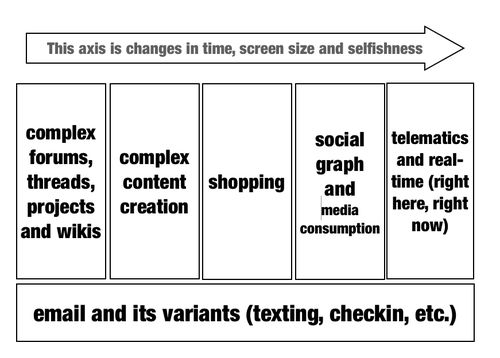
It might be about the size of the screen and whether or not you're standing up.
Start at the bottom. For the first five years of the Internet, the most used function was email. Email remains a bedrock of every device and system that's been built on top of the internet, though sometimes it looks like a text message or a mobile check in. This is the layer for asynchronous person to person connection, over time.
Moving from left to right, we see how the way we use the thing we call the internet has evolved over time. We also see how devices and technology and bandwidth have changed the uses of the net and, interestingly, how a growth in mass has led to a growth in self-motivated behavior.
Early online projects were things like Archie and Veronica and checking in changes to the Linux code base. You needed patience, a big screen and a sense of contribution.
Layer on top of this a practice that is getting ever more professional, which is creating content for others to consume. Sometimes in groups, sometimes using sophisticated software and talented cohorts.
Click on Image to Enlarge
As we move to the right (and through time) we see the birth of online shopping. Still to this day, most online shopping happens on traditional devices, often sitting down.
The sitting down part is not a silly aside. Ted Leonsis theorized twenty years ago that the giant difference between TV and the internet was how far you sat from the screen. TV was an 8 foot activity, and you were a consumer. The internet was a 16 inch activity, and you participated. I think the sitting down thing is similar. You're not going to buy an armoir while standing on the subway.
Moving over in time and device and intent, we see the idea of consuming content. While tablets get their share of shopping, this is where they really shine. I think 2011 is going to be the year of the tablet, from the Kindle to the iPad to the thing we used to call a phone.
It's in the last two categories that these other devices, things that don't involve sitting down, are superior, not just a mobile substitute. The social graph is a very low bandwidth, peripheral attention interaction, perfect for this audience and this medium. And the last category–tell me where I am, where to eat, who's near me, what's the weather, get me a cab right now–is all about me and now and here.
I don't believe this is a winner take all situation, any more than one bestselling book makes all other books obsolete. I think different pillars work for different devices, and there will continue to be winners in all of them.