UNIDIR (United Nations Institute for Disarmament Research) has produced a superb checklist approach to the mission of reducing the proliferation of small arms, which kill and maim and orphan tens of millions at a time. The Director of UNIDIR at the time, Dr. Patricia Lewis, was the first UN official in modern times to contemplate the need for a UN-sponosred World Brain. 2003 Lewis (UNIDIR) Creating the Global Brain: The United Nations.
Citizen science is a term used for projects or ongoing program of scientific work in which individual volunteers or networks of volunteers, many of whom may have no specific scientific training, perform or manage research-related tasks such as observation, measurement or computation.
The use of citizen-science networks often allows scientists to accomplish research objectives more feasibly than would otherwise be possible. In addition, these projects aim to promote public engagement with the research, as well as with science in general. Some programs provide materials specifically for use by primary or secondary school students. As such, citizen science is one approach to informalscience education.
Phi Beta Iota: Citizen Science is in its infancy, but with the emergence of open source software and open source intelligence combinations such as represented by SourceMap.org, Citizen Intelligence and Citizen Counterintelligence are sure to be coming along soon….and if combined with multi-lingual networks such as provided by Telelanguage, a global multinational citizen information-sharing and sense-making grid can be created that implements the Swedish vision of M4IS2: Multinational, Multiagency, Multidisciplinary, Multidomain Information-Sharing and Sense-Making. This has enormous implications for both real-time science and real-time warning as well as real-time Emergency Action.
National Journal By James Kitfield Saturday, Jan. 9, 2010 [Subscription]
Hidden behind walls of top-secret classification, senior U.S. government officials meet in what is essentially a star chamber to decide which enemies of the state to target for assassination. There is no single master list, but all names pass through an elaborate, multi-agency vetting process that ends at the level of the National Security Council and ultimately requires presidential approval.
Frankly, we don’t need more commissions or bureaucracies. We do need intelligence professionals and their managers who are committed to a new culture of quality, cooperation, and accountability.
Talking to veteran counterterrorism officers, I hear a common theme that unites these two disastrous lapses: The CIA has adopted bureaucratic procedures that, while intended to avoid mistakes, may actually heighten the risks. In the words of one CIA veteran, “You have a system that is overwhelmed.”
But those standard agent-handling rules have been violated routinely, in Iraq and now Afghanistan, because senior officials have concluded it's too dangerous outside the wire. “At least 90 percent of all agent meetings are conducted on bases,” estimates one CIA veteran. The agency wants to protect its people, understandably — but the system actually works to increase vulnerability.
The Khost tragedy shows that the CIA needs to take the counterintelligence threat from al-Qaeda more seriously. Intelligence reports over the past year have warned that groups linked with al-Qaeda were sending double agents to penetrate CIA bases in Afghanistan.
The brave CIA officers serving overseas deserve a better system than this.
CIA Director Leon Panetta should use these searing events to foster a culture of initiative and accountability at a CIA that wants to do the job — but that needs leadership and reform.
A replay of long-standing criticisms of CIA's short-tours, lack of memory, refusal to take counterintelligence seriously, and general ineptitude outside the Embassy cocktail circuits.
A CIA inquiry is focused on two main questions: why the bomber was not more thoroughly screened and where he received the training and explosives used in the attack.
Updated | 4:15 p.m. As my colleague Stephen Farrell reports on Saturday, the Jordanian suicide bomber who killed eight intelligence officers at a C.I.A. base in Afghanistan last month apparently recorded a martyrdom video before his death, in which he said that his attack was an act of revenge for the assassination of the Pakistani Taliban leader Baitullah Mehsud in an American drone strike. The video was broadcast by Al Jazeera and is featured in this report on the satellite channel’s English-language Web site:
Now hear this again “The US is trying to change Islam itself!!!”. Without any shame, they are openly stating that we have a desire not only to influence the Muslim societies but we want to change the religion itself! Probably at the time of Bani Israel those Rabbis who were changing the book of Allah never dared to say so openly! These, without even hiding it, are saying that we want to change Islam, yes we do!
Bothers and sisters, when a Muslim, a true Muslim, hears this, he hears that non-Muslims who have no knowledge about the religion, who do not believe in Allah Almighty who don't believe in Muhammad (peace and blessings of Allah be upon him) and don't take Quran as the book of Allah, when a Muslim hears that such a people, are openly claiming that we want to change your religion, this should make any Muslim who has any love of Allah Almighty angry!
Emir of Emirate Caucasus Dokka Abu Usman: ‘Nevsky Express' was just a beginning…!
According to Emir Dokka Abu Usman, more than 20 Martyr operations have been carried out over the past year on the territory of Emirate Caucasus. Last year, the Mujahideen considerably intensified sabotage operations inside Russia and they conducted by the Martyrs' Brigade “Riyad-us-Saliheen”, reestablished by an order of the Emir of the Emirate Caucasus.
Dokka Abu Usman specially emphasized that all military and sabotage operations had been carried out under his orders. He also pointed out that the claims by Kremlin and its puppet Kadyrov that “a stability and peace had been established in Chechnya” were utterly false.
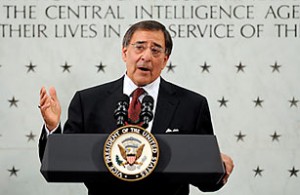
The CIA is proud to be on the front lines against al-Qaeda
By Leon Panetta
Sunday, January 10, 2010; A13
. . . . . . .
We have found no consolation, however, in public commentary suggesting that those who gave their lives somehow brought it upon themselves because of “poor tradecraft.” That's like saying Marines who die in a firefight brought it upon themselves because they have poor war-fighting skills.
. . . . . . .
From: Robert Steele, KR-594
To: Leon Panetta
Subj: Getting in touch with reality
As someone who scored in the top ten of their 65 person clandestine Ops I and Ops II training, and then went on to achieve five times the regional recruiting average across three tours focused on terrorists and extremists, ultimately serving in three of the four Directorates and being selected for the CIA Mid-Career Course; and as someone who has actually served in the US Marine Corps and in zones of conflict, I beg to differ with your Washington Post Op-Ed.
A number of us have tried to help you, from the day we intuited your selection, a selection I applauded because of your unique background as both a Chief of Staff in the White House (knowing what the President needed to know) and as a Director of the Office of Management and Budget (understanding means in relation to ways and ends).
The death of so many CIA personnel was a failure of tradecraft at multiple levels and also, I am sorry to have to point out, a failure of management. Were you to demand an honest report of the skills and experience of all those associated with this incident, you would learn two things:
EDIT of 9 Jan 10: Note seven comments from retired senior officers.
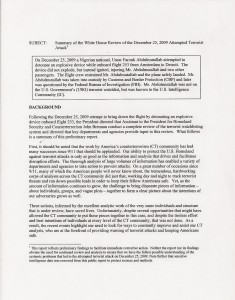
Critique of the CT Summary for the White House
This is a negligent piece of work that fails to include all that is known merely from open sources of information, but more importantly its judgments are misdirected. This incident remains incompletely investigated until the person who video-taped events on the airplane comes forward and is identified.
Where we differ:
1. It was passengers who restrained the individual, not the flight crew, as is stated in the first paragraph.
1) Does not identify the primary error. The Embassy officer (or CIA officer) who interviewed the father did not elevate the matter. The same kind of mistake occurred when the Taliban walked in and offered us Bin Laden in hand-cuffs.
2) The absence of a machine-speed cross-walk among US and UK visa denials is noted, but the weakest link is overlooked. The Department of State either didn’t check their visa files or, as has been remarked, may have failed to get a match because of misspelling. The necessary software is missing. State continues to be the runt in the litter (we have more military musicians than we have diplomats) and until the President gets a grip on the Program 50 budget, State will remain a dead man walking.
3) Another point glossed over: the intelligence community, and CIA in particular, did not increase analytic resources against the threat. Reminds us of George Tenet “declaring war” on terrorism and then being ignored by mandarins who really run the place.
4) “The watchlisting system is not broken” (page 2 bottom bold). Of course it is broken, in any normal meaning of the word “system”. John Brennan is responsible for the watchlisting mess, and this self-serving statement is evidence in favor of his removal. If we are at war, we cannot have gerbils in critical positions (quoting Madeline Albright).
5) “A reorganization of the intelligence or broader counterterrorism coummunity is not required…” at the bottom of page 2. Reorganization, in the sense of moving around blocks on a chart, may not be required, but the entire system is broken and does need both principled redesign and new people the President can trust with the combination of balls and brains and budget authority to get it right. Thirteen years after Aspin-Brown we still have not implemented most of their suggestions; the U.S. intelligence community is still grotesquely out of balance; and the Whole of Government budget is still radically misdirected at the same time that our policies in the Middle East are counterproductive.


![[gerecht]](http://s.wsj.net/public/resources/images/ED-AK786_gerech_D_20100107190103.jpg)