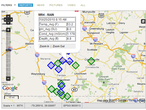
+ Collect information from cell phones, news and the web.
+ Aggregate that information into a single platform.
+ Visualize it on a map and timeline.
Crowdmap is designed and built by the people behind Ushahidi, a platform that was originally built to crowdsource crisis information. As the platform has evolved, so have its uses. Crowdmap allows you to set up your own deployment of Ushahidi without having to install it on your own web server.
China-North Korea: China offered to help North Korea control cross-border crime and build law-enforcement forces, according to a report by Agence France-Presse on 12 August. A spokesman also said China provided military equipment to North Korea's National Defense Commission during a visit by China's Deputy Public Security Minister Liu Jing on 8 August.
North Korea's Security Ministry staff and a Chinese public security delegation met on 12 August, according to the Korean Central News Agency.
NIGHTWATCH Comment: The reports are intermittent in the public media, but cumulatively they establish a pattern of China using economic and law enforcement linkages to tie North Korea more tightly. When North Korean leadership has been strong, it strongly and successfully has resisted Chinese initiatives. That does not appear to be the case at this time. China's admission of providing “military equipment” is unusual and rare. The actors mentioned in the report suggest the reference is to crowd control equipment.
Phi Beta Iota: Hybrid and M4IS2 (along with bottom-up self-governance) will be the defining attributes of local to global governance in the 21st Century. The USA has consistently made the mistake of selling arms and withholding information sharing and intelligence capacity building (providing stealable funds does not count). A mix of hybrid bi-lateral (such as Australian-Cambodian task forces on human trafficking) and hybrid multi-lateral (e.g. a regional intelligence centre for Central America) will flip the international relations and national security paradigms.
Rosalind S. Helderman, The Washington Post, Tuesday August 10, 2010
RICHMOND — Virginia officials reacted with bipartisan dismay on Monday to Defense Department budget shifts that will cost the state thousands of jobs in coming years and will dramatically impact the economies of the Norfolk area and Northern Virginia.
Most of the immediate reaction revolved around Defense Secretary Robert M. Gates's proposal to close the U.S. Joint Forces Command. It is a major employer in Hampton Roads, including Norfolk and Virginia Beach, whose elimination could translate into the loss of 6,100 military, civilian and contractor jobs in the region.
A version of this op-ed appeared in print on August 1, 2010, on page WK8 of the New York edition.
IT was on a Sunday morning, June 13, 1971, that The Times published its first installment of the Pentagon Papers. Few readers may have been more excited than a circle of aspiring undergraduate journalists who’d worked at The Harvard Crimson. Though the identity of The Times’s source wouldn’t eke out for several days, we knew the whistle-blower had to be Daniel Ellsberg, an intense research fellow at M.I.T. and former Robert McNamara acolyte who’d become an antiwar activist around Boston. We recognized the papers’ contents, as reported in The Times, because we’d heard the war stories from the loquacious Ellsberg himself.
. . . . . . .
What was often forgotten last week is that the Pentagon Papers had no game-changing news about that war either and also described events predating the then-current president.
. . . . . . .
The papers’ punch was in the many inside details they added to the war’s chronicle over four previous administrations and, especially, in their shocking and irrefutable evidence that Nixon’s immediate predecessor, Lyndon Johnson, had systematically lied to the country about his intentions and the war’s progress.
Objectives: Create an annual flagship event and news hub to build and maintain the identity of the international Open Science Movement. Organize the various sub-communities into an effective, global, socio-technological force for rapid change in science/innovation policy. An attempt to gather all stakeholders who want to liberate our scientific and technological commons and enable a new era of decentralized, distributed innovation to solve humanity’s greatest challenges. Continue reading “Event: 29-31 July 2010, Berkeley CA, Open Science Summit”
Acting Director of National Intelligence, David C. Gompert, reaction to the Washington Post series
This morning, the Washington Post began a series of articles on the growth of the Intelligence Community following the terrorist attacks on 9/11. The reporting does not reflect the Intelligence Community we know.
The nation's spy world is anxiously — certainly not eagerly — anticipating a Washington Post series looking at CIA and Pentagon contractors, according to insider reports. And the intelligence community has been preparing for an expected offensive by plotting its defense.
The Atlantic has posted a memorandum, “Internal Memo: Intelligence Community Frets About Washington Post Series,” sent by Art House, the media manager for the Director of National Intelligence. He outlines what he thinks the series will say about the “IC” (intelligence community) and offers talking points for press aides.
Here are some of the highlights of the memo:
Themes
While we can't predict specific content, we anticipate the following themes:
*The intelligence enterprise has undergone exponential growth and has become unmanageable with overlapping authorities and a heavily outsourced contractor workforce.
*The IC and the DoD have wasted significant time and resources, especially in the areas of counterterrorism and counterintelligence.
*The intelligence enterprise has taken its eyes off its post-9/11 mission and is spending its energy on competitive and redundant programs.
Management of Responses
We do not know which agencies will receive attention, and each agency will need to manage its own responses. …
It might be helpful as you prepare for publication to draw up a list of accomplishments and examples of success to offer in response to inquiries to balance the coverage and add points that deserve to be mentioned. In media discussions, we will seek to garner support for the Intelligence Community and its members by offering examples of agile, integrated activity that has enhanced performance. We will want to minimize damage caused by unauthorized disclosure of sensitive and classified information. …
House's conclusion: “This series has been a long time in preparation and looks designed to cast the IC and the DoD in an unfavorable light. We need to anticipate and prepare so that the good work of our respective organizations is effectively reflected in communications with employees, secondary coverage in the media and in response to questions.”
Keep your eyes peeled for this blockbuster.
Phi Beta Iota: Panetta had a chance to get it right and blew it. Clapper will finish the job of destroying whatever integrity is left in the US Intelligence Community. This is not news, but the Washington Post has finally caught up with the rest of us.