Journal: Death by a Thousand Cuts? Or Deliberate Elite Murder of the USA?

09 Terrorism, Budgets & Funding, Strategy
DefDog Recommends...

See all those security lines? Just because al Qaeda's recent attacks haven't succeeded doesn't mean the terrorist group's overall strategy is failing.

Foreign Policy

BY DAVEED GARTENSTEIN-ROSS | NOVEMBER 23, 2010

“Two Nokia phones, $150 each, two HP printers, $300 each, plus shipping, transportation and other miscellaneous expenses add up to a total bill of $4,200. That is all what Operation Hemorrhage cost us… On the other hand this supposedly ‘foiled plot', as some of our enemies would like to call [it], will without a doubt cost America and other Western countries billions of dollars in new security measures.”Thus begins the lead article in the latest issue of Inspire, the English-language online magazine produced by al Qaeda in the Arabian Peninsula (AQAP), the jihadi group's Yemen branch, which was released Saturday. The cover features a photo of a UPS plane and the striking headline: “$4,200.” It is referring to the recent cartridge-bomb plot, and specifically the great disparity between the cost of executing a terrorist attack and the cost to Western countries of defending against asymmetric warfare — costs now numbering in the billions of dollars a year and climbing. The magazine warns that future attacks will be “smaller, but more frequent” — an approach that “some may refer to as the strategy of a thousand cuts.”

The slick packaging may be new, but al Qaeda's emphasis on bleeding the U.S. economy is not.Read rest of article online….

Continue reading “Journal: Death by a Thousand Cuts? Or Deliberate Elite Murder of the USA?”
NIGHTWATCH Extract: China Expands to the Seas

02 China, 03 India, 10 Security, 11 Society, Analysis, Geospatial, Strategy

Click to Enlarge

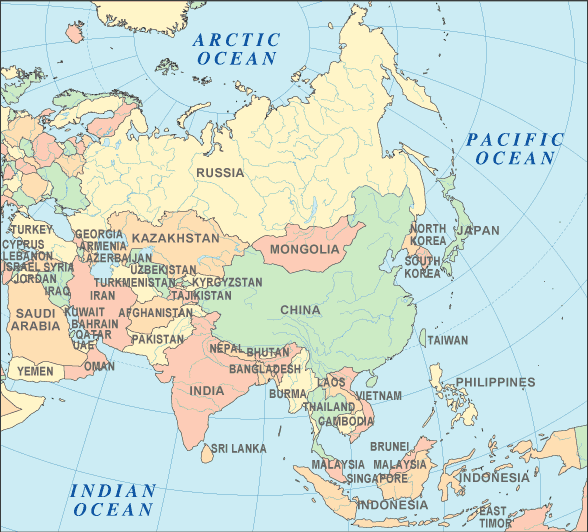
China-Burma: Construction of a high-speed rail link between China's southwestern province of Yunnan and Myanmar will begin in two months. The line will link Kunming, Yunnan's capital to Yangon (Rangoon), on the Indian Ocean, according to Wang Mengshu, an academic from the Chinese Academy of Engineering.

Wang said a China-to-Cambodia high-speed rail connection is under discussion as well as a link between Yunnan and Vientiane, the capital of Laos. He said that all three rail connections are likely to be completed with 10 years. Wang said the project aims to boost cooperation between China and its Southeast Asian neighbors and foster the economic development of China's western regions.

China-Bangladesh: China is interested in increasing cooperation with Bangladesh in different sectors including agriculture technology, trade, commerce and communication, according to a report about the 21 November meeting between Lu Hao, leader of a visiting Chinese delegation and a member of the Communist Party of China and Bangladesh President Zillur Rahman, The Daily Star reported. Rahman called for more Chinese cooperation on socioeconomic development, adding that China is a great friend to Bangladesh. Lu said he hopes the new cooperation will strengthen bilateral relations.

NIGHTWATCH Comment: China is creating a sphere of influence that stretches from North Korea to Pakistan, and surrounds India. This is a threat to US interests as well as to the political independence of the states accepting Chinese aid. A rail line to the Burmese port of Rangoon would give China access to two Indian Ocean ports with direct rail links to China. The other will be Gwadar in western Pakistan which was built with Chinese investments and aid.

Rail links from China through the Karakoram Range to Pakistan Rail and then a spur to Gwadar are undergoing feasibility studies. The link to Rangoon is much more advanced.

NIGHTWATCH KGS Home

Phi Beta Iota: We must disagree with our learned colleague whose analytic skills we greatly admire.  China's building of infrastructure to the seas is not a threat to American the Beautiful as envisioned by our Founding Fathers–it is only a threat to a predatory imperialist out of control government stupid enough to spend $750 million dollars EACH on three fortresses in Baghdad, Kabul, and Islamabad, at the same time that US infrastructure and US economic competitiveness has been DESTROYED by a two-party tyranny that has sold the American public out–in a word, treason against the public interest.  ENOUGH.  It is time to shut down the Empire before the Empire shuts down America the Beautiful.  Tomorrow we will post a review of Buckminster Fuller's Ideas and Integrities written in 1928.  He nailed it.  The US Government at the political level is NOT in “friendly” hands….certainly not friendly to the 90% that actually pay their taxes unmindful of how those taxes are funding fraud, waste, and abuse on a global scale.  America desperately needs an honest President willing to sponsor Electoral Reform in February in time for the 4th of July recall of anyone who votes against it, and a Director of National Intelligence (DNI) who actually wants to create a Smart Nation and stop going along with $90 billion a year in fraud, waste, and abuse….[less the 4% that General Tony Zinni says is useful].

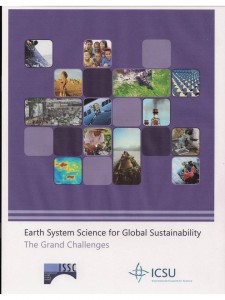
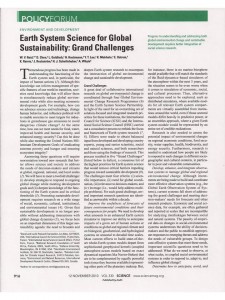
Reference: Earth System Science for Global Sustainability–Grand Challenges

Analysis, Augmented Reality, Budgets & Funding, Communities of Practice, Earth Intelligence, Ethics, Geospatial, History, info-graphics/data-visualization, InfoOps (IO), Intelligence (government), International Aid, IO Sense-Making, Key Players, Maps, Methods & Process, microfinancing, Mobile, Open Government, Policies, Politics of Science & Science of Politics, Power Behind-the-Scenes/Special Interests, Real Time, Secrecy & Politics of Secrecy, Standards, Strategy, Technologies, Threats, Tools, Waste (materials, food, etc)
Main Document (24 Page PDF)

The International Council for Science (ICSU) is spearheading a consultative Visioning Process, in cooperation with the International Social Science Council (ISSC), to explore options and propose implementation steps for a holistic strategy on Earth system research. Five Grand Challenges were identified during step 1 of the process. If addressed in the next decade, these Grand Challenges will deliver knowledge to enable sustainable development, poverty eradication, and environmental protection in the face of global change.

The details of the Grand Challenges are contained in the document ‘Earth System Science for Global Sustainability: The Grand Challenges’, representing input from many individuals and institutions.

Science Article (2 Page PDF)

INTERNATIONAL COUNCIL FOR SCIENCE – PRESS RELEASE

Thursday 11 November 2010

Scientific Grand Challenges identified to address global sustainability

Paris, France—The international scientific community has identified five Grand Challenges that, if addressed in the next decade, will deliver knowledge to enable sustainable development, poverty eradication, and environmental protection in the face of global change. The Grand Challenges for Earth system science, published today, are the result of broad consultation as part of a visioning process spearheaded by the International Council for Science (ICSU) in cooperation with the International Social Science Council (ISSC).

The consultation highlighted the need for research that integrates our understanding of the functioning of the Earth system—and its critical thresholds—with global environmental change and socio-economic development.

The five Grand Challenges are:

  1. Forecasting—Improve the usefulness of forecasts of future environmental conditions and their consequences for people.
  2. Observing—Develop, enhance and integrate the observation systems needed to manage global and regional environmental change.
  3. Confining—Determine how to anticipate, recognize, avoid and manage disruptive global environmental change.
  4. Responding—Determine what institutional, economic and behavioural changes can enable effective steps toward global sustainability.
  5. Innovating—Encourage innovation (coupled with sound mechanisms for evaluation) in developing technological, policy and social responses to achieve global sustainability.

Continue reading “Reference: Earth System Science for Global Sustainability–Grand Challenges”

Journal: The Future of the Internet

03 Economy, Analysis, Audio, Augmented Reality, Collective Intelligence, Collective Intelligence, Commercial Intelligence, Computer/online security, info-graphics/data-visualization, InfoOps (IO), IO Technologies, Journalism/Free-Press/Censorship, Maps, Methods & Process, Mobile, Open Government, Real Time, Standards, Strategy, Technologies, Tools
Jon Lebkowsky Home

Tim Wu and the future of the Internet

Tim Wu explains the rise and fall of information monopolies in a conversation with New York Times blogger Nick Bilton. Author of The Master Switch: The Rise and Fall of Information Empires (Borzoi Books), Wu is known for the concept of “net neutrality.” He’s been thinking about this stuff for several years, and has as much clarity as anyone (which is still not much) about the future of the Internet.


I think the natural tendency would be for the system to move toward a monopoly control, but everything that’s natural isn’t necessarily inevitable. For years everyone thought that every republic would eventually turn into a dictatorship. So I think if people want to, we can maintain a greater openness, but it’s unclear if Americans really want that…. The question is whether there is something about the Internet that is fundamentally different, or about these times that is intrinsically more dynamic, that we don’t repeat the past. I know the Internet was designed to resist integration, designed to resist centralized control, and that design defeated firms like AOL and Time Warner. But firms today, like Apple, make it unclear if the Internet is something lasting or just another cycle.

Journal: Afghanistan Winds Down

02 Diplomacy, 08 Wild Cards, Government, Military, Strategy
DefDog Recommends...

Its over: US NATO formally announcing ‘transition’ to Afghan withdrawal

Pakistan Patriot

Posted on 14 November 2010

The Obama administration and its NATO allies will declare late this week that the war in Afghanistan has made sufficient progress to begin turning security control over to its government by spring, months before the administration’s July deadline to start withdrawing U.S. troops, according to U.S. and European officials.

Even as it announces the “transition” process, which will not immediately include troop withdrawals, NATO will also state its intention to keep combat troops in Afghanistan until 2014, a date originally set by Afghan President Hamid Karzai.

The seemingly contradictory messages, in communiques and agreements to be released at NATO’s upcoming summit in Lisbon, are intended to reassure U.S. and European audiences that the process of ending the war has begun.

At the same time, the coalition wants to signal to the Taliban – along with Afghans and regional partners who fear a coalition withdrawal, and Republicans in Congress who oppose it – that they are not leaving anytime soon.

Read rest of entry…

Karzai wants U.S. to reduce military operations in Afghanistan

Washington Post

Sunday, November 14, 2010; 12:52 AM

KABUL- President Hamid Karzai said on Saturday that the United States must reduce the visibility and intensity of its military operations in Afghanistan and end the increased U.S. Special Operations forces night raids that aggravate Afghans and could exacerbate the Taliban insurgency.

Rest of article and also a photo gallery….

Phi Beta Iota: Deja vu…we have the uneasy feeling that Brzezinski and whoever is still whispering in Obama's ear is pulling a Kissinger–four more years will kill thousands more at a cost we cannot afford for a purpose we have never legitimately defined.

See Also:

Journal: Taliban Tet a Tet + Tet Offensive

Journal: AF BODY COUNT–$50 Million Per Body

Journal: US War Policy Enters the Rubber Room

Review: The Trial of Henry Kissinger

Review: Politics Lost–How American Democracy Was Trivialized By People Who Think You’re Stupid

Journal: Taliban’s grip is far stronger than the West will admit

04 Inter-State Conflict, 05 Civil War, 08 Wild Cards, 10 Security, Analysis, History, InfoOps (IO), Intelligence (government), Military, Misinformation & Propaganda, Officers Call, Power Behind-the-Scenes/Special Interests, Strategy
Chuck Spinney Recommends...

Afghanistan – behind enemy lines

James Fergusson returns after three years to Chak, just 40 miles from Kabul, to find the Taliban's grip is far stronger than the West will admit

Independent, 14 November 2010

The sound of a propeller engine is audible the moment my fixer and I climb out of the car, causing us new arrivals from Kabul to glance sharply upwards. I have never heard a military drone in action before, and it is entirely invisible in the cold night sky, yet there is no doubt what it is. My first visit to the Taliban since 2007 has only just begun and I am already regretting it. What if the drone is the Hellfire-missile-carrying kind?

Three years ago, the Taliban's control over this district, Chak, and the 112,000 Pashtun farmers who live here, was restricted to the hours of darkness – although the local commander, Abdullah, vowed to me that he would soon be in full control. As I am quickly to discover, this was no idle boast. In Chak, the Karzai government has in effect given up and handed over to the Taliban. Abdullah, still in charge, even collects taxes. His men issue receipts using stolen government stationery that is headed “Islamic Republic of Afghanistan”; with commendable parsimony they simply cross out the word “Republic” and insert “Emirate”, the emir in question being the Taliban's spiritual leader, Mullah Omar.

The most astonishing thing about this rebel district – and for Nato leaders meeting in Lisbon this week, a deeply troubling one – is that Chak is not in war-torn Helmand or Kandahar but in Wardak province, a scant 40 miles south-west of Kabul.

Read rest of this direct look at ground truth….

Phi Beta Iota: We are reminded by this piece of how the best CIA desk officers knew instantly, the day we announced going to war in Viet-Nam, that we had gotten it wrong, that Ho Chi Minh was a nationalist, and that we would lose.  By the time Afghanistan rolled around, intelligence had become both jejeune and unethical (silent in the face of treason), and politics had become even more ideologically psychopathic and corrupt than ever before.  James Fegusson has given us a very fine contribution–this is ground truth at its best.

See Also:

Worth a Look: Book Review Lists (Negative)

and most especially:

Review: War Without Windows

Review: None So Blind–A Personal Account of the Intelligence Failure in Vietnam

Review: Who the Hell Are We Fighting?–The Story of Sam Adams and the Vietnam Intelligence Wars

Reference: How Voters Can UNRIG the Two-Party Shell Game

11 Society, Analysis, Augmented Reality, Blog Wisdom, Budgets & Funding, Civil Society, Collective Intelligence, Counter-Oppression/Counter-Dictatorship Practices, Ethics, InfoOps (IO), Mobile, Open Government, Real Time, Reform, Strategy
Nancy Bordier

How Voters Can Unrig the 2012 Elections with Transpartisan Voting Blocs and Electoral Coalitions

Voters did not get what they said they wanted from the 2010 elections. In fact, they got the opposite because the two major parties rigged the elections.

The parties have been rigging elections for decades by gerrymandering election districts and passing campaign financing and election laws that prevent third party candidates from beating major party candidates.

These rigged elections give voters no choice but to vote for one of the two major parties. So voters do the only thing they can do, which is to routinely kick out the major party incumbents in the futile hope that the new major party candidates they elect will not flout their will to the same degree. But regardless of which party candidates they vote for, they get roughly the same policies. These typically sacrifice voters' interests to the special interests that fund lawmakers' electoral campaigns.

Unless voters are empowered to put an end to rigged elections before the 2012 elections, using mechanisms like the one proposed below, the middle class and working Americans will be ruined financially by the lawmakers and special interests that are enabling the business and financial sector to take more than their fair share of national income.

Continue reading “Reference: How Voters Can UNRIG the Two-Party Shell Game”

noble gold