Review: Hope of the Wicked

5 Star, Capitalism (Good & Bad), Economics, Environment (Solutions), Nature, Diet, Memetics, Design, Survival & Sustainment, Values, Ethics, Sustainable Evolution

Amazon Page
Amazon Page

Essential Foundation for Understanding Worst Case View,

December 18, 2006

Ted Flynn

I was asked recently if I had fallen in with the conspiracy theorists, and my answer was no, I had not, but in my very broad reading, had come to realize that they represent a very important alternative view of reality without which one cannot ably evaluate current threats, policies, and relationships. The invasion of Iraq and our continued occupation of that country, for example, is either sheer stupidity by the White House, or a stroke of genius, depending on your hidden agenda.

I truly respect this author and this book, and along with Crossing the Rubicon and Rule by Secrecy, would put it way up there among the books from this point of view.

Personally I believe that the US Government is populated by good people trapped in a bad system, and that most laws have dual purposes–one as understood by the rank and file in government, the larger one at the very highest levels where the White House and the Wall Street elite (a handful of individuals) speak in studied privacy.

The author is completely correct to point out that war is a foundation for profit at the highest levels, where the banks will support both sides and be the only winners. I would reinforce the author by pointing toward General Smedley Butler's book, War Is a Racket: The Anti-War Classic by America's Most Decorated General, Two Other Anti=Interventionist Tracts, and Photographs from the Horror of It and the DVD Why We Fight.

There are other good reviews of the substance of this book, so I want to focus this review on an emerging Collective Intelligence/Natural Capital line of thinking. Collective Intelligence represents to power of the people to attack themselves like leeches to specific corporations and out their misdeeds and bad practices in detail. Natural Capital, something that Paul Hawken has been pursuing since he first helped write Seven Tomorrows and later the The Ecology of Commerce, suggests that the commercial world can only be saved–can only achieve sustainable long-term profitability–if it goes green to both reduce its impact on the environment and to offer the public genuinely intelligent design.

The more I read in this literature, the more I am persuaded that it is both correct and reaching critical mass, yet at the same time, I perceive a positive possibility that the Exxons and Goldman Sachs of this world may finally be on the verge of realizing that if they do not reform themselves, they will be put out of business by a global informed public.

So I would end by saying that this book, and Natural Capitalism: Creating the Next Industrial Revolution are bookends for the public mind, both essential, neither complete in and of itself.

Vote on Review
Vote on Review

Click Here to Vote on Review at Amazon,

on Cover Above to Buy or Read Other Reviews,

I Respond to Comments Here or There

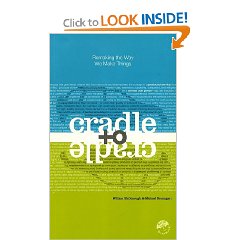
Review: Cradle to Cradle–Remaking the Way We Make Things

4 Star, Capitalism (Good & Bad), Economics, Environment (Solutions), Intelligence (Commercial), Nature, Diet, Memetics, Design, Survival & Sustainment, Values, Ethics, Sustainable Evolution

Amazon Page
Amazon Page

Hawken & Pals Better, But These Authors Are Part of the A Team,

December 14, 2006
William McDonough,  Michael Braungart

Warning. This is a plastic book (recycled something other than paper, waterproof). A pen smears, so plan to use a pencil if you are a normal person who reads serious books with an annotating hand. It is a fast light read, and in some ways I think the authors do not do their pioneering work full justice.

It was very helpful to me to have first read Paul Hawken's books (with his co-authors–see my reviews for a fast overview), namely Seven Tomorrows, The Ecology of Commerce, and Natural Capitalism. With that background, and of course having read Limits to Growth and related works in the 1970's, I found these authors to be impressive, coherent, and on target. HOWEVER, someone without that broader background could possibly find this book facile and unpersuasive if not somewhat opaque, which would be unfair to the authors. They are brilliant and merit our attention.

The book opens with a review of the industrial era which is characterized by cradle to grave design, meaning all things are designed for eventual disposal, generally at the taxpayers' expense and without regard to the natural capital cost of what was produced. This era, as the authors describe it, has been characterized by one size fits all planning (which wastes enormously on diverse points along the spectrum of actual need); by design for worst case conditions (more waste when they do not materialize 80% of the time); by the application of brute force to the land (with all that implies in energy consumption); by a monoculture concept (lawns with pesticide instead of natural gardens as eco-systems), and relatively crude products.

The authors' bottom lines here are that being less bad is not good enough, because in a closed system you can only go so far in relegating stuff to a grave, eventually the whole Earth will be one massive grave.

The four R's, and they give credit throughout the book to others, are Reduce, Reuse, Recycle, and Regulate.

They are very specific in stating that downcycling is not true recycling, and most often leads to a cumulative increase of toxins with each reuse.

They are conscious of and discuss conflicting views of growth, but like Paul Hawken, they are clearly pro-business and articulate in pointing out that if Henry Ford can see the value of going green, then all businesses should take this general message seriously: sustainable profit is ONLY possible if you go green.

They distinguish between biological recycling and technical recycling. Although many more examples could have been provided of both processes being successfully implemented, they go far enough to be understood on this point.

“Clean” water is not so clean after all. Just as fish are absorbing and passing on to human very high levels of mercury, so also is even the cleanest of water being found to be contaminated in alarming ways.

The authors conclude that it is possible to design cradle to cradle products if one commits to converting the products into leased services, with the “producer” being responsible for taking any given product back for proper and full recycling. This gives the producer every incentive for designing products that can be easily broken down, re-used, and purified of all toxins from cradle to cradle.

The localizing of processes, but especially of waste treatment, is another theme that runs strongly here. Not only can neighborhoods create aquatic biological localized waste treatment processes that are beautiful and natural, but since the water they drink comes out the other end, they are individually incentivized to avoid dropping toxins into the natural waste system.

The authors have a triangle comprised of Energy, Equity, and Economy, and without getting into the public philosophy (see my review of the book by that title), suggest that the three must go forward together.

They point out that feedback is important, that information improvements can contribute a great deal to our making progress along the lines they suggest, with business being the greatest beneficiary.

The book concludes with five steps and five guiding principles.

The five steps are:
1) Get rid of known toxins and culprits in every product and service
2) Follow informed personal preferences
3) Do detailed analysis of the positive, neutral, and negative components of any product or process
4) Design around the positive
5) Reinvent constantly–exceed the first fix again and again

The five guiding principles are:
1) Signal intention
2) Restore, restore, restore
3) Innovate and keep innovating
4) Understand and prepare for the learning curve of the client
5) Exert inter-generational (sustainable) responsibility

This is not a good book to read in isolation. It earned four stars because of the authors' proven accomplishments, but the book I wish they had written would have had much more substance of successful natural designs from the past, and proposed new designs for neighborhoods, townships, rural areas, and cities as well as factories. It would be quite interesting for these two authors to create a book on “Designing Forever: The Way It Needs to Be.” If they write it, I will buy it and review it here at Amazon.

Vote on Review
Vote on Review

Click Here to Vote on Review at Amazon,

on Cover Above to Buy or Read Other Reviews,

I Respond to Comments Here or There

Review: Seven Tomorrows

5 Star, Change & Innovation, Environment (Solutions), Future, Survival & Sustainment, True Cost & Toxicity, Values, Ethics, Sustainable Evolution

Amazon Pag
Amazon Pag

Published in 1982, Relevant Today and Proven with Time,

December 13, 2006
Paul Hawken
I am finding that many of the books from the 1970's and 1980's that focused on Limits to Growth, the global reach of multinational corporations, the dangers of centralized financial power, are all becoming accutely relevant now. They were a quarter century before the mainstream, and are now ready to be accepted and acted on by at least 80 million in the USA alone.

This is such a book. It focuses on five “driving trends”: energy, climate, food, the economy, and values. The latter is especially important, as we discover that our failure to adapt our educational systems, and our failure to *have* national values, insisting on government being “neutral,” has actually made us hollow and vulnerable.

The set the stage by listing key factors that today are much more worse: diverse social values, a turbulent world devoid of the stabilizing influence of the Cold War, slow energy growth, burdensome debt (who could have imagined what Bush-Cheney would do), an aging population, slowing economic growth, a social legacy of distrust (which also increases the costs of doing business), no end to crime (now $2 trillion a year, which along with $2 trillion in waste, makes the remaining $5 trillion in legal economics seem much devalued), continuing environmental degradation, rising level of disease and related costs, and deterioration of soil (meaning topsoil, which pesticides have now poisoned).

The authors had no way of knowing in 1982 that in 2006 the High Level Threat Panel of the United Nations would identify the ten global threats as poverty, infectuous disease, environmental degradation, inter-state conflict, civil war, genocide, other atrocities, proliferation, terrorism, and transnational crime. For the cost of this book in 1982, we could have saved a quarter century of loss had the adults at the time been willing to listen.

In the manner made so internationally respected by Peter Schwartz, who is one of the three authors, the book then posits a positive, middle of the road, and negative future for each of the five driving trends, and from that combination, then derives the seven scenarios that are ours to choose from:

1) The Official Future
2) The Center Holds
3) Mature Calm
4) Chronic Breakdown
5) Apocalyptic Transformation
6) Beginnings of Sorrow
7) Living Within Our Means

Each is discussed in detail, including tables showing specific countries likely to prosper or decline, and specific occupations likely to be in demand or face extinction.

The book ends with a discussion of cultural economics and why values matter, and provides at the end three tables of values as the authors anticipated they would be among a Right Wing, a Left Wing, and a Transformation Alternative. The latter, contrary to my expectations, is not a balanced reasoned transpartisan value system, but one that romanticizes some aspects and ignores other (e.g. crime and national-level threats including poverty).

The author first posit an emphasis on decentralization (today I use the word localization) and also address the dangers of moving so far in favor of individualism that the good of the group is lost sight of.

The bibliography is as fine a list of important books from the decade preceeding the publication of this book as to be worthy of study on its own merits.

I put the book down lamenting how ill-suited our current systems of governance and business are to the need for listening to reasonable people who can actually forecast the future and warn us of the dire consequences. Peak Oil was well known in 1974-1979, but because of the values in place, the Senate and the oil companies felt they could ignore the problem and deceive the majority of the people–the many who did not read or think about such matters, postponing the day of reckoning, which is today, and dramatically reducing our flexibility while increasing the cost to future generations of the remedial measures.

This book is still relevant, and indeed all the more enjoyable in the context of the two latest books by Paul Hawkins and friends, and the forthcoming book “Blessed Unrest.” I was fortunate to buy this book from a third party through Amazon, and am quite pleased to have it for its current value as well as its tangible demonstration that we did indeed have smart people a quarter century ago who knew exactly where we would end up if we continue with “the official story” of endless growth without regard to the “natural capital” of the planet.

Vote on Review
Vote on Review

Click Here to Vote on Review at Amazon,

on Cover Above to Buy or Read Other Reviews,

I Respond to Comments Here or There

Review: Natural Capitalism–Creating the Next Industrial Revolution

6 Star Top 10%, Capitalism (Good & Bad), Economics, Future, Nature, Diet, Memetics, Design, Values, Ethics, Sustainable Evolution

Amazon Page
Amazon Page

The One Book That Can Save Capitalism & The Planet,

December 12, 2006
Paul Hawken
Edit of 19 Jan 08 to add links.

This book is pro-business, pro-market, and pro-life. It outlines how profits can be made by going green and getting in touch with the actual cost of goods and services. It demonstrates how efficiencies can produce a 71% per year after tax Return on Investment (ROI).

On page 261, the following quote summarizes the intellectual victory that this book represents over economic fundamentalism: “That theology treats living things as dead, nature as a nuisance, several billion years' design experience as casually discard able, and the future as worthless.”

The three authors are “originals” whose genius dates back to the 1980's, and I am finding that the books written in the 1970's and 1980's were a quarter-century before their time of acceptance, and now pressing urgent and relevant.

They advocate a shift from a production economy that disregards the actual costs of goods, toward a service economy in which durability, ease of repair, and the elimination of waste transforms commerce so that we have sustainable profit, not short-term destructive profit.

The basic premise of the book is that in the next 100 years the population will double while available natural resources will drop by one half to three quarters.

The authors are damningly trenchant when they point out that we have taken just 300 years to consume 3.8 billion years of natural capital by turning scarce resources into permanent waste.

I am at one with these authors when they suggest that labor is now abundant–I for one believe that national leaders must demand full employment and cease substituting technology, which requires natural capital, for human capital. We need to reverse the process and restore full employment, community-based resource allocation.

In the course of two days with this book, I pulled 21 key ideas that I list here in tribute to these authors and their work:

1) Cars can generate electricity during the 90% of the time they are parked, and this will allow the replacement of ALL coal and nuclear plants

2) We waste 1 million pounds per person per year in the USA

3) Authors are saving business, not fighting business

4) Two trillion out of nine trillion in the total economy per year is waste of no value, including time spent in automobile gridlock

5) Real-time feedback is the number one resource saver

6) Biological processes create Kevlar strength silk (spiders) and walls (oysters)–we should emulate them instead of continuing our toxic ways.

7) Green buildings increase human productivity while reducing waste

8) Continuous education of designers and engineers is the single best investment for continually updating our ability to eliminate waste

9) Point to point air travel in smaller more numerous aircraft is a much more efficient alterative to the hub systems

10) We must end our perverse subsidies of wasteful agricultural, energy, forestry, fishery and other harmful practices by publicizing the foolish budget allocations

11) We should tax pollution and waste rather than income

12) Agricultural residues can be used to make paper, which can be recycled and substituted (e.g. electronic). We must end junk mail and unneeded packaging that outlasts its contents.

13) Restore localized agriculture, deep sustainable farming that does not deplete topsoil, get smart on water and fuel consumption.

14) Get a national water policy and water education, recover all rain (which can meet all of Africa's needs), use gray water; get a grip on toilets to include separate capture of urine and feces.

15) Protect the climate

16) Conserving energy is cheaper, faster, better than trying to produce more

17) Canceling or updating antiquated laws long overdue (for example, giving away billions of gold based on 1800 laws, for pennies)

18) Adjust prices to reflect external costs

19) Implement no fault insurance purchased at the pump

20) Create information feedback loops at all levels

21) Need systemic approach (what I call the ten threats, twelve policies, eight challengers) to avoid unintended spill-over consequences

22) The market cannot do it all. We need government.

Above all intelligence and information can make this happen. Simply labeling switches allows localized awareness and individual actions to save energy. The lack of accurate and up to date information is the largest correctible deficiency

I put this book down hoping that I might one day be able to take the secret intelligence budget of $60 billion a year, cut it by two thirds, and apply one third of that budget to implementing this book's ideas, and one third to creating a new form of global education that is continuous, free, online, in every language, and equally balanced between structured human teaching, interactive social networking, and self-paced online learning through serious games.

There is plenty of money and plenty of brainpower to save our planet and our quality of life while elevating the five billion poor, what we lack is inspired political transpartisan leadership, and a model, perhaps a model to be created in British Columbia, Washington, and Oregon.

I want to be part of this “big push” and am in awe of these authors and the big ideas they represent.

My top ten green to gold books:
The Limits to Growth
Seven Tomorrows
Silent Spring
Ecological Economics: Principles And Applications
High Noon 20 Global Problems, 20 Years to Solve Them
The Future of Life
Plan B 3.0: Mobilizing to Save Civilization, Third Edition
Green to Gold: How Smart Companies Use Environmental Strategy to Innovate, Create Value, and Build Competitive Advantage
Cradle to Cradle: Remaking the Way We Make Things

I would also point with enormous respect to books on green chemistry, beneficial bacteria, sustainable design, and what I think of as the “home rule” literature: an end to corporate personality, localized agriculture, localized credit (e.g. Interra Project), and an end to absentee landlords and mega farms that produce indigestible corn for cattle whose waste gets into our spinach, and for fuel (one tank of ethanol consumes enough corn to feed an individual for an entire year).

Vote on Review
Vote on Review

Click Here to Vote on Review at Amazon,

on Cover Above to Buy or Read Other Reviews,

I Respond to Comments Here or There

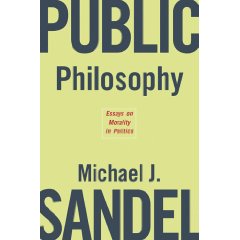
Review: Public Philosophy–Essays on Morality in Politics

5 Star, Intelligence (Public), Philosophy, Politics, Public Administration, Strategy

Amazon Page
Amazon Page

Brilliant Work, Foundation for the Future of the Republic,

December 10, 2006
Michael J. Sandel
I picked this lovely book up on a whim while visiting the Harvard bookstore, and let it lie fallow for months. It was not until I read Paul Hawken's “Ecology of Commerce,” that this book demanded to be read. I had no idea how well the two would go together.

Published in 2005, it is a balanced collection of essays written over the previous decade, and I found it to be better than any textbook or more labored treatise. This book really worked for me. Here are the highlights that made this book vital reading for any adult concerned about where we are going in the aftermath of the Bush-Cheney debacles.

Liberalism–root word liberty–has lost its moral voice. It has no compelling vision just when public philosophy is most needed. The author is quietly passionate about how values–enduring values–both enable localized self-governance and come from localized communities where everyone knows one another.

According to the author, individual knowledge of public affairs, and a sense of belonging to a larger commonwealth, are the underlying foundation for the Republic as our Founding Fathers bequeathed to us–“a Republic, if you can keep it,” as Benjamin Franklin told us all.

This author is most powerful in making the case that “laissez faire” on values is to NOT have national values. The author uses the early portion of the book to make the case that the larger question on anything is this: what strategy or policy will most support the nurturing of self-governance at the local and state levels? This connects DIRECTLY to the current focus in Ecotopia (British Columbia, Oregon, and Washington State) on resilience and on the equivalent focus by the global public health intelligence network on the same word: resilience!

I was moved, almost to tears, to read this author quoting and discussing Thomas Jefferson and Justice Brandeis, who were both certain that concentrated power is threatening to liberty and self-governance. Think Wall Street–Goldman Sachs, Carlyle, Wal-Mart, Exxon.

The rise of big government, led by Teddy Roosevelt, was intended to be an answer to big business, but it did not work. Of course, carried to its logical conclusion, global business demands big government (that will not work).

The author tells us that we went astray in the 1960's. We focused on economic growth and federal justice instead of the larger issue of what “political economy” would reinforce rather than diminish citizenship. We focused on economic outputs rather than either the cost of inputs (see Herman Daly and Paul Hawken) or the goal of nurturing community.

This is really quite a brilliant thoughtful book. In the middle section it explores the conflict between the concepts of rights of individuals versus the common good being imposed. One has to ask (see George Will) should soulcraft be imposed or nurtured?

The book/author also drives a stake in the heart of globalization and corporations–it's about the economy, stupid, BUT not as Bill Clinton used it. It's about decentralizing economic power, the collision between capitalism and community.

The author touches on impeachment (which is on the minds of many as citizens rally all over America today to demand that Congress impeach Bush-Cheney) and can not be more explicit: impeachment is warranted when the President (or the Vice President in his name) undermines the system of government–the separation of powers. [I would note, as an estranged moderate Republican, that we should at the same time impeach every Republican serving in Congress for abdicating their role as the FIRST branch of government (see Coburn).

From this book we are reinforced in our belief that corporate money is impacting on the political system in ways absolutely not anticipated by our Founding Fathers. Money has supplanted reasoned dialogue.

The book closes with a marvelous review of Dewey as the greatest American philosopher, focusing on pragmatism as well as an openness to experimentation, a love of tolerance, and an avoidance of the absolute. For Dewey, democracy was not about giving every individual what they wanted but rather about drawing the greatest good from the greatest number of diverse individuals.

In passing the author notes that the use of nuclear weapons, genocide (and one might add, ecocide) are global wrongs, for they destroy entire multi-generational cultures in all their history and diversity.

The author chooses to end with a salute to Rabbi David Hartman's interpretative pluralism (room for varied interpretations) and ethical pluralism (room for varied faiths). The author and Hartman conceive of religion as a means of making sense of the world and of one another.

The last bit focuses on John Rawls, and the three debates he inspired: utilitarian versus rights; what rights? and should the government be neutral?

There is a breath-taking finish, describing how a judge approved Martin Luther King's march on public highways, despite George Wallace's objections, because the enormity of the wrongs being protested warranted such a significant granting of privilege.

I am in awe of this author, of this book, and of the Republic for which it stands.

Vote on Review
Vote on Review

Click Here to Vote on Review at Amazon,

on Cover Above to Buy or Read Other Reviews,

I Respond to Comments Here or There

Review: The Ecology of Commerce–A Declaration of Sustainability

6 Star Top 10%, Best Practices in Management, Complexity & Resilience, Economics, Environment (Solutions), Intelligence (Commercial), Nature, Diet, Memetics, Design, Values, Ethics, Sustainable Evolution

Amazon Page
Amazon Page

Foundation Reference for Future of Business Without Waste,

December 8, 2006
Paul Hawken
This is easily one of the top ten books on the pragmatic reality of what Herman Daly calls “ecological economics” (see my list of Environmental Security).

The author excels at painting a holistic view of the realities that are not being addressed by the media or by scholars in anything other than piecemeal fashion.

The bottom line: what we are doing now in the face of accelerating decay (changes and losses that used to take 10,000 years now take three years) is the equivalent of “trying to bail out the Titanic with teaspoons.” On page 21-22 the author states that we are using 10,000 days of energy creation every day, or 27 years of energy each day.

This is a practical book. In brief, we can monetize the costs of the decay, we can show people the *real* cost of each product and in this way inspire both boycotts (of wasteful products) and boycotts (Jim Turner's term) of solar energy and long-lasting repairable products.

The author appears to be both pro-business and very wise in seeing that the cannot save the environment by destroying business, but rather must save business so it can save the environment–we must help business understand that doing more with less is what they must do to survive.

The author includes a recurring theme from the literature, that diversity is an option generator, and hence one of the most precious aspects of life on Earth. Diversity is the ultimate source of wealth, and anything that reduces diversity is impoverishing the planet and mankind. In a magnificent turn of phrase, the author states that the loss of a species is the loss of a biological library.

At its root this book is about missing information, needed information, about the urgency of making all inputs, processes, and outputs from corporate production transparent. He quotes Vaclav Havel on page 54 as saying that this is an information challenge, a challenge of too much (or too little) information and not enough actionable intelligence supporting sustainable sensible outcomes.

This is also a financial problem that has not been monetized properly. Although E. O. Wilson takes a crack at the strategic or gross costs of saving the Earth in his book “The Future of Life,” this author looks at the retail level and describes the waste inherent in our military system. He reminds me of Derek Leebaert's “The 50 Year Wound” when he notes that the US and the USSR spent over 10 trillion dollars on the Cold War, enough to completely re-make the entire infrastructure of Earth, including all schools. As I myself like to note, for the half trillion we have spent on the war against Iraq, we could instead have given a free $50 cell phone to each of the 5 billion poor people, and changed the planet forever.

The author is compelling in pointing out that conservation alone would save more energy than drilling in Alaska, and that President Reagan not rolled back gasoline mileage expectations, we would today be free of any dependency of Middle Eastern energy.

A good part of the book focuses on the need to eliminate waste, what some call “cradle to cradle” (waste must be fully absorbed of other pieces of the system), and where waste cannot be eliminated, to include the cost of its storage in the price of the product, requiring producers of products to take them back (e.g. refrigerators).

I am inspired by the author's view that not only is technology NOT a complete solution, but that full employment is possible if we REDUCE our excessive acquisition of technology that not only replaces humans, but also consumes energy and produces pollution.

This is an extraordinarily clever and useful book that fully integrates discussions of feedback loops and especially of financial and legal feedback loops that are now misrepresentative. One example the author uses is the GATT demand that there be no discrimination of “like” products based on methods of production. This is code for blocking labor laws by imposing high tariffs on products made by slaves or under sweatshop conditions.

I completely agree with one of the author's most important opinions, that we must end corporate claims of “personality” and the rights of a person. This has had two pernicious effects, the first allowing corporations to dominate the public debate; and the second of exempting managers from legal liability and transparency.

The book emphasized the restoration of human and natural capital as vital foundations for evaluating investments–this would dramatically reduce the financial criteria's dominance and emphasis on short-term returns that do not reflect the cost of natural resources and lost jobs to the future and the community.

Distressingly but importantly, the author notes that a major component of the cost of goods is in advertising, where corporations spend more on advertising than the government spends on all secondary schools, and on packaging, much of which is designed to last vastly longer than the contents.

I especially liked the author's suggestion that insurance costs be included in the price of homes and of gasoline, essentially making universal insurance affordable for all. I also liked his idea for indexing Nations by their sustainability, i.e. Most Sustainable Nation (MSN).

The author ends with a restatement of his three fundamentals:

1) End waste
2) Shift to renewable power (solar and hydro)
3) Create accountability and feedback

Although this book was published in 1993 and the author has now published “Natural Capital” (next on my reading list), I did not discover it until recently and am now very enthused about the author's newest project, the World Index of Social and Environmental Responsibility (WISER). I am certain in my heart that a bottom up Earth Intelligence Network is forming, and that end-user voluntary labor–social networks–are going to place enough information in the hands of individuals to restore participatory democracy and moral communal capitalism. This author is extraordinary in his understanding and his ability to teach adults about reality and the future.

Vote on Review
Vote on Review

Review DVD: 9/11 Mysteries – Part I: Demolitions

5 Star, 9-11 Truth Books & DVDs, Crime (Corporate), Crime (Government), Impeachment & Treason, Intelligence (Public), Misinformation & Propaganda, Power (Pathologies & Utilization), Reviews (DVD Only)
Amazon Page
Amazon Page

Nails It!,

December 7, 2006
Avatar
Edit of 11 Jun 09 to fix Tarpley and add links.

I read a lot, but lately I have been discovering the real value of non-fiction DVDs. This is one of the best, one of the most important DVDs that I have ever seen. I recommend it without reservation.

Although I am a very conservative person, my views have been radicalized by the superb non-fiction coming from Webster Tarpley, Jim Marrs, and Michael Ruppert, among others.

This DVD systematically and logically covers the power blackout that turned off the security camaras and access devices, the withdrawal of the bomb-sniffing dogs, the heavy dust each morning in the days preceeding 9-11, the secondary explosions that strongly suggest a planned demolition of three buildings (one of them, WTC 7, not hit at all), and–quite interesting–the asbestos problem that made the buildings, built in the 1960's–a real loser unaffordable to fix or take down. 9-11 was literally a $7 billion bonanza for its owners, at one stroke destroying the bulk of the complex to be cleaned up at taxpayer expense, and paying a DOUBLE insurance premium (in court, the claims that the two airplanes were two separate incidents rather than one coordinated attack, doubled the money paid out by the insurance companies). Bottom line: I think the US Government “let it happen” for its own reasons, and Larry Silverman was tipped off and it was Larry Silverman, not the US Government, that brought the buildings down. If this is obvious to me after a cursory examination of public materials, I have to ask myself: 1) how much did Rudy Guliani get for scooping and dumping to destroy the crime scene? and 2) is the insurance company part of the scam, or just stupid?

I have to say, on the basis of all my reading and my own past experience as a professional intelligence officer, that I am certain of one thing: this has not been properly investigated; and I am fairly certain of a second thing: 9-11 was known to be happening by a handful in the US Government and a handful in Israel as well as Pakistan, and it was welcomed as a cataclysmic event that would also be financially profitable to another handful. All of the suspicious activity began when Larry Silverman took possession of the complex.

Although I am less inclined to believe–without a proper investigation–that 9-11 was in fact made to happen at the instigation of Dick Cheney among others, I do believe there is enough evidence about neo-conservative views that such an event was needed, to *demand* a public investigation. The 9-11 Commission was a whitewash, actually criminal in its negligence.

See also:
9/11 Synthetic Terror: Made in USA, Fourth Edition
The 9/11 Commission Report: Omissions And Distortions
Vice: Dick Cheney and the Hijacking of the American Presidency
Breach of Trust: How Washington Turns Outsiders Into Insiders
Weapons of Mass Deception: The Uses of Propaganda in Bush's War on Iraq
Running on Empty: How the Democratic and Republican Parties Are Bankrupting Our Future and What Americans Can Do About It
Crossing the Rubicon: The Decline of the American Empire at the End of the Age of Oil
The New Craft of Intelligence: Personal, Public, & Political–Citizen's Action Handbook for Fighting Terrorism, Genocide, Disease, Toxic Bombs, & Corruption
Election 2008: Lipstick on the Pig (Substance of Governance; Legitimate Grievances; Candidates on the Issues; Balanced Budget 101; Call to Arms: Fund We Not Them; Annotated Bibliography)

Vote on Review
Vote on Review

Click Here to Vote on Review at Amazon,

on Cover Above to Buy or Read Other Reviews,

I Respond to Comments Here or There

noble gold