Review: Intelligence Analysis – How to Think in Complex Environments

4 Star, Intelligence (Commercial), Intelligence (Government/Secret)
Amazon Page
Amazon Page

Wayne Michael Hall and Gary Citrenbaum

4.0 out of 5 stars Utterly Brilliant, Mind-Glazing, 440 Pages of Straight Text, December 2, 2013

You could read this book a hundred times and learn something new every time. I have taken off one star because the book is too dense by far, with not a single graphic, table, or highlighted anything. 441 pages, pure text. What needs to happen, plain and simple, is a complete do-over — this book needs to go to 500 pages at least, with 60 added graphics, tables, or lists.

What I love most about this book, and its companion, Intelligence Collection: How to Plan and Execute Intelligence Collection in Complex Environments (Praeger Security International) are the following two attributes:

01: Among all the books I have read on intelligence, these two books are among the most detailed, structured, critical, and relevant I have read. Both books share the same flaws, flaws that superior editing and a graphics team could easily fix for a second edition, which I would strongly recommend. BEFORE the books go to paperback, they need to be redone. As they are now, the books are too overwhelming for 98% of those who might otherwise benefit.

02 Buried within each chapter are absolute gems of blood-letting romping stomping criticism of the US Intelligence Community at every level (tactical to strategic) across every mission area. This book is startling in its depth and breadth of understanding. The authors are articulate but dense, and I dearly hope they will redo both books to make them more accessible to the vastly larger audience that needs this level of detail, but served up as a quiver of “open” chapters instead of one really dense baseball bat that clubs you to death with compounded words.

Although I am troubled by the book's lack of a holistic analytic model, its lack of any reference to true cost economics, and its general avoidance of any discussion of the complexity of the customers for intelligence in the aggregate (the focuses on individual commanders and their needs, not on Whole of Government or Multinational or Eight Tribe collection and analytics), I whole-heartedly recommend this book for every library on intelligence (decision-support), and I sincerely hope the authors will re-do both books to open them up — more graphics, more white space.

Below, for this particular book, I list the chapter headings that are a Master's course in advanced analytics:

Continue reading “Review: Intelligence Analysis – How to Think in Complex Environments”
Review (Guest): Who Really Killed Kennedy? 50 Years Later – Stunning New Revelations About the JFK Assassination

5 Star, Crime (Corporate), Crime (Government), Executive (Partisan Failure, Reform), Impeachment & Treason, Intelligence (Government/Secret), Power (Pathologies & Utilization), Secrecy & Politics of Secrecy
Amazon Page
Amazon Page

Jerome R. Corsi

5.0 out of 5 stars The New Bush/Dulles Free Trade World Order and the Assassination of JFK, December 1, 2013

Herbert L. Calhoun

Introduction

On page 317, of this book, “Who Really Killed Kennedy 50 years later: Stunning new revelations about the JFK assassination,” the author, Jerome R. Corsi, summarizes the consequences of a nation willing to sit idly by and accept as a permanent fait accompli, having their elected leader shot down in cold blood, as follows:

“After fifty years of US government disinformation and deliberate stonewalling, researchers are just at the edge of discovering the truth about how and why JFK was assassinated in one of the greatest crimes in US history — a coup d'etat in which rogue groups, including the highest intelligence services in the land, conspired to remove JFK from the presidency and to place LBJ in the White House. The consequence of this conspiracy are immeasurable, if only because a group of traitors successfully flouted the constitution and got away with it.”

Corsi goes on to say that: ” … History will need to be rewritten to condemn those responsible as traitorous criminals. While prosecutions may no longer be possible simply because so many of the involved parties have already died, justice can be served by setting the historical record straight. At this late date, any attempt by the US government to withhold from the public documents pertaining to the JFK assassination should be deemed by Congress to be a continuation of the traitorous act that killed JFK.”

Continue reading “Review (Guest): Who Really Killed Kennedy? 50 Years Later – Stunning New Revelations About the JFK Assassination”

Worth a Look: Understanding Shadows – The Corrupt Use of Intelligence

5 Star, Intelligence (Government/Secret), Worth A Look
Amazon Page
Amazon Page

Vague references to the ‘war on terror’ and the ‘threat to national security’ are frequently used by venal politicians to cover-up criminal associations and covert illegal activity, ranging from money-laundering, narcotics trafficking, abduction and murder to the wholesale slaughter of non-combatant civilians. Their detritus is glibly dismissed or erased from mainstream media coverage of state terror around the world. But an awareness of what intelligence agencies are doing in the shadows is necessary if we are ever to grasp the true reality of momentous public events we wrongly think we understand. .

The issues in Understanding Shadows include how the bloody and brutal end of ‘democratic Islam’ in Algeria has facilitated the “fear and loathing” which has dominated the West’s security agenda since 9/11. The arrogance and political hubris of former British PM, Tony Blair, and the corrupt use of intelligence, took the UK to war in Iraq, and was a factor in the lonely death of WMD specialist, Dr David Kelly, while ‘off stage’ Israel continued its colonization of occupied Arab lands and upgraded its collective punishment of Gaza.

There is an account of the curious journey the CIA’s USSR ‘dangle’, Lee Harvey Oswald, made across Cold War Europe in June 1962, while the end of the apartheid regime in South Africa provided an opportunity for self-serving, power-hungry ANC politicians to ‘feather their own nests’ at the expense of the impoverished majority of their fellow citizens – a depressing example of a righteous liberation struggle turned sour. Meanwhile, the ‘long war’ continued.

Continue reading “Worth a Look: Understanding Shadows – The Corrupt Use of Intelligence”

Review: The Ageless Generation: How Advanced in Biomedicine Will Transform the Global Economy

4 Star, Disease & Health
Amazon Page
Amazon Page

Alex Zhavoronkov

4.0 out of 5 stars Excellent on Regeneative Health, Light on Preventive Health, Ignores Corrupt Toxic Corporate Practices, November 26, 2013

I was given this book as a gift and was glad to go through the substance. It is very strong on regenerative health but at a very high level. The examples and charts and lists of specifics that I was expecting are not there.

It touches on preventive health as a responsibility, and suggests that individuals as well as organizations should be held accountable for poor health practices they embrace. However, there is not a word in this book about the evils that we do every day in the way of growing, processing, and selling toxic food, flushing drugs into our water, and so on.

The book is a quick read in part because it focus strictly on the 10,000 foot level — more or less an executive overview of how and why regenerative medicine is possible, affordable, and vital.

Among the author's practical points:

01 Era of age is here — most can expect to live at least a decade if not longer than their parents, perhaps much more if they take care of themselves and preventive / extender medicine kick in (the book does not cover either)

Continue reading “Review: The Ageless Generation: How Advanced in Biomedicine Will Transform the Global Economy”

Review (Guest): Global Catastrophes and Trends – The Next Fifty Years

5 Star, Complexity & Catastrophe, Complexity & Resilience
Amazon Page
Amazon Page

Vaclav Smil

5.0 out of 5 stars Very balanced and insightful thinking on the topic, September 3, 2010

Gaetan Lion

Contrary to what the title suggests, this is not about over-hyping any apocalyptic scenarios. To the contrary, Smil thinks through issues in an insightful and detached way. From the book, you develop critical thinking skills to vaccinate your mind against Media hype. You also develop a healthy skepticism towards any forecasts as they always miss the boat.

Smil classifies changes that could affect our civilization into two categories. First, the abrupt ones are unpredictable and potentially devastating. They include natural phenomena such as asteroids, volcanic eruptions, tsunamis, floods, earthquakes, and influenza pandemics. They also include man-caused wars, genocides, and terrorism. The second type of changes occur over half a century or more. Those include the energy transition away from fossil fuel, and the slow changes in balance of geopolitical powers.

Smil states we are notoriously bad at forecasting risks or anything else. He mentions numerous Peak Oil forecasts that were invariably wrong. Smil mentions how in the 1970s, we were concerned a next ice age was upon us. Geopolitic, economic, and demographic forecasts have been wrong too. The rapid economic ascent of China and rapid retreat of Japan since 1990 were unforeseen by everyone. The sudden break up of the USSR was also unexpected.

Smil states we are even bad at explaining what already happened. As an example, Diamond in his book Collapse: How Societies Choose to Fail or Succeed mentioned only deforestation as a cause of the devastation of the Easter Island community. But, he missed out on rats infestation, infectious diseases, and enslavement. We invariably miss out on tons of variables when explaining past events.

Continue reading “Review (Guest): Global Catastrophes and Trends – The Next Fifty Years”

Review (Guest) The Crash of 2016 – The Plot to Destroy America – And What We Can Do to Stop It

4 Star, America (Founders, Current Situation), Banks, Fed, Money, & Concentrated Wealth, Capitalism (Good & Bad), Complexity & Catastrophe, Congress (Failure, Reform), Consciousness & Social IQ, Corruption, Crime (Corporate), Crime (Government), Culture, Research, Economics, Executive (Partisan Failure, Reform), Justice (Failure, Reform), Misinformation & Propaganda, Peace, Poverty, & Middle Class, Politics, Power (Pathologies & Utilization), Priorities, Public Administration, Threats (Emerging & Perennial), Values, Ethics, Sustainable Evolution, Voices Lost (Indigenous, Gender, Poor, Marginalized)
Amazon Page
Amazon Page

Thom Hartmann

4.0 out of 5 stars Provocative and Troubling Look at an Impending Economic Implosion, November 16, 2013
Book Shark

“The Crash of 2016” is a provocative and troubling look at an economic implosion that will occur unless we take drastic measures to stop it. “A story of how America was dragged into the Crash of 2016.” Well-known progressive national and international radio and TV talk show host and accomplished author, Thom Hartmann places his focus on an economic crisis that may turn into the Fourth Great Crash since the Declaration of Independence in 1776. This stimulating 294-page book includes sixteen chapters broken out by the following five parts: 1. The Economic Royalists and the Corporatist Conspiracy, 2. Why We Crashed, 3. “Oppression, Rebellion, Reformation”, 4. The Great Crash, and 5. Out of the Ashes.

Positives:
1. A professional and gifted author Hartmann is a master at engaging the public with a well- balanced narrative of history, current events and foresight.
2. The book has great format and flow. It's entertaining, enlightening and the pages turn themselves.
3. Hartmann is a great and passionate thinker. His knowledge of history, and his ability to identify patterns is only matched by the skill to convey his conclusions in a lucid, straightforward manner.
4. Troubling, straight-forward eye-opening conclusions. “This crash is coming. It's inevitable. I may be off a few years plus or minus in my timing, but the realities of the economic fundamentals left to us by thirty-three years of Reaganomics and deregulation have made it a certainty. We are quite simply repeating the mistakes of the 1920s, the 1850s, and the 1760s, and we are so far into them it's extremely unlikely that anything other than reinflating the recent bubbles to buy a little time here and there will happen.”

Continue reading “Review (Guest) The Crash of 2016 – The Plot to Destroy America – And What We Can Do to Stop It”

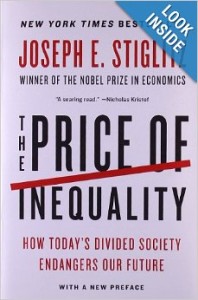
Review: The Price of Inequality:How Today’s Divided Society Endangers Our Future

5 Star, America (Founders, Current Situation), Banks, Fed, Money, & Concentrated Wealth, Capitalism (Good & Bad), Congress (Failure, Reform), Corruption, Crime (Corporate), Crime (Government), Economics, Executive (Partisan Failure, Reform), Future, Impeachment & Treason, Misinformation & Propaganda, Nature, Diet, Memetics, Design, Peace, Poverty, & Middle Class, Politics, Power (Pathologies & Utilization), Priorities, Public Administration, Threats (Emerging & Perennial), True Cost & Toxicity, Values, Ethics, Sustainable Evolution, Voices Lost (Indigenous, Gender, Poor, Marginalized)
Amazon Page
Amazon Page

Joseph Stiglitz

5.0 out of 5 stars Ethical Economist Confronts Two-Party Tyranny — Defines 70% of the Way Forward, November 26, 2013

I have admired this economist, one of a tiny handful who are not bought and paid for by the banks, for quite a long time. I'd like to see him at Director of the Office of Management and Budget (OMB), with a Deputy Director for Management that actually has authority for Whole of Government strategy and management. Of course that would require an honest president and an honest congress, so I am not holding my breath on this one.

In passing, I ran for President as an accepted candidate for the Reform Party in 2012 — it only took six weeks to recognize that neither Occupy nor any of the other candidates (there are EIGHT accredited parties in the USA, only 2 of which are allowed to actually run for office) were in the least bit interested in a universal demand for electoral reform and a coalition cabinet. See the six big ideas at bigbatusa.org, where you will also find the author of this book listed as the ideal member of the Cabinet for the OMB function.

There are so many other excellent reviews, I am using my contribution to list his specific recommendation for economic reform, and point to a few other related books that support this extraordinary work. My comments added below are in brackets.

THE ECONOMIC REFORM AGENDA

Continue reading “Review: The Price of Inequality:How Today's Divided Society Endangers Our Future”

noble gold