A Few Inconvenient Details about Western History, October 29, 2013
Herbert L. Calhoun
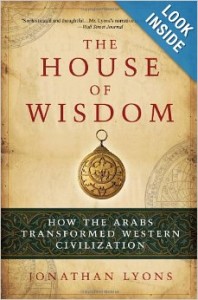
For centuries after the fall of Rome, Western Europe was unaccountably still locked in the dark ages, a period referred to as “dark” for good reasons. Despite the rich intellectual heritage from both Greece and Rome, it is not well known that little of it had seeped into the medieval feudal and violence-torn Western European veins before the thirteenth century. Even less well known is that what little did seep in came by way of the rich history and cultural institutions of the Arab dominated Near East, a region that drunk the intellectual wines of both Greece and Rome nearly a millennium earlier than the West did.
Although Western Europeans were ever ready to fight each other, most of them could not read, write or tell time. There were only a handful of libraries. Neither streets nor people had unique names or numbers. Violence and instability were the order of the day. Even as the Kingdom and the Catholic Church viciously vied for power, Europe was essentially a region being run by “outlaws,” the equivalent of petty warlords that we see today in places like Afghanistan.
5.0 out of 5 stars6 Star — Utterly Brilliant Man, Mind, and Treatment, October 24, 2013
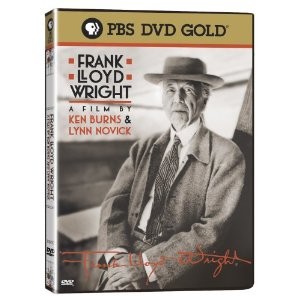
WARNING: This DVD has two parts, and if you are inattentive, you can get to the end of Part I (the 1920's and Frank Lloyd Wright's low point) and forget that there is a Part II (the rest of his life, with his greatest accomplishments during his 70's).
PBS has really out-done itself with this production. The detail, the mosaic of interviews and the integration of glorious music and spectacular photography make this one of the best DVDs I have ever enjoyed.
This is not just a DVD about a man; it is a DVD about a philosophy of life, about the integration of humanity, nature, work, and artifact – from a single house that is a spiritual temple to heaven on earth, and across the board re-invention of how man relates to everything.
I've had several translations of the I Ching Before, and this one is far superior to the rest. At first glance the advice in the various hexagrams may seem nearly the same, from one hexagram to the next; but the repetitions are examples of core Taoist philosophy, which tend to apply in almost any situation, like remaining calm, being flexible, and not letting ego battles determine one's course of action. That's what I like about this translation: it keeps reminding you to cultivate those qualities. In that sense it's almost like a Taoist master continually advising you. Of course it's not a master but the Tao itself that guides. The hexagrams simply alert you to qualities of the situation and the perspective of the Tao.
No one knows how the I Ching works, but it always seems to understand the exact situation you are consulting it about; or, that has always been true for me. Maybe it can give you insights into choosing your courses of action in the various endeavors of your life.
For centuries, The I Ching or Book of Changes has been consulted for sage advice at life's turning points. When its wisdom is sought with sincerity and sensitivity, this Chinese oracle will help to promote success and good fortune and to impart balance and perspective to your life. Its everlasting popularity lies in the lessons that it teaches about how to use your positive qualities in order to attain life's greatest rewards-prosperity, understanding, and peace of mind.
The other book is “365 Tao: Daily Meditations,” by Deng Ming-Dao. Again, this book is extraordinary. I've read many books on the Tao, but none compare to this one, because the book is laid out in 365 different topics—one for each day of the year. But I haven't been reading it that way. I've been flipping through it and reading any topic that peaks my curiosity. So the book is from the position of a Taoist master discussing a range of topics. And I'm continually amazed that Taoism is essentially a philosophy of integral thinking. The ancient sages were seeing things from the perspectives of systems thinking and complexity thousands of years before contemporary Western science.
Most important about this book: it uses language that explains clearly the concepts that you and I and the other posters at phibetaiota are always trying to articulate but have difficulty putting into words. So it's an excellent aid in trying to articulate a systems perspective in respect to social issues. In that regard, I doubt there's another book like it.
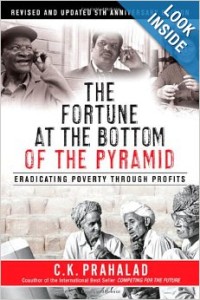
Here's the math that I was surprised to not see in the book: the top billion people that business focuses on are worth less than a trillion in potential sales. The bottom four billion, with less than $1000 a year in disposable income, are worth four trillion in potential sales.
In combination, Prahalad and Hart make it clear that business suffers from the same pathologies as the Central Intelligence Agency and other bureaucracies: they are in a rut.
I will end by emphasizing that I believe this author merits the Nobel Peace Prize. As the U.S. Department of Defense is now discovering, its $500 billion a year budget is being spent on a heavy metal military useful only 10% of the time. Stabilizization and reconstruction are a much more constructive form of national defense, because if we do not address poverty and instability globally, it will inevitably impact on the home front. This author has presented the most common sense case for turning business upside down. He can be credited with a paradigm shift, those shifts that Kuhn tells us come all too infrequently, but when they come, they change the world. It may take years to see this genius implemented in the real world, but he has, without question, changed the world for the better with this book, and make global prosperity a possibility.
Is this the Penultimate CIA hangout position, or just another “Case Closed?”, October 22, 2013
Herbert L. Calhoun
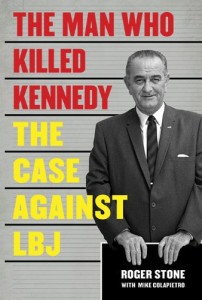
This is an interesting theory. In fact it is a slightly more robust and sophisticated off-shoot of the “renegade CIA officers did it” theory. However, the critical element — of linking it to Clint Murchison — shows up here as being mostly rhetorical, and thus is weak at best. The language used on page 155 is that “Murchison could have easily arranged the meeting between Cord Meyer and LBJ.” However, is it unfair to point out that the authors are way too far down the road and into the weeds to be using as the finally linking connection, a “mealy-mouth” phrase such as “could have easily been arranged?”
In any case, the LBJ/Cord Meyer angle is an E. Howard Hunt death bed concoction. Which raises another fair question to ask: Who in their right mind would believe anything that E. Howard Hunt would say, especially since he never admitted being the third “faux tramp” taken from a train in full view of the world and arrested only yards away from the Grassy Knoll the day of the assassination? Is that what he refers to as being a “bench warmer?” And with the exception of “Poppy Bush,” and Richard Nixon, Hunt is also the only man in the known universe who did not know where he was on the day JFK was murdered? (Did he not lose a million dollar law suit to the Liberty Lobby and Spotlight Magazine on the basis of lying about where he was on that fateful day?) And did his son, St. John Hunt, not confirm that Court verdict by insisting that his mom had told him “that daddy is on a business trip to Dallas” — as well as recognizing his father unmistakably as being the third tramp in the picture shown across the world on that fateful day?
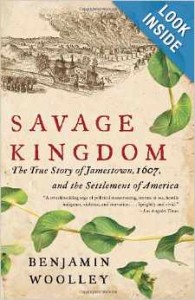
Chapter Twenty-One, entitled the Imbangala, tells the story of how slavery got into the English colonial picture. It is such an interesting and unexpected story that I am including a rough summary of it here as well.
The transatlantic slave trade began under a license issued at Seville, in 1598 while Portugal was a province of Spain. At the time, Portugal had had much success in enlisting very unreliable local black armies to help it defeat local towns in Angola raided for large caches of slaves taken as spoils of war. That is, until it was routed by a chief of the Ndogolo people. Rather than continuing to rely on the unreliable “black armies,” Portugal hired the much more feared and ruthless, if not entirely barbaric, group of itinerant marauders called the “Imbangala,” best known for settling within a country, sucking it dry and then moving on.
5.0 out of 5 starsSingle Best Value — Better than any book, October 20, 2013
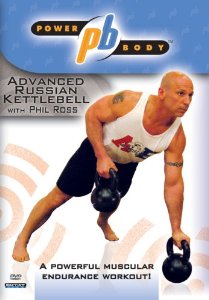
After reading through Kettlebells For Dummies I have to conclude that this DVD by itself is vastly more useful than any book. This is a complete package offering 45 minutes of perfectly displayed instruction for a routine that can be completely in 30 minutes.
Introduction. Basics include flat shoe or barefoot. Chalk up and hydrate but you must complete the exercise in the allotted amount of time to achieve the optimal benefit. Do not settle for anything less than a cast iron single piece kettlebell. This stuff is DANGEROUS if you are not warmed up, trained up, and ready to do the relatively coordinated actions such as swinging a kettlebell up, letting go the handle, and catching it the palm of you hand. What impresses me about this advanced version is that it clearly is a full-body work out where bending of the knees, a straight back, flexible hips, and balance are essential.
Tutorial. In this section a series of exercises are demonstrated with ample words, ending with the towel halos using a single sixteen pound RK and swinging the RK around in a manner that is clearly a full body work-out. And dangerous. If you are not good at this you could let go and hurt someone — or be hurt by others not yet ready for this exercise.

 A Few Inconvenient Details about Western History, October 29, 2013