He was the one who campaigned, in 2008, on Hope and Change. He was the one who deployed high-flying rhetoric to promise a new day in Washington politics.
He was the one who said he was going elevate the level of discourse and make government transparent. He positioned himself as a new kind of leader. He was the one who turned his candidacy into a religious experience.
He was the one who convinced voters he stood above the fray, as a man and as a symbol, and on that basis they boarded his train and rode it all the way.
He was the one who, inheriting a desperate economy, made his signature move upon gaining office:
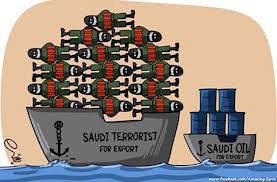
Saudi Arabia-US: Saudi Arabia's intelligence chief Prince Bandar bin Sultan told European diplomats the kingdom will make a “major shift” in its relations with the United States, according to an unidentified source close to Saudi policy on 22 October.
Prince Bandar said the US had failed to act effectively on the Syria crisis and the Israeli-Palestinian conflict, was growing closer to Tehran, and had failed to back Saudi support for Bahrain when it crushed an anti-government revolt in 2011.
Prince Bandar also that he plans to limit interaction with the US. “Relations with the US have been deteriorating for a while, as Saudi feels that the U.S. is growing closer with Iran and the U.S. also failed to support Saudi during the Bahrain uprising,” according to the source. Bandar reportedly said there would be no further coordination with the United States over the fighting in Syria.
Comment: The information comes from an unidentified source, but appears consistent with Saudi Arabia's reasons for refusing to accept a seat on the UN Security Council as a rotating member. That suggests it is an official leak. In announcing this action, the Saudi attitudes towards the US resembles the Iranian hardline clerics who said this week that if the US is encouraged by Iranian diplomacy then the diplomacy is wrong.
Saudi Arabian leaders have been quietly but sternly critical of multiple recent US actions in the Middle East, especially the installation of a Shiite-led government in Baghdad through elections. They have not broken openly with the US.
Is this the Penultimate CIA hangout position, or just another “Case Closed?”, October 22, 2013
Herbert L. Calhoun
This is an interesting theory. In fact it is a slightly more robust and sophisticated off-shoot of the “renegade CIA officers did it” theory. However, the critical element — of linking it to Clint Murchison — shows up here as being mostly rhetorical, and thus is weak at best. The language used on page 155 is that “Murchison could have easily arranged the meeting between Cord Meyer and LBJ.” However, is it unfair to point out that the authors are way too far down the road and into the weeds to be using as the finally linking connection, a “mealy-mouth” phrase such as “could have easily been arranged?”
In any case, the LBJ/Cord Meyer angle is an E. Howard Hunt death bed concoction. Which raises another fair question to ask: Who in their right mind would believe anything that E. Howard Hunt would say, especially since he never admitted being the third “faux tramp” taken from a train in full view of the world and arrested only yards away from the Grassy Knoll the day of the assassination? Is that what he refers to as being a “bench warmer?” And with the exception of “Poppy Bush,” and Richard Nixon, Hunt is also the only man in the known universe who did not know where he was on the day JFK was murdered? (Did he not lose a million dollar law suit to the Liberty Lobby and Spotlight Magazine on the basis of lying about where he was on that fateful day?) And did his son, St. John Hunt, not confirm that Court verdict by insisting that his mom had told him “that daddy is on a business trip to Dallas” — as well as recognizing his father unmistakably as being the third tramp in the picture shown across the world on that fateful day?
Philosophy Professor, Karen Frost-Arnold, has just published a highly lucid analysis of the dangers that come with Internet accountability (PDF). While the anonymity provided by social media can facilitate the spread of lies, Karen rightly argues that preventing anonymity can undermine online communities by stifling communication and spreading ignorance, thus leading to a larger volume of untrustworthy information. Her insights are instructive for those interested in information forensics and digital humanitarian action.
Click on Image to Enlarge
To make her case, Karen distinguishes between error-avoidance and truth-attainment. The former seeks to avoid false beliefs while the latter seeks to attain true belief. Take mainstream and social media, for example. Some argue that the “value of traditional media surpasses that of the blogosphere […] because the traditional media are superior at filtering out false claims” since professional journalists “reduce the number of errors that might otherwise be reported and believed.” Others counter this assertion: “People who confine themselves to a filtered medium may well avoid believing falsehoods (if the filters are working well), but inevitably they will also miss out on valuable knowledge,” including many true beliefs.
Seeing What Is in a Laundry List of Search Results
In late October I will be delivering a webinar version of my lecture “What to Do When Google Doesn’t Answer Your Question.” The webinar is at this time not open to the public. My topic is that free Web search engines offer useful information. Most people have neither the time nor tools to pinpoint the item which provides significant insight or a useful fact; for example, a relationship between two people or a phone number of a person associated with a subject like the Muslim Brotherhood.
You may be one of the hundreds of millions of Bing or Google searchers who uses the results lists as they are presented. I have no desire to argue with anyone about relevance, precision, and recall. The reason is that modern technology makes ad-supported search results the Great Destroyer of objective information retrieval measures. In short, precision and recall are dead. Too bad. I miss them. Nevertheless, useful information is in the public and open source indexes. The problem is finding useful information.
One of the topics in the 2.5 hour lecture at the ISS World Conference for intelligence and law enforcement professionals elicited quite a bit of post-presentation discussion. The interest in the topic fueled the upcoming webinar.
I want to highlight one service I described at ISS World and will touch upon in the webinar in late October 2013.
The system is Cluuz.com, a service of Sprylogics. Sprylogics is a Canadian outfit originally set up by a former military officer. To follow along with this example, point your browser to www.cluuz.com.
Here are the steps I followed on October 8, 2013. Because content in public Web indexes changes, your results will differ. Also, Cluuz.com is a metasearch engine. The system sends a query to a public Web index and then processes the results. The Sprylogics’ technology extracts entities, performs relationship analyses, and formats results in a laundry list and graphic reports. Remember, at this time Cluuz.com is available without charge.


 Is this the Penultimate CIA hangout position, or just another “Case Closed?”, October 22, 2013