Yoda: Follow the Money – Voters, Voting, Information and Influence

Politics
0Shares
Got Crowd? BE the Force!

Follow the Money

Recent court decisions (re)affirming corporate personhood and premise that campaign contributions are (protected) free speech punctuated the fear of some that politicians—biennially for sale to the highest bidder—would increase in cost and become the exclusive province of the rich, which would give truth to the sobriquet, “the ruling class”.

It is unfair, however, to think only of politicians for sale, when it is politics in its broadest dimension that is for sale. In the instance of campaign contributions, for example, follow the money: campaigns are conducted to amass votes—to urge voters to cast their ballots for the campaigner or, at least, refrain from casting a vote for the opposition. So, is the tsunami of campaign contributions buying votes?…or, in kind, buying not (only) politicians but voters?

If we consider that campaign contributions are (in some way) buying votes/voters, it is awe inspiring to calculate the cost (value?) of a vote or, alternatively the price of a voter [an exercise left to the reader].

Once (in a Chicago-minute, when all politics was truly local) it was more direct to simply pay people for their vote—cash or spirits, take your pick. This stimulus to the economy really did trickle down. Thanks, in part, to exposure by the high-minded media, we have (largely) curtailed this practice. Too bad, perhaps: many citizens, struggling economically, would be delighted with such a biennial windfall. And, if the (contributing) power of unions has declined and shifted to the rich, all the better: doesn’t this represent a compelling expression of transfer payments—something to which every citizen is “entitled”?

Continue reading “Yoda: Follow the Money – Voters, Voting, Information and Influence”

Chuck Spinney: The Iranian War Fraud

Corruption, Government, Media, Military
0Shares
Chuck Spinney

The Path to War with Iran  is an analysis by Robert Merry, editor of The National Interest and a historian. (I reformatted it to highlight its main points but did not change any words or the order of his words.) Merry analogizes the current situation with that facing FDR in the late 1930s, and he introduces a fascinating vignette, which if true, adds substance to those who claim Roosevelt was trying to push the Japanese into war.  But the analogy is really beside the point.  Merry's focuses the substance of his argument entirely on the nuclear question.  At first glance, this appeared to me to be very well argued and important, but for some reason, I was a little uneasy about it.  So, I forwarded to my good friend Pierre Sprey and asked him for his take on Merry’s argument.  Pierre has a very different view; he thinks a war with Iran is very unlikely for reasons unrelated to the nuclear question.  In effect, nucs may be a red herring that keeps populations lathered up and distracted from more fundamental issues.  For the record, I agree and am familiar with Pierre’s arguments “a” (about the war weariness) and “b.” — the fact that I needed to be reminded of these more fundamental issues is a yet another example of how nucs can capture one’s thinking.

I urge readers to think about both points of view.

Chuck Spinney
Menton, France

——[Response from Pierre Sprey]——-

Chuck,

Most interesting (and new to me) is Merry's vignette of FDR deliberately moving to lock up all the Japanese-Americans on the same day that he pushed the Japanese government over the brink–just one more testimonial to FDR's boundless lust for power and utter cynicism when it came to right, wrong, justice or causing the death of millions. Reminds you of LBJ, doesn't it?

Continue reading “Chuck Spinney: The Iranian War Fraud”

Open Source Everything Manifesto Hits #50 for Democracy

Manifesto Extracts
0Shares
Amazon Page

For a tiny book from a boutique publisher, this is huge….there is no advertising budget, no public sales effort, etcetera.  This is a word of mouth rising.

Amazon Best Sellers Rank: #37,210 in Books (See Top 100 in Books)

#50 in Books > Politics & Social Sciences > Government     > Democracy

NOTE:  Amazon is selling the book for just under $10, a savings of almost $5 from the retail price.

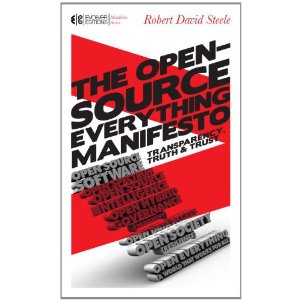
What the world lacks right now—especially the United States, where every form of organization from government to banks to labor unions has betrayed the public trust—is integrity. Also lacking is public intelligence in the sense of decision-support: knowing what one needs to know in order to make honest decisions for the good of all, rather than corrupt decisions for the good of the few.The Open-Source Everything Manifesto is a distillation of author, strategist, analyst, and reformer Robert David Steele life's work: the transition from top-down secret command and control to a world of bottom-up, consensual, collective decision-making as a means to solve the major crises facing our world today. The book is intended to be a catalyst for citizen dialog and deliberation, and for inspiring the continued evolution of a nation in which all citizens realize our shared aspiration of direct democracy—informed participatory democracy. Open-Source Everything is a cultural and philosophical concept that is essential to creating a prosperous world at peace, a world that works for one hundred percent of humanity. The future of intelligence is not secret, not federal, and not expensive. It is about transparency, truth, and trust among our local to global collective. Only “open” is scalable.

Review of the Book by Ralph Peters   …   Manifesto Extracts at Phi Beta Iota   …   Book Page at Amazon   .   Book Page at Barnes & Noble   .   Book Page at McNallyRobinson   .  Book Page at North Atlantic Books (Publisher)   .   Book Page at Powell’s Books   .   Book Page at Random House   .   Book Page at Super Book Depot

Review (Guest): Atlas Drugged: Ayn Rand Be Damned!

5 Star, America (Founders, Current Situation), Banks, Fed, Money, & Concentrated Wealth, Capitalism (Good & Bad), Complexity & Catastrophe, Congress (Failure, Reform), Corruption, Crime (Corporate), Crime (Government), Culture, Research, Economics, Empire, Sorrows, Hubris, Blowback, Impeachment & Treason, Justice (Failure, Reform), Misinformation & Propaganda, Politics, Power (Pathologies & Utilization)
0Shares
Amazon Page

Stephen Goldstein (Author)

5 Stars, often hilarious June 15, 2012

By David Swanson

The Florida Sun Sentinel has for many years been rather unique, as a corporate newspaper with a regular columnist who's actually good, and I don't mean just good for the context, but actually worth reading even if the masses of South Florida weren't reading along. Happily, they are.

Stephen L. Goldstein has just published a book, also worth reading, called Atlas Drugged (Ayn Rand Be Damned!) It's fiction, often hilarious fiction, aimed at debunking the notion that Ayn Randian “free-market” trickle-down crapitalism can coexist with basic human decency. “This is a work of fiction,” says the back cover. “But any resemblance to actual events, locales, or persons, living or dead, is entirely intentional. The names have been changed but, hopefully, not enough to protect the guilty.”

In fact, while the book takes rightwingerism to an extreme, it blends in plenty of elements from reality. Imagine the most outlandish carrying of so-called conservatism to its logical conclusion, and abandoning New Orleans to a hurricane, or watching a fire department stand by while a house burns (because the owner didn't pay the proper fees) fits right in.

Continue reading “Review (Guest): Atlas Drugged: Ayn Rand Be Damned!”

The Open Source Everything Manifesto: Chapter 5 Integrity, Lies, and Panarchy Extract II

Manifesto Extracts
0Shares
Amazon Page

The Open Source Everything Manifesto: Chapter 5 Integrity, Lies, and Panarchy Extract II

Every major segment of our society–academia, civil society [including labor unions and religions], commerce, government, law enforcement, media, military, and non-government/non-profit–is currently suffering from epidemic lack of integrity, which only gets worse at large scales of operation, leading to implosion from corruption of intelligence and information-sharing.

. . . . . . .

For many years I though that our elected representatives had been corrupted by corporations, and more recently, by banks (or I should say, the people who use these structures as veils for their own unethical accummulation of profit).  I was in error.  As we now know from numerous cases, the most blatant being that of former Congressman Randy Cunningham, it is more often the elected representative who have been shaking down banks and corporations in order to fund their own ambitions to remain in power and to profit at the expense of the people.

. . . . . . . .

This manifesto is a political and intellectual “call to arms” for carrying out a non-violent revolution that restores the sovereignty of We the People.  With Oath Keepers gaining ground among law enforcement professionals, and Ron Paul receiving more support from veterans than all other 2012 Presidential candidates combined, it's possible that the police and military can come together with labor, Occupy, the Tea Party, and Independents to achieve electoral reform and then intelligence, governance, and national security reform.

Review of the Book by Ralph Peters   …   Manifesto Extracts at Phi Beta Iota   …   Book Page at Amazon   .   Book Page at Barnes & Noble   .   Book Page at McNallyRobinson   .  Book Page at North Atlantic Books (Publisher)   .   Book Page at Powell’s Books   .   Book Page at Random House   .   Book Page at Super Book Depot

Mini-Me: Agent Orange Dump Courtesy US Marines

07 Other Atrocities, Corruption, Earth Intelligence, Military
0Shares
Who? Mini-Me?

Huh?

Deadly legacy of Agent Orange spreads to Japan

U.S. veterans have told the Japan Times that the Marine Corps buried a massive stockpile of Agent Orange at the Futenma air station in Okinawa, Japan. This buried stockpile has possibly poisoned the base's former head of maintenance and is potentially contaminating the ground beneath the base, as well as nearby residents. The former mayor of the nearby town of Ginowan said local authorities had never been told of the 1981 Agent Orange find, and that he was worried about the potential level of contamination in the ground water and land, which consists of many caves and natural springs. ‘If the dioxin is still in the soil, then we can confirm its presence with sampling. But the Japanese government won't grant permission to conduct such tests within U.S. installations in Okinawa,' Iha said. 20 schools and 109 more elementary schools are in close proximity to the barrels' location…

. . . . . . . .

Under Japanese law, the U.S. military is not responsible for cleaning up former bases returned to civilian usage, and apparently has a bad track record of polluting its installations in Okinawa.

Read full article.

Robert Steele

ROBERT STEELE:  Marines like to claim they are the “gold standard” for integrity.  This is delusional idiocy.  The fact is that the entire US Government, each Cabinet Department, each agency, each service, have devolved into little cesspools of fraud, waste, and abuse.  There is neither intelligence nor integrity in the US Marine Corps, or the rest of the US Government.  A Director of National Intelligence (DNI) with integrity would insist–demand–and implement an intelligence program that began with “Ground Zero.”  Until we get the truth on the table about what, when, where, why, and how of our past crimes against humanity and the Earth, we will not be in a position to deal with it.  Absent that truth as a starting point–and absent strategic intelligence that is  holistic (ten threats, twelve policies, eight demographics)–the US Government cannot–even with the best of intentions that are nowhere apparent–act in the public interest.

See Also:

2012 PREPRINT AS SUBMITTED: The Craft of Intelligence

2010: Human Intelligence (HUMINT) Trilogy Updated

2010 INTELLIGENCE FOR EARTH: Clarity, Diversity, Integrity, & Sustainability

Journal: Reflections on Integrity UPDATED + Integrity RECAP

Open Source Everything Manifesto Hits #50 for Democracy


Tom Atlee: Emerging Economics #3 – The Sharing Economy

Money
0Shares
Tom Atlee

Emerging Economics #3: The Sharing Economy

Dear friends

One of the key features of “the new economy” is sharing.  More and more people are sharing housing, cars, bikes, tools, meals, skills, money, books, ideas, music, energy, recreation, projects, transportation, knowledge, problem-solving, visions, jobs, ownership, clothes, stories, time…

Sharing is a resource in hard times as well as a source of intrinsic meaning and satisfaction any time.  To an increasing number of people, sharing offers compelling alternatives to the corporate-dominated money-saturated whole-society bustle we normally think of as “the economy”.

They wonder:  To what extent would we buy things and work long hours and struggle alone in separate homes and families if we could get our needs met by sharing?

The existing economy is designed to get us to look out for ourselves so that we'll consume, compete and work at paying jobs.  It nurtures the illusion that we are independent, building lives for ourselves in a world where everyone else is out for themselves, too.  Closer examination, however, suggests that such independence is largely a myth, a well-promoted appearance obscuring our profound dependence on the competitive buy-and-sell economy which, in turn, conceals our dependence on nature, culture, and each other.

Continue reading “Tom Atlee: Emerging Economics #3 – The Sharing Economy”