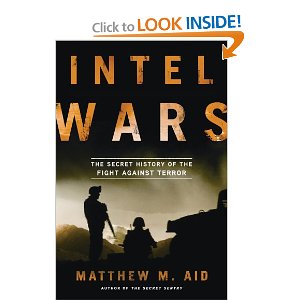
Review (Guest): Intel Wars – The Secret History of the Fight Against Terror

5 Star, Intelligence (Government/Secret)
0Shares
Amazon Page

Matthew M. Aid

5.0 out of 5 stars Inside the Secret World,January 16, 2012

By Retired Reader (New Mexico)

This is an interesting and informed account of how the major players of the U.S. Intelligence Community have conducted what the administration of President George W. Bush usually called the Global War on Terror. In the course of doing this its author, Mathew Aid, does a good job explaining the complexities involved in that War and specifically provides a very good summary of U.S. operations in Afghanistan and rocky relationship with sometimes ally Pakistan. The book does not cover all of the many intelligence pockets that have been directed towards counter-terrorism, but concentrates primarily on the activities of CIA, the FBI, and the NSA, but also notes the work of the military intelligence services and the NGA. Surprisingly the book also provides what appears to be a fair and accurate assessment of the contributions of both the Office of Director of National Intelligence (ODNI) and Department of Homeland Security (DHS). Aid provides a balanced and apparently accurate assessment of the overall performance of these agencies. He notes their successes and failures, but makes clear that the U.S. Intelligence System continues to be hampered by serious technical flaws and very weak leadership in its higher echelons. A good read that provides an educated description of how the U.S. in general and its intelligence system in particular has handled the threat of terrorism since the 9/11 tragedy.

Vote and/or Comment on Review

Phi Beta Iota:  The author is very blunt across the book about the routine lying that seems to be the norm for senior officers in both the military and political arenas.  He also has a great story about VP Cheney insisting on 24/7 helicopter cover for Blair Mansion when he was in residence as well as insisting that Google Map fuzz pictures of the place. We do not make this stuff up.  We can only wonder at what other insanities uniformed officers accept in their confused substitution of loyalty for integrity.

Review: A Memoir of Injustice

5 Star, Atrocities & Genocide, Congress (Failure, Reform), Corruption, Crime (Corporate), Crime (Government), Executive (Partisan Failure, Reform), History, Impeachment & Treason, Justice (Failure, Reform), Military & Pentagon Power, Peace, Poverty, & Middle Class, Politics, Power (Pathologies & Utilization), Public Administration, Voices Lost (Indigenous, Gender, Poor, Marginalized)
0Shares
Amazon Page

Jerry Ray, Tamara Carter

5.0 out of 5 stars Solid Support for THE Book on USG Assassination of MLK,January 17, 2012<

I am unemployed and cannot afford books the way I once could, so my review is actually applause from the sidelines, and a pointer–something I can still do as the #1 Amazon reviewer for non-fiction, toward THE book:

An Act of State: The Execution of Martin Luther King (Updated)

MLK was assassinated at the direction of J. Edgar Hoover, with the active collaboration of the U.S. Army, and one suspects with at least the tacit knowledge of Lyndon Johnson, himself complicit in the assassination of JFK. I note with reverence that Bobby Kennedy calmed a major crowd with a voice close to that of MLK, only to be himself assassinated later. On JFK see:

Continue reading “Review: A Memoir of Injustice”

Mini-Me: Smoking Gun Documents on Iran From Israel Mossad?

05 Iran, 08 Wild Cards, 09 Justice, 10 Security, 11 Society, Corruption, Government
0Shares
Who? Mini-Me?

Smoking Gun Documents On Iran “Found” By US-Backed Terror Group

The people pushing for war against Iran are the same neocons who pushed for war against Iraq. See thisand this. (They planned both wars at least 20 years ago.)

The IAEA report being trumpted as a casus belli contains no new information, but is based on a re-hashing of old, debunked claims stemming from “laptop documents”.

State Department cables released by Wikileaks reveal that the new IAEA head was heavily backed by the U.S., based upon his promises of fealty to the U.S. Indeed, as we’ve seen in the nuclear energy arena, the IAEA is not a neutral, fact-based organization, but a wholly-captured, political agency.

But where did the documents come from originally?

Read full article.

Phi Beta Iota:  See the below quote from State of War–The Secret History of the CIA and the Bush Administration (Hardcover)

3) Slightly less sensational, the book reveals for the first time that a CIA “bait” operation actually delivered to Iran completely useful plans for creating a nuclear bomb…the CIA “flaws” intended to render the plans unworkable were detected in one glance by a Russian courier scientist, and easily correctable by the Iranians.

See Also:

Iran Played “Pivotal Role” in 9/11? Craven Idiocy

Journal: Iranians Making Sense on Climate Matters?

Marcus Aurelius: US at Permanent “War” + War RECAP

Syria a Satellite of Iran? USG Lies, CNN Pimps…

Koko: Scary science, national security, and open-source research

IO Impotency
0Shares
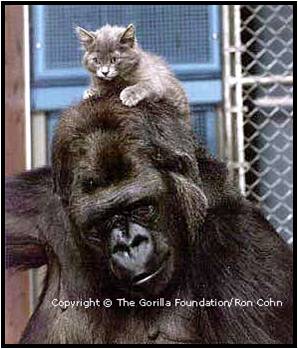
Koko

Koko Sign: Transparency good.

Scary science, national security, and open-source research

Maggie Koerth-Baker

BoingBoing, 13 January 2012

I've been following the story about the scientists who have been working to figure out how H5N1 bird flu might become transmissible from human to human, the controversial research they used to study that question, and the federal recommendations that are now threatening to keep that research under wraps. This is a pretty complicated issue, and I want to take a minute to help you all better understand what's going on, and what it means. It's a story that encompasses not just public health and science ethics, but also some of the debates surrounding free information and the risk/benefit ratio of open-source everything.

. . . . . . .

I make the same argument today that we made in 2005 — publishing those experiments without the details is akin to censorship, and counter to science, progress and public health. … Giving the full details to vetted scientists is neither practical nor sufficient. Once 20–30 laboratories with postdoctoral fellows and students have such information available, it will be impossible to keep the details secret. Even more troublesome, however, is the question of who should decide which scientists are allowed to have the information. We need more people to study this potentially dangerous pathogen, but who will want to enter a field in which you can't publish your most scientifically interesting results?

Phi Beta Iota:  From 1990-1994 various parties tried to censor Peter Black, Winn Schwartau, Robert Steele, and others laying out the grave dangers that lay in cyberspace if the US Government continued to be stupid about it.  In 1994 Steele finally assembled a one billion dollar a year budget from four world-class experts and delivered it to Marty Harris.  Nothing was done.  Secrecy kills.  Secrecy not only keeps vital information from being shared with those able to do something about it whom we do NOT know beforehand, but secrecy also allows grotesquely inept and unethical programs to survive absent accountability.

See Also:

Site Search 1994 Sounding the Alarm

Josh Kilbourn: Winner Take All Politics – Deliberate Engineering of America’s Vast Inequality

Uncategorized
0Shares
Joshua Kilbourn

Jacob Hacker & Paul Pierson on Winner Take All Politics

Bill Moyers explores how America's vast inequality didn't just happen, it's been politically engineered.

Xcorps:  3 BIG CHEERS for whistle blowers like Jacob Hacker and Paul Pierson along with journalists like Bill Moyers for giving them a platform to shout the details on Winner Take All politics detailing the slide to HELL we have been on!  Occupy Now!

Jacob Hacker & Paul Pierson on Winner Take All Politics from BillMoyers.com on Vimeo.

Venessa Miemis: Intentcasting an Epic Vision – How to Bootstrap Creative Economy 3.0

Cultural Intelligence
0Shares
Venessa Miemis

Intentcasting an Epic Vision: How to Bootstrap Creative Economy 3.0

Q: How do the Amish raise a barn without money?

A: Community, and the social capital that weaves it together.

In my husband’s Latvian community, they have a concept similar to barnraising called “talka,” which describes collective volunteer work for the good of society and environment.

Several times a year we come together at our camp in the Catskill Mountains, and everybody chips in to maintain the property – clearing branches, building bridges, fixing roofs, painting, and whatever else needs to get done. No one gets paid for it (unless you count food, beer, and bonfires as payment), yet everyone helps.

Why?

Because we’re invested in ourselves and each other and are stakeholders in our community and believe that preserving and cultivating our culture matters.

So. How does that ethic translate to online community, and can we show that we have one?

**Let’s intentcast to bootstrap Creative Economy 3.0**

Read full article.