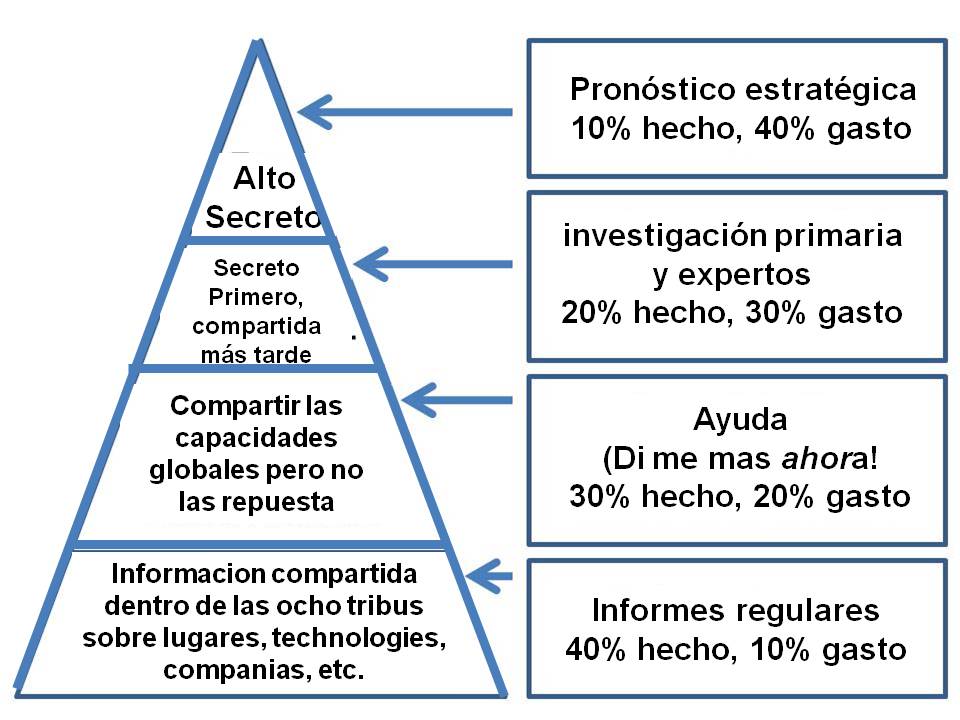
Why don’t we use open source software development techniques in the energy industry? There’s an easy answer to that, of course. The current structure of competition is so heavily biased towards zero-sum game conceptions, between companies and between the corporate sector and host governments, that it would be hard to make happen. Ghana, or Yemen, or the UK come to that, wants to sell a data package to oil companies bidding for exploration licenses. They want to keep the results of their processing and analysis of that data as a competitive edge. Doh!
This has been bugging me for some time, being both an oil and open source geek. But it was given fresh edge yesterday while reading Daniel Yergin’s new Quest(of which one can only really say “masterful”), where he described the breakthrough of Petrobras in deep offshore Brazil. Continue reading →
Study. Scientists finally realized the US electrical grid is too much of a patchwork to collapse with a small disruptive event. As in: the US grid doesn't have a single systempunkt. Not sure that matters much to global guerrillas. Why? Basically, an attack on a high level electrical systempunkt still works well regionally (as in 50-70 m people).
Anonymous cancels Operation Cartel. This entire thing was hilarious.
Interesting to see how much participation Occupy Oakland gets in its ‘general strike' today. Posters. Oakland's dynamics evolved the movement faster than what we've seen nationally. (as in: Police get violent with the movement, including some petty thuggery. Community pushback forces the mayor to back down and vacillate. Police confused….)
Illicit cigarette sales on the rise. If you need to act like a criminal to smoke, why not be one?
Stuxnet blowback. It's very cool how the US/Israeli gov'ts demonstrated (with its use against Iran) the plausible promise of building cyber weapons that can damage, disrupt, or explode factories. They've set the bar, it's up to the global community of hackers and tinkerers to bring it to the next level. (The same is going to be true with military drones — particularly the small/cheap/smart ones).
Facebook builds new data center in Sweden, where no warrant is needed to intercept internet traffic.
Congress' net worth increased by at least 25% in the last two years.
Washington: The Pentagon is offering field commanders control of counterintelligence operations to cope with the never-ceasing efforts by countries such as China, Iran and Israel to gain access to classified information and technology.
Undersecretary of Defense for Intelligence Mike Vickers approved the plan in an Oct. 5 memorandum. Groups such as Central Command and Special Operations Command can now choose to do their own CI work within their organizations, according to the memo. Formal investigations are still handled by the services.
“We gave the [combat commands] an option to develop an organic CI capability… or to rely on [the Defense Department],” Pentagon spokesman Lt. Col. James Gregory said. “We did not want to legislate either way but instead wanted to give [them] an option.” The decision comes as the Pentagon and intelligence community are preparing for a $25 billion to $40 billion budget cut over the next decade.
Phi Beta Iota: At the tactical level intelligence has always been the runt, generally one rank down from operations, and within intelligence, counterintelligence is where the runts of the runts go. Marty Hurwitz destroyed tactical intelligence with his consolidation of the General Defense Intelligence Program (GDIP) and the well-intentioned but badly conceived Joint Intelligence Center (JIC) concept. While Jim Clapper destroyed Marty Hurwitz, he did not make tactical intelligence (counterintelligence silent as in non-existent) healthy again, going on to make national consolidation every worse. There is a huge difference between security and defensive counterintelligence – they are not the same but ignorant commanders will treat them as one. There is a huge difference between defensive counterintelligence and offensive counterintelligence – no one in the US national intelligence community is competent as offensive counterintelligence, and the commanders will be oblivious to this until such time as we finally eliminate the regional commands and reset national defense and multinational information-sharing and sense-making. The budget cuts are trivial – $40 billion over ten years is $4 billion a year, that is a 4% cut on $90 billion a year, while at least 50% of what the IC spends now is fraud, waste, and abuse, 70% of that on contractor vapor-ware. The greatest enemy of America is a dishonest intelligence community that cannot do holistic analytics relevant to everything we need to know.
More practically, COCOMs consist of headquarters staffs and operational units sourced from the Services. Counterintelligence is currently a functional support service provided to the COCOMs by the Services and perhaps DIA. I know of no joint CI force structure designed for COCOMs. So, for COCOMs to run their own CI operations, they will require resources to be sourced, either permanently or temporarily, from the Services or from DIA, which itself gets its military personnel from the Services and competes with the rest of the Intelligence Community to hire civilians. That would serve principally to exacerbate existing shortages in counterintelligence personnel and force structure. In other words, Mike Vickers is not leading, he is scamming.
Iran-Israel: Iran is on “full alert” and ready to retaliate for any strike against the Islamic Republic, Iranian military officials warned Wednesday amid Israeli media speculation of plans for an attack.
“We consider any threat — even those with low probability and distant — as a definite threat,” said General Hassan Firouzabadi, the armed forces' chief of staff. “We are ready to punish them.” The United States also “will suffer serious damages should there be a military attack by the Zionist regime against Iran,” the Iranian chief of staff warned.
Comment: The significance of this statement is that it represents feedback to the Israelis that their chest thumping and foot stomping is registering in Tehran. It also makes clear that if Israel ever attacks Iran, Iran will attack US installations in reach as well as Israel.
Phi Beta Iota: We have learned not to underestimate the ideological idiocy of the neo-cons still entrenched across the US national security “regime,” nor the ineffectiveness of the White House is doing anything other than “going along.” Israel is out of control; the US Government is out of control; this does not bode well for anyone.
The first book is important because it points out the fact that globalization has been the economic equivalent of the world putting all its eggs in one basket. The imminent collapse of all national currencies will make that abundantly clear. Countries need to strive harder for self-sufficiency, sustainability, and renewability in order to avoid these kind of global economic wildfires in the future.
The second book is important because when national currencies fail, local currencies will have to be created in order to facilitate the resurrection of local economies. Only *local* economies and currencies will be able to prime the financial pumps of *national* economies and currencies, which in turn are essential for *international trade*, which in turn is essential for most *urban economies*. This is bootstrap economics. It puts the power back in local hands and takes it out of the hands of “Wall-shington Street.” (to coin a new phrase)
Most “first world” countries cannot sustain themselves without outside resources. Japan is perhaps the most extreme example. But all countries need to find ways to become as self-sustaining as possible. Self-suffiecincy and local currencies are the only things that can provide firewalls to prevent economic wildfires from spreading around the globe and wiping out every economy at once—–the downside to globalization.
The Titanic sank because the watertight compartments didn't go all the way up to the top deck. Water was able to spill over and sink the whole ship. It's the same principle with globalization as it now exists. The first book describes the problem and the second one offers a locally-based solution to the problem (at least in regard to currencies). The second book, therefore, can be of value whether or not the crash happens. If it happens, it will provide a solution. If it doesn't, it will provide a means for local economies to free themselves from the investment bankers of “Washing-Wall Street.”
4.0 out of 5 stars At full reading, disappointing, October 30, 2011
After a full reading:
Disappointing. Some authors, George Will comes to mind, do well with their recycled Op-Ed columns. I've reduced this to four stars because it just does not add up for me. At least the price was right. The “current news” nature of the author's opinion pieces simply does not bode well for their reshuffling in book form. Here are the Parts, but disconcertingly the pieces within the parts are not in chronological order, for example, a piece written in 2002 is at the end of one part.
Part I: Obama and Progressive America. Very disappointing. Weak gasps of disbelief as the white half of Obama, bought and paid for by Goldman Sachs, wallowed in business as usual.
Part II: A New Economic Narrative. There are gems here, but on balance the author skirts around the two words that matter: CORRUPTION (rules in Washington) and INTEGRITY (not to be found in Washington).