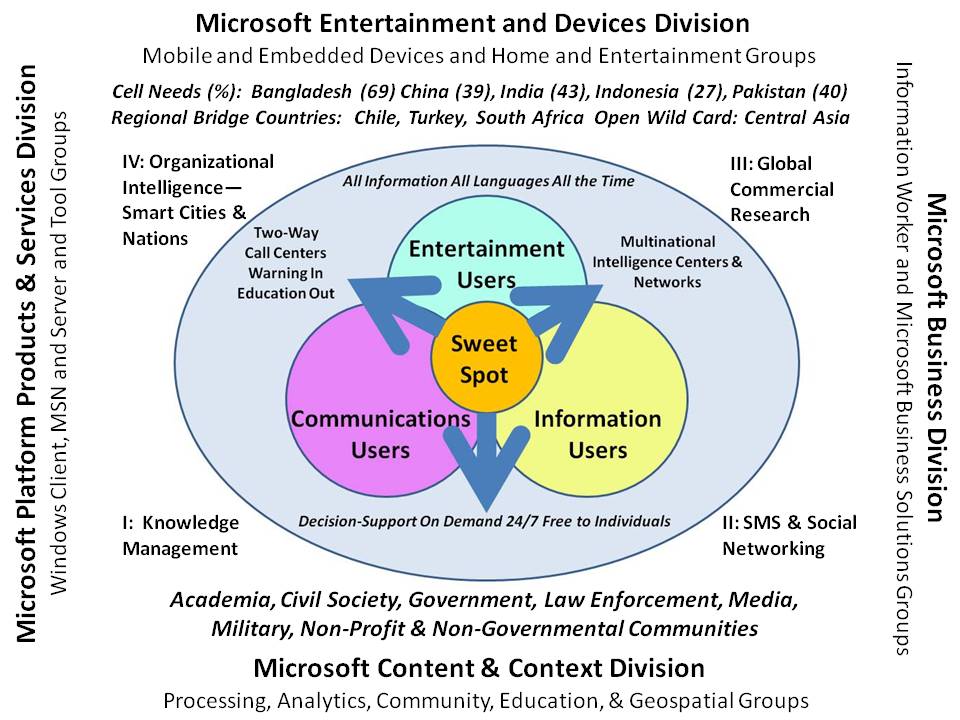
After some effort, the below memorandum on Operation Cloudburst was delivered to and read by Reed Hastings and Norm Judah (the latter Chief Technical Officer for Microsoft). Microsoft as a culture evidently cannot make the intellectual leap from legacy kludge to Open Everything, monetizing the aggregate instead of the instance. This memorandum is the intellectual property of Robert Steele and is now in the public domain under Creative Commons license, with the observation: this is what we need to build based entirely on Open Source software, Open Source hardware, and networks of hybrid paid and volunteer human minds.
Beginning last October and continuing through May I wrote a book part 1 and part 2 in which I have tried to examine Research and Education networks globally but with the primary emphasis on The Netherlands, Europe and the US as exemplified by Internet2. These networks are morphing into a platform for the conduct of collaborative science and present a potentially compelling alternative to commercial internet. These are taking shape into what could be a powerful alternative network based economy.
This January, when I saw US UCAN described in the abstract I became very enthusiastic about it a potential morphing into a national public internet for supporting John Robbsian Resilliant Communities. While Internet 2 finally got a much needed dose of new leadership i found that its Washington DC grant oriented minimum risk taking culture has not changed significantly.
At 140,000 words I realized in May I needed and introduction and summary for my book. I wrote one a a contribution to the Peer to Peer Foundation Wiki. That may be read here.
Unfortunately given the austerity kick under way there is no support for outreach and i am beginning in frustration to go back to the the run of the mill commercial internet. However Michell Bauwens did present my summaries on the P2P foundation blog.
I will post updates of those as follow ups to this.
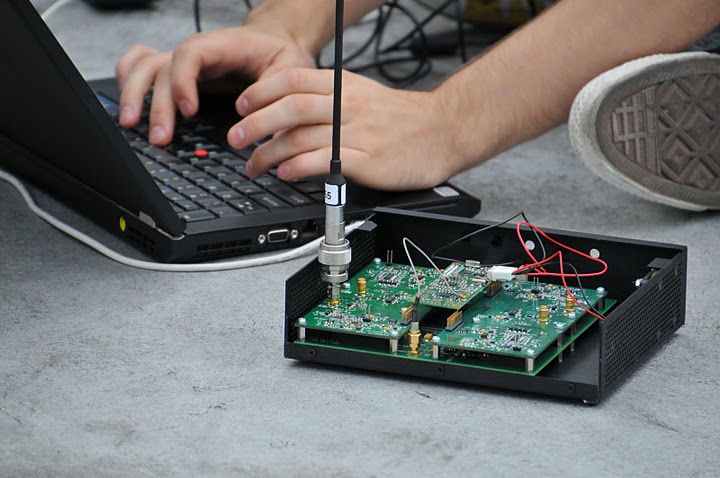
MoblleActive.org recently had the opportunity to test an off-the-grid GSM base station. Kurtis Heimerl presented The Village Base Station (VBTS), (link is a PDF) a low-power means of providing mobile network service without grid power or network infrastructure.
Phi Beta Iota: As best we can tell, OpenBTS is central–vital–to the achievement of Open Society as well as Open Government, and is the only way that we can reasonably scale free to very low cost Internet access to the five billion poor.
A sobering Japanese bookend to the stunning Sprey-Cockburn report which documented Fukushima's increased infant death rates in some cities in the United States (distributed on 16 Aug). Yet another nail in the claim that we can evolve a safe carbon-free economy in the near term. Given the low power density of green technologies, like wind and solar, going carbon-free or moving away from fire — i.e., the invention that launched millions of years human cultural evolution — in the next 30-100 years necessarily involves a huge expansion in nuclear power, because is the only high power-density, non-carbon solution available over the foreseeable future).
Japanese doctors warn of public health problems caused by Fukushima radiation.
by Dahr Jamail
Scientists and doctors are calling for a new national policy in Japan that mandates the testing of food, soil, water, and the air for radioactivity still being emitted from Fukushima's heavily damaged Daiichi nuclear power plant.
“How much radioactive materials have been released from the plant?” asked Dr Tatsuhiko Kodama, a professor at the Research Centre for Advanced Science and Technology and Director of the University of Tokyo's Radioisotope Centre, in a July 27 speech to the Committee of Health, Labour and Welfare at Japan's House of Representatives.
Read more….
Phi Beta Iota: We do not agree with Brother Spinney's conclusion. Infinite free energy is available now, particularly in countries such as Chile where a wide variety of solar, geo-thermal, and oceanic forms can be deployed. We have lacked both political will and scientific imagination, as well as the essential focus on distributed self-sufficiency. The “central” generation paradigm is corrupt and will not scale.
The interplay of chance with necessity means that no one can predict the future evolutionary pathway in Libya or the US role in Libya, but Ted Galen Carpenter of the libertarian CATO Inst. provides a thoughtful lens for thinking about potential ramifications of NATO's precipitate intervention in Libya.
Key issues discussed:
De facto or de jure partition vs a unification that sows the seeds of future conflict?
How to replenish empty Libyan treasury and repair infrastructure (including restoring oil production capability)?
Will US get sucked into another NATO stabilization, peacekeeping, nation-building mission?
After weeks of very little movement either militarily or diplomatically in Libya, there are apparent developments on both fronts in recent days. Rebel forces, aided by NATO’s air support, finally appear to be advancing into western Libya and cutting off supply lines to Tripoli, the long-time stronghold of support for Muammar Qaddafi. And reports are swirling about secret negotiations that might provide a peaceful exit from the country for the aging dictator.
Those developments underscore that U.S. and NATO officials urgently need to consider what strategy they intend to pursue if Qaddafi’s more-than-four-decade hold on power finally comes to an end. That is more crucial for the leaders of the European members of the alliance, since Libya is located on Europe’s Mediterranean flank, but because the Obama administration unwisely chose to involve the United States in Libya’s internecine conflict by launching air strikes, it has become a pertinent issue for Washington as well.
The outlook for a post-Qaddafi Libya is midpoint between sobering and depressing. It is possible that the warring parties will accept a de facto division of the country between the eastern and western tribes, although a formal agreement to that effect is unlikely. Even an informal partition would more accurately reflect the demographics, politics, and history of that territory than an insistence on keeping Libya intact.
Phi Beta Iota: A serious world power would heed the wisdom of Ambassador Mark Palmer, and have Undersecretaries for Peace at both foreign affairs and defense, with two strategies: one for dictators that agree to a five year non-violent exit strategy, and another for those that do not. What is happening in the Middle East today is a direct representation of the fact that there are no serious world powers in being today.
(Susan Lindauer) Here’s breaking News from a confidential source inside Tripoli. And it’s nothing like what CNN is broadcasting… Pay attention to live reports from Zawia.
First, today the power went out in all of Tripoli today. As a gift to the Muslim community for their 17th day of Ramadan, NATO bombed a power plant and six high voltage sub stations. Apparently they believed the Libyans would have no ability to repair this, and so, in their “humanitarian effort to protect civilians,” they tried to cut power to 2 million innocent people during the holy month of Ramadan and the hottest month of the year in this desert country. Well, NATO sorely underestimated these resilient people. They had the power back in 6 hours! You know, there is NO fighting in Tripoli, never has been, no fighting on the outskirts never has been. So, NATO has been continually bombing a peaceful city, destroying the infrastructure, killing and constantly terrorizing civilians.
Second, the media outside is trying to win this war by completely flipping the truth upside down. Ghadafi is stronger than ever. Today, people gathered in two areas of Tripoli where people said NATO was planning on bombing. Hundreds of thousands of people waving green flags, chanted (Allah, Muammar, Libya, Wah bes) (God and Muammar makes Libya complete). Dancing and daring NATO to come and hit them.
These people are so pissed at NATO that they would all lay down their lives before they let “The NATO” win as they say. A young woman from the Foreign Minister’s office named Sana spoke with us tonight. She said the people are so used to NATO now that they are beginning to name their worthless pets after NATO.
Sana said that the Western news media is showing old pictures of Zawia in an attempt to show bunches of rebels there. So a few people went and waved a green flag at the over pass that the media was showing on the news. And guess what? The group was never on camera, because it was not a live shot.
She also told us that the Libyans are now in complete solidarity behind the legitimate government and Ghadafi. She said all the Libyan people have offered to have Ghadafi come and sleep at their homes, he should switch homes every night, all Libyans are prepared to die for Ghadafi. She said, Ghadafi should run for president in the US, because the US is so divided and people are so disgusted with their government there. The unity of Libya behind Ghadafi is unmatched for any leader world wide, she thinks the American people need someone to unite them, not to divide them.
Spoke with the Electronic army, they say there are small pockets of rebels they liken to gangs in Misurata and the Libyan army is the middle of the city cleaning them out. Most of them are running away.
Dr Moussa Ibrahim stated yesterday that Oil Companies of the aggressor nations are trying frantically to open avenues of communication with any and every minister trying to garner favor and regain their once lucrative contracts. You won’t see that in the Western news, even though this release was given to all the journalists here in Tripoli.
That is all for now.
Phi Beta Iota: NATO attacks against Tripoli are an atrocity–commanders and pilots should be held accountable for obeying blatantly illegal orders.
Deliberative public engagement is a distinctive approach to involving people in decision-making. It is different from other forms of engagement in that it is about giving participants time to consider and discuss an issue in depth before they come to a considered view. The aim of this 18-page background paper (2008) from Involve and the National Consumer Council is to encourage and support deliberative public engagement in public policy.
Deliberation itself – where a range of people learn, discuss and work out solutions together – is not new. Forums, advisory groups, partnerships and some forms of consultation have done this for years and are becoming increasingly sophisticated. More recently, citizens’ juries and large-scale citizens’ summits have found favour with government and public service providers at both local and national levels.
Involve and the National Consumer Council (NCC) believe that deliberative public engagement can be valuable in helping to create better public services, promote social cohesion and foster a thriving democracy. There is already good practice throughout the UK, and the full potential contribution of deliberation to improving the quality of decisions and policy solutions, and to enhancing representative democracy is becoming clearer as experience grows.
The government and other public bodies are currently developing general guidelines on public and stakeholder engagement – making it timely for Involve and NCC to draw on the growing body of learning and evidence to contribute a set of specific principles on deliberative public engagement from outside government.
This is far from being the last word. Over the next year Involve and NCC will continue to monitor the field, listen to feedback on the value and relevance of these principles, and consider the potential need for more detailed guidance. In the mean time, we hope our work will contribute to the already-flourishing debate on the role of deliberative public engagement in Britain today.
Phi Beta Iota: The 18 page document is available in English, French, and Turkish. The nine principles of public engagement discussed in the document are:
The process makes a difference.
The process is transparent.
The process has integrity.
The process is tailored to circumstances.
The process involves the right number and types of people.
The process treats participants with respect.
The process gives priority to participants' discussions.
The process is reviewed and evaluated to improve practice.