Renewed instability in global food markets requires urgent response, UN expert said
An independent United Nations human rights expert today called on governments and the international community to promptly tackle the renewed instability of global food markets, noting the related social unrest that has hit some countries in recent weeks.
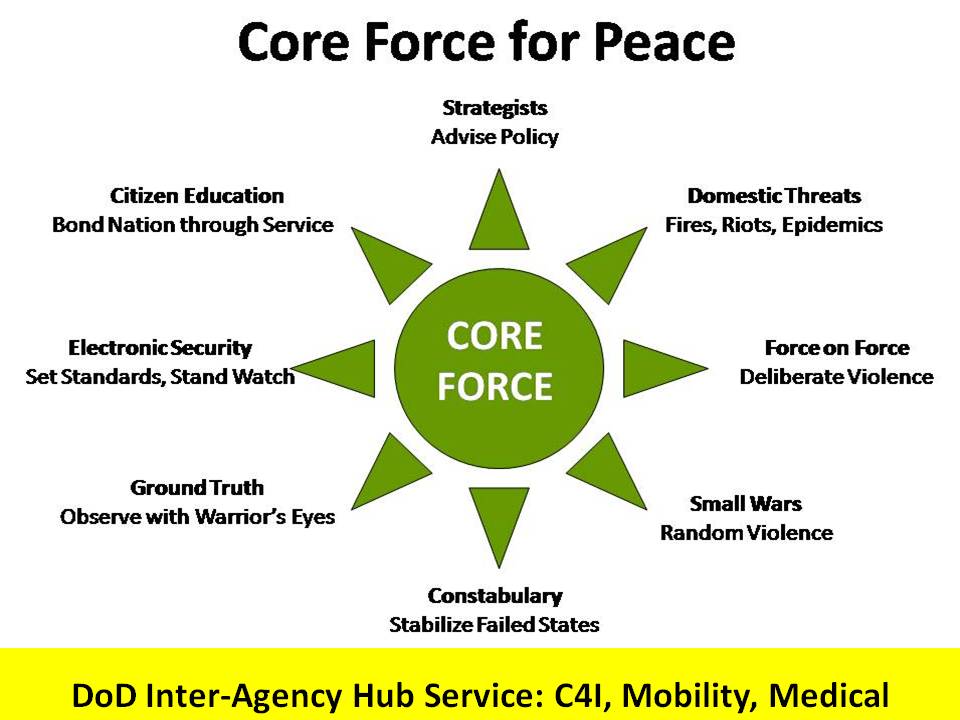
This graphic was created for a lecture to Eastern European Parliamentarians at the George C. Marshall Center in the mid-tolate 1990's. Many understood back then that the Department of Defense (DoD) was the only element of the U.S. Government (USG) capable of serving as a hub or backbone for USG Whole of Government and dynamic or surge inter-agency operations as well as multinational operations other than war (OOTW).
Unfortunately, the military services have managed to avoid, undermine, or ignore leadership from a series of Secretaries of Defense, so today we do not have a Global Information Grid (GIG) nor do we have joint mobility, weapons, or communications systems that are truly inter-operable.
Originally posted online in 2008 when this Blog was first created, we are updating the publication date to make it more easily visible–this will be, we believe, a central graphic for the multinational endeavors of the future.
Many years ago I attended a series of Headquarters briefings for out-going CIA Chiefs of Station. Our main speaker was Richard Helms, then the Agency’s Director and one of the lions of American foreign policy in the 1960’s and 70’s. A man who was subsequently crucified in the Nixon catastrophe. Dick was essentially giving us our instructions, and in my mind his most telling directive was the quiet statement: “Ring the Bell.” Telling us to sing out when we apprehended a major disaster in the offing.
It’s time to ring the bell on Iraq.
Briefly put, in a matter of months Iran will emerge the unchallenged military and economic power dominating the area from Lebanon to Pakistan. It will control Iraq, and be in a position to shut off all oil supplies from the Persian Gulf. It will be free to provide extensive assistance to the Taliban in Afghanistan, thus ensuring a NATO defeat in that country. It will be in a position to provide crucial support to radical Islamic elements in Pakistan – which may well result in the collapse of that already shaky nuclear-armed government. It will be free to radically increase its support to a variety of terrorist organizations targeting the US. And, in conjunction with well-armed radical Palestinian forces that already exist on Israel's borders, it will pose the greatest threat ever faced by Israel. A threat that I do not believe Israel could survive without direct US military intervention.
Sadly, we had to give up comments, and searches are the best way for us to be responsive to what individual visitors are looking for. Here are three results, only the last of which yields satisfactory results. You can also send an email (About). If AFRICOM ever decides to go for the gold and BE the 21st Century multinational stabilization harmonizer, we'd like to hear from them.
President Felipe Calderone’s crackdown on drug cartels in Mexico has claimed 28,000 lives since 2006, but the best coverage of the non-stop mob hits and government stings isn't coming from the nation’s major media outlets.
Instead, it comes from a student with a six-month-old blog. Blog del Narco began as a hobby for the highly secretive blogger, but in time he found that his facelessness allowed him get away with stories that would endanger known journalists — many of whom have been kidnapped or killed for divulging such information. Now, his site has become indispensable for its no-holds-barred coverage of the endless carnage caused by the drug trade. The AP reports that for the first time, a blog on the conflict can count its most dangerous participants among its most obsessive readers, as the kingpins and cops rely on the information just as much as the public does.
Phi Beta Iota Summary: Where should NATO go on out-of-area expeditionary operations? How does NATO define security & stability? How does NATO achieve balance between territorial defense and expeditionary operations, and between the voice of the big nations and the small nations? What is defense? What is 360 degree defense in a complex world? How should NATO address a complex world? Is over-simplification a threat of its own? Is NATO predominantly a forum for dialog about collective intelligence? Does NATO really need to get into global anti-missile defense?