Barbara Marx Hubbard was the second of two female candidates for Vice President of the United States of America, at the Democratic Convention of 1984 along with Gerraldine Ferraro. She was nominated from the floor because of her short presentation on the need to connect everything and have a Peace Room as sophisticated as what we imagine for war. Today (2010) she is one of the most respected pioneers for conscious evolution within diversity.
How easily we forget the balance books of history. Below are two pieces, one from the colonial era written in 2006, the other from the recent “neo-colonia” era in which the author examines the specifics of the Clinton Administration's policies toward Haiti. Chuck
Full Story Online
America's Historic Debt to Haiti
By Robert Parry February 10, 2006
As Haiti intrudes again on the U.S. consciousness with a new round of troubled elections, Americans see a violent, backward, poverty-stricken country run by descendants of African slaves. There are feelings of condescension mixed with a touch of racism.
But what few Americans know is that they owe this Caribbean nation a profound historical debt. Indeed, perhaps no nation has done more for the United States than Haiti and been treated as badly in return.
If not for Haiti – which in the 1700s rivaled the American colonies as the most valuable European possession in the Western Hemisphere – the course of U.S. history would have been very different. It is possible that the United States might never have expanded much beyond the Appalachian Mountains.
Full Story Online
Before and After the Quake
The Incapacitation of Haiti
By ASHLEY SMITH January 14, 2010
Why were 60 percent of the buildings in Port-au-Prince shoddily constructed and unsafe in normal circumstances, according to the city's mayor? Why are there no building regulations in a city that sits on a fault line? Why has Port-au-Prince swelled from a small town of 50,000 in the 1950s to a population of 2 million desperately poor people today? Why was the state completely overwhelmed by the disaster?
To understand these facts, we have to look at a second fault line–U.S. imperial policy toward Haiti. The U.S. government, the UN, and other powers have aided the Haitian elite in subjecting the country to neoliberal economic plans that have impoverished the masses, deforested the land, wrecked the infrastructure and incapacitated the government.
The fault line of U.S. imperialism interacted with the geological one to turn the natural disaster into a social catastrophe.
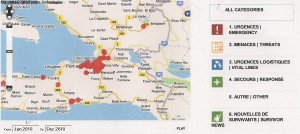
This initiative is a joint effort between Ushahidi, UN OCHA/Colombia and the International Network of Crisis Mappers (CM*Net). OCHA/Colombia recently deployed Ushahidi for an earthquake response excercise so we're very grateful for their invaluable contribution to this Haiti deployment. We're completing the customization of the platform as fast as we can. Please follow @Ushahidi on Twitter for updates and help spread the word, especially to colleagues inside Haiti. Please do contact us if you want to help. Our thoughts are with the people of Haiiti and with our humanitarian colleagues on the ground.
Structure effondres | Collapsed structure – Structures a risque | Structures at risk – Personnes prises au piege | People trapped — Route barree | Road blocked — 1. Urgences | Emergency — Seisme et repliques | Earthquake and aftershocks — 2. Menaces | Threats — Secours Medical | Medical response — 5. Autre | Other — 6. Nouvelles de Survivants | Survivor News — 4. Secours | Response — Recherche et sauvetage | USAR Search and Rescue — Sans courant | Power Outage — 3. Urgences logistiques | Vital Lines — Refuge | Shelter — Morts | Deaths
Phi Beta Iota: This is a very early look at how a Global to Local Range of Needs Table could be implemented.
See also:
Boston Globe Photos
Phi Beta Iota: Now imagine the Peace Jumpers distributing 20 Google Ground-Level GPS-Enabled 360 View Photo Bicyles that transmit to an immediately established Wide Area Network and then up to a circling AWACs. If we applied just 10% of DARPA's budget to steering and leveraging the global private sector–Google is not the only one with innovative ideas, by now we would have a Local Range of Needs Table down to individual and household levels, and could precision-drop “just enough, just in time” Peace from Above. The Navy is *always* 4-6 steaming days away from anything.
President Obama has a rapidly vanishing opportunity to achieve historical greatness as a trust buster by breaking up the banks. Trust busting is an almost risk free path to lasting respect — Teddy Roosevelt's honored place in American history is more a result of his trust busting than his gross imperialism.
In the attached article, my good friend Marshall Auerback explains why Obama's faux populism attacks the symptom rather than the disease now infecting our financial system.
My guess is that Obama's “reform” policies — i.e., change we can believe in — will not even be smart politics in the long run, because at the end of the day, suckering the Tea Baggers (not to mention the so-called progressives) with phony populist appeals, while supporting cosmetic banking reforms, will alienate just about everyone except the oligarchical elites benefitting from his protectionist policies. In this sense, Mr. Obama is rapidly becoming just another Bill Clinton, a highly intelligent, self-made man of the people who squandered his opportunity for greatness on the altar of short-sighted service to the rich and powerful.
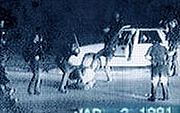
Phi Beta Iota: The police will not only lose this one, we anticipate that one day the Second Amendment will apply to radar detectors and other forms of defense against state excesses. Certainly the public needs to take its right to be armed–both with weapons and with hip-pocket recording devices, with the utmost seriousness.
Three observations:
1. Society has forgotten how to be civil at the same time that government has forgotten how to govern (satisfy most of the people most of the time, deal humanely with the rest).
2. Police have become increasingly militarized and the 9/11 pork has made them more so, at the same time that the FBI and similar forms of authority have forgotten how to do arrests without a SWAT team crashing through the door first.
3. If you tell the truth and act according to the truth, such counter-surveillance is utlimately beneficial to the truth teller rather than the abuser.
Ultimately, in our view, public use of public technologies to create public intelligence about police abuse and government waste and corporate externalizations of cost (Taiwan now pays for citizen cell recordings of pollution discharges), will be a beneficial means of restoring the public's power over “it's” police forces.
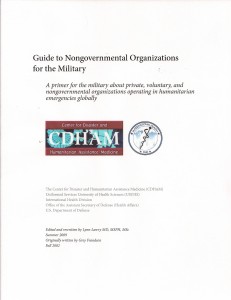
A good start but less than 20% of what is needed. This should be a living online directory that spans all military occupational specialties (e.g. communications, engineering, water treatment, power) and it should have a multinational information-sharing and sense-making component including of course reach-back to the Multinational Decision Support Center, wherever that might be located. It would also benefit from a revitalization of DARPA's STRONG ANGEL and TOOZL, and a new pilot project to integrate Twitter and UNICEF's RapidSMS into the overall “outside the wire” C4I campaign plan.