Alvin and Heidi Toffler are the original researchers, visionaries, cartographers, path-finders, and mentors for a legion of pioneers who have created the future. The writing is but the tip of the their influential iceberg–their personal relationships worldwide, and the manner in which they inspire and introduce special people to one another, is without equal in this world.
Elegant essay with embedded references, March 6, 2008
David Boren
Edit of 14 Mar 08: FRAUD ALERT. I like and admire David Boren, but I am now fed up with his sanctimoneous appearances calling for “bi-partisanship” while failing to recognize all the other parties that have been–with malice aforthought–shut out of the political process. “Bipartisanship” is CODE for”save the two-party spoils systme.” ENOUGH. Anyone who cannot explain the difference between Transpartisanship and Bipartisanship is a FRAUD.
This is an elegant intelligent book of reflection, but I have to say up front that is misses the core point: the need to end the strangle-hold of the two parties that dismissed the League of Women Voters from the presidential debate process because they had the temerity to want to ask questions not provided in advance, and to include third, fourth and fifth parties. I know many people will be reading this book, and perhaps also this review, and the mere existence of the book as a focal point for dialog is worthy of five stars.
There are eight specific electoral reforms that could be easily passed, four in time to impact on November 2008, the others for impact in 2010. The fact is–and I saw this demonstrated in Oklahoma where I went to see for myself how Michael Bloomberg fared. He was, in my view, made to look the fool because no one there knew the difference between bipartisanship (code for keeping the the two party spoils system alive) and transpartisanship, which buries the two party mafiosos and restores sovereignty to the people.
I funded the Earth Intelligence Network at the same time that Jim Turner, Ralph Nader's first hire, created the Transpartisan Policy Institute. We identified the top experts on the ten high-level threats, and we have devised tranpartisan answers to 52 tough questions not a single candidate can answer coherently today. In my view, there is still a need for an independent transpartisan team to run for the full range of positions, and demonstrating in advance of election they can balance the budget.
This book deserves five stars, but it is futile unless Senators McCain, Obama, and Clinton will sponsor the simple eight point Electoral Reform Act, and we discuss openly the degree to which Dick Cheney, Donald Rumsfeld, Paul Wolfowitz and Dough Feith are impeachable for their role in telling 935 explicitly documented lies, and in the case of Cheney, 25 explicitly identified high crimes betraying the public trust.
I will end on a positive note: there is no lack of money–for one third of what we spent on war this year, we could have begun the rapid eradication of the ten high-level threats to humanity, and catalyzed the creation of new wealth everywhere.
Bipartisanship is NOT the right answer. Electoral reform and Transpartisanship, such as represented so ably by Reuniting America, is the best possible path to restoring America the Beautiful.
Edit of 10 November 2008 to lament the betrayal of John McCain.
The election is over. Obama fooled most of the people, and the Democrats out-frauded the Republicans with at least $300 million in illegal campaign contributions and double voting between New York and Florida and varied other states. McCain did himself in, allowing Bush staffers to destroy any attempt to address the substance of governance, and less the staffer that helped create the first speech by Governor Palin, Vice Presidential Operations was staffed by inept has-beens from spin-land, none of them with any deep knowledge about governance.
Sadly Obama, himself a talented individual, has been bought and paid for by Wall Street, and his transition team is totally committed to keeping the two party spoils system alive. He is, in short, a fraud. I am deleting fivce of the HOPE books below, and herewith provide five books that should give any citizen pause–Obama will be Cheney lite, seeking to pursue Abraham Lincoln's treasonous expansion of Executive powers with the active connivance of a treasonous Congress unfit to represent the United STATES of America.
Bernie's review is great and I have voted for it. I am going to stop buying formula books that combine a politician's name with a staffer's library browsing. I was especially distressed to not find the world “intelligence” or its commercial equivalent, decision-support. There is nothing wrong with the content, but as someone who writes and reads broadly about intelligence and decision support under conditions of ambiguity, this book could not hold my attention.
I read a lot. Non-fiction. This is one of the most important and inspiring books I have read in some time. It is especially meaningful to me because my oldest of three sons is a pirate who refuses to waste my money on college “credentialing” and has told me point blank there is nothing he cannot learn on his own.
While I have been totally “open” since I published E3i in the Whole Earth Review (Fall 1992) and was called a lunatic by the spy world, and I have given a Gnomedex keytone on “Open Everything,” this book–I am shaking my head trying to find the right words–has been an inspiration to me.
Bottom line: the pyramidal structure, the Weberian bureaucracy model that characterizes all governments and corporations, is DEAD. The circule model, the open network model, is kicking serious butt.
This author has in my view demonstrated world-class scholarship, given us gifted writing, and developed a story line that I can only call DAZZELING. This is an important story we all need to understand.
Here are my flyleaf notes:
+ Pirates are rocking the boat.
+ Information Age has hit puberty.”
+ Citing Mark Ecko, a graffiti artist whose brand is now worth $1 billion: “The pirate has become the producer.”
+ Punk capitalism.”
+ Punk Plus equals creative destruction at hurricane force.
+ Purpose is everything.
+ Citing Shane Smith: In America there is no anti-status quo media–it's all the same four big companies…there is no voice.
+ Punk and green are converging on substance and style.
+ Citing Richard Florida, “Rise of the creative class”
+ 3d printing is here now, 3d product download is on the horizon (I envision FedEx Kinko's as a “one of” production facility, but the dumb ass at FedEx CEO blew me off when I proposed that he print books to lower their carbon footprint).
+ USA was founded on the basis of piracy of European technologies.
+ Three core punk ideas are 1) do it yourself; 2) resist authority; 3) combine altruism with self-interest.
+ Canal Street moves faster than Wall Street.”
+ Pirate radio as musical petri dishes creating new spaces.
+ “Today a new generation is demanding more choice.”
+ Net neutrality matters (FYI, Google has a programmable search engine that will let you see only what others pay to let you see. Google is now totally EVIL.
+ Lawsuits are a sign of corporate wekaness.
+ Monsanto is totally evil, and these morons have filed patents claiming they own all the pigs on the planet. Hard to believe. Time to close them down.
+ INSIGHT HALFWAY THROUGH THE BOOK: Punk and integral consciousness, pirates and creative commons, are converging.
+ 3 pirate hyabits: 1) look outside the market; 2) create a vehicle; 3) harness your audience.
+ Remix is HUGE.
+ Graffiti is explained brilliantly by this author.
+ Open Source is going physical, e.g. open source beer.
+ File sharing boosts sales and extends range of for-sale music.
+ Free education online (and my own idea, one cell call at a time) is the ultimate positive sharing experience.
+ 1.5 billion youth around the world waiting to explode in creativity or destruction–I ask myself, what are we doing to help them go creative?
+ Four pillar s of community: 1) Altruism, 2) Reputation; 3) Experience; 4) Pay them (revenue sharing with customers).
+ Authenticity is huge.
+ Weaker boundaries = stronger foundations.”
+ Hip hop as “sustainable sell-out,” a “powerful form of collective action.”
+UN Secretary Gen3eral Kofi Annan recognized hip hop as an international language.
+ Flash mobs
+ Create a virus and feed it: 1) Audeince makes the rules, 2) Avoid limelight, speak only to the audience; 3) Feed the virus; 4) Let it die.
Conclusion: our youth have a new world view, empowered by global information technology, and they are the pinnacle of incredibly efficient networks.
I am just totally blown away by this book. The author has written a manifesto of enormous import.
Extraordinary, Beautifully Put Together, Basic Reference, March 4, 2008
Ronald J. Deibert
This is a beautifully put together book in terms of brains, content, presentation, and coverage.
An edited work, with ten primary authors, it actually reflects the collaborative efforts of an international network of collaborators, and can safely be considered the seminal basic reference on this topic.
The first 150 pages include an introduction and six chapters, on measuring global internet filtering, the politics and mechanisms of
control, tools and technology for filtering, filtering and the international system, corporate filtering, and ethics. The rest of the book, 285 pages, is taken up by regional overviews and then country-specific summaries of filtering policy.
The motives for filtering are three: politics & power; social norms & morals, and security concerns.
Two types of filtering occur: announced, and disguised. Announced filters show a blocking page, unannounced filters pretend there was an error. Blocking anc be of entire sites, or specific pages identified by keywords.
The eye-opener for me was that filtering is not just on content, but on capability. Skype and Google Earth are two of the primary capabilities that are being denied to the people around the world by repressive ignorant governments who would rather have perpetual poverty than allow the people to leverage every aspect of the Internet including free global communications.
This is a first class intellectual, social, economic, and political contribution to the literature.
More Relevant Than Ever, Great Addition to the Literature, March 4, 2008
William K. Tabb
Although this book was published in 2004, I did not notice it until recently, and I must say, I find it more relevant than ever today, in 2008. It could have lost a star for not being sufficiently visionary or for not offering a specific implementable plan for overturning the broken global economic governance regimes that it so brilliantly dissects, but out of respect for the author's superior scholarship and my own limitations, I must go with five stars.
Indeed, I am astonished to not see another review. The author deserves reading and recognition.
Here are a few of my flyleaf notes:
+ Superb detailed examination of how the so-called global economic governance organizations are the last gasp of the pyramidal pathologies, lacking in democratic public dialog or deliberation.
+ author struck me as overly generous to the USA but he clearly points out the need to understand and respect the detailed reaons why others do not agree with US “designs” and the US insistence on treating each country alone, rather than in a regional context.
+ I was taken with the author's concise focus on the dangerous combinations of US subsidies, excessive borrowing (this was before the subprime mortage and credit crisis we are now experiencing).
+ Switzerland has reformed SLIGHTLY and is still the banker of choice for dictators and corrupt despots who are looting their countries, creating failed states and perpetual poverty. I have a side note: “time to invade Switzerland and demand open banking?”
+ The author points out that free flowing investment and rules against expropriation are diametrically opposed to sovereign governance and any attempt to provide for sustained development and financial stability.
+ Global institutions too easily manipuated by developed nations.
+ QUOTE pages 373-374: “The excess capacity visible on a global scale, downward pressure on prices, the threat of deflation, and the impact of desperate countries seeking to compete by ignoring labor rights and environmental concerns produce a shallow and uneven development.
I put this book down with considerable humility–like John McCain, economic (and methematics) are my weak zone. I did learn enough from this book to realize that this author is gifted and should be listened to and given an opportunity, along with C. K. Prahalad and Jeff Sachs and Paul Krugman, to restore the social aspects of political economy.
Afterthought: the index is *very* disappointing (publisher's fault) but the bibliography by the author is itself another book and quite fascinating and comprehensive.
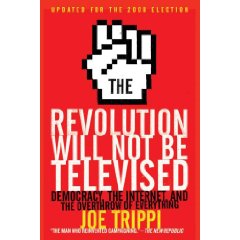
Joe Trippi helped rock democracy when he, Joe Costello, and Zephyr Teachout created “The Big Bat” for Howard Dean. He is one of the 24 co-founders of the Earth Intelligence Network, and specifically responsible for visualizing how individual citizens can eliminate corporate and other special interest money from all political and advocacy campaigns. His book, The Revolution Will Not Be Televised, is one of the standards in the field and preceeded the many other books about bottom-up public power.
Amazon Page
Above is the new updated edition.
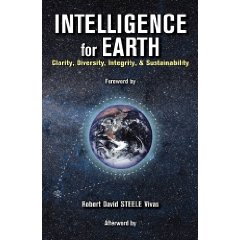
Click on the cover below to pre-order the new book by Robert Steele that integrates work by the 24 co-founders of Earth Intelligence Network, a 501c3 Public Charity.