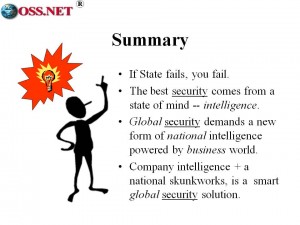
Relatively large file, several minutes at cable speed (a lot of book covers and other images). Below is the concluding slide.

The truth at any cost lowers all other costs — curated by former US spy Robert David Steele.
Relatively large file, several minutes at cable speed (a lot of book covers and other images). Below is the concluding slide.
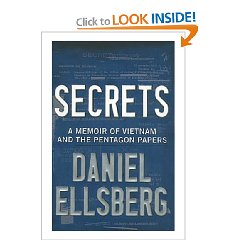

The author does an effective job of bringing forward the lessons of history, not only from Truman and Eisenhower forward, but from the Japanese and French occupations of Indochina. We failed to learn from history, and even our own experts, such as Lansdale showing McNamara the rough equipment that the Vietnamese would defeat us with because of their “will to win,” were sidelined.
As a public administration and public policy text this book offers real value as a primary source. The author provides valuable insights into how quickly “ground truth” can be established; on how the U.S. Government is not structured to learn; on how the best answers emerge when there is not a lead agency and multiple inputs are solicited simultaneously; and most importantly, on how private truths spoken in secrecy are not effective within any Administration. The author stresses that Americans must understand what Presidents are doing in their name, and not be accomplices to war crimes or other misdeeds. He does a brilliant job of demonstrating why we cannot let the Executive Branch dictate what we need to know.
Interwoven with the author's balanced discussion of how to get ground truth right is his searing and intimate discussion of the pathology of secrecy as an enabler for bad and sometimes criminal foreign policy, carried out without public debate or Congressional oversight. The author adds new insights, beyond those in Morton Halperin's superb primer on Bureaucracy and Foreign Policy, regarding the multiple levels of understanding created by multiple levels of classification; the falseness of many written records in an environment where truth may often only be spoken verbally, without witnesses; the fact that the Department of Defense created false records to conceal its illegal bombings in Laos and Cambodia, at the same time that the White House created false secret cables, used Acting Director of the FBI Patrick Gray to destroy evidence, and sought to bribe a judge with the offer of the FBI directorship. The author presents a compelling portrait of an Executive Branch-regardless of incumbent party-likely to make major foreign policy miscalculations because of the pathology of secret compartmentation, while also being able to conceal those miscalculations, and the cost to the public, because of Executive secrecy. He is especially strong on the weakness of secret information. As he lectured to Kissinger: “The danger is, you'll become like a moron. You'll become incapable of learning from most people in the world, no matter how much experience they have in their particular areas that may be much greater than yours” [because of your blind faith in the value of your narrow and often incorrect secret information. P. 236]
On such a foundation, the author discusses the ethics of Presidential leadership. He is especially strong-and relevant today-in discussing how Presidential appointees regard loyalty to the President as a mandate for lying to Congress and the media and the public. The author excels at bringing forward how our corruption in permitting corruption is easily recognized and interpreted by indigenous personnel-just as how whom we support is quick evidence of how little we know about local politics.
From here the author segues into the ethics of collateral damage and the liability of the American people for war crimes and naked aggression against the Vietnamese because of our deliberate violation of the Geneva accords and our support for a corrupt series of dictatorships in South Viet-Nam. Much of what we did in Viet-Nam would appear to qualify for prosecution under the International Tribunal, and it may be that our bi-partisan history of war crimes in Viet-Nam is what keeps us from acknowledging the inherent wisdom of accepting the jurisdiction of the International Tribunal in future wars. Tellingly, at one point his wife reads the Pentagon Papers and her tearful reaction is: “this is the language of torturers.”
Administratively we are reminded that the Pentagon Papers were 7,000 pages in total; that Neil Sheehan from The New York Times actually stole a set of the papers from Ellsberg before being given a set; that character assassination by the U.S. Government is a routine tactic in dealing with informed dissent; and that it is not illegal to leak classified information-only administrative sanctions apply, outside a narrow set of Congressionally-mandated exceptions.
This book is a “must read” for any American that thinks and votes.

See original text version:
The minor plot elements aside (the usual cast of media mediocrities, intra-office back-stabbers, etc.), this book makes aircraft safety *exciting.* I was completely absorbed in what this author has put together, and highly recommend this book as an intelligent thriller with a practical foundation.

The author does a really effective job of investigating and communicating the horrible realities of life where…managers and corporate regulations and plain meanness deprive hundreds of thousands of people of things many of us take for granted: the right to go to the bathroom, to pause for a few minutes, even to sit down quietly for a few minutes in a clean room.
Especially admirable is her focus on rent and the conditions that are imposed on the poor and lower working class (between minimum wage and $15 an hour)–not having enough money for a deposit, being forced to pay outrageous rents for decrepit motel rooms rented by the week, having to spend a precious working day finding a place to stay, etcetera.
This is a very valuable book, both from the perspective of someone who might benefit from a little humility and gratitude for their blessings and advantages; and from a policy point of view–our understanding of poverty and welfare and what it takes to allow decent hard-working people to have a *life* appears to be terribly, terribly flawed. As the author documents so ably, it is not enough to have a job in America, you need to have one that pays enough to cover rent, food, and medicine.
I was especially moved by the many details the author provided on how life at the lower levels brings on more and more hardships–not enough money for good shoes, bad shoes causing major spinal and related injuries and pain. The pain–the endless hours, the desperation for aspirin and other pain killers, cigarettes as the least expensive narcotic for the pain–this is very powerful stuff.
At a minimum, this book changes how I will evaluate politicians that speak in ignorance about welfare and poverty and safety nets–and it is going to substantially increase how much I tip and how I tip–from 15% to 25%, and in cash… This might be a good time to think of ourselves, and follow the Golden Rule–our welfare system should be what we would want it to be if we were the ones asking for welfare.

The book accomplished three things with me, and I am a very hard person to please: 1) it compellingly demonstrated the inadequacy of the industry standard briefing, consisting of complex slides with complex ideas outlined in excrutiating detail; 2) it demonstrated how a story-telling approach can accomplish two miracles: a) explain complex ideas in a visual short-hand that causes even the most jaded skeptic to “get it,” and b) do this in such a way that the audience rather than the speaker “fills in the blanks” and in so doing becomes a stakeholder in the vision for change; and 3) finally, provides several useful appendices that will help anyone craft a “story” with an action-inducing effect.
The footnotes and bibliography are sufficient to make the point that this is not just a story, but a well-researched and well-documented real-world experience of great value to any gold-collar revolutionary struggling to overcome obstacles to reform.